Best Lever Action Rifles of 2026
When I was a kid, there were three reasons I wanted a lever action rifle. First, they were cool. Second, because I grew up just outside New Haven, Conn., the historic home to Marlin and Winchester, they were my hometown guns. Third, they were cheap.
Only one of these things is still true. Lever guns always have been and always will be cool, though they will never again be cheap, nor—barring divine intervention—will they ever again be produced in Gun Valley.
Writing about the top lever action rifles is a bit tricky. Do you focus on the best of all time, which is great for us nostalgic sorts, or do you talk about great lever action rifles that you can buy new?
I tilted this list of the best lever action rifles in favor of those you can order new. Though if you have a hankering for one of the old-time classics, there are plenty to be had on the used market. Just don’t expect to find any bargains. Nearly all quality lever actions command a premium.

- Marlin 1895
- Smith & Wesson Model 1854
- Henry Lever Action Supreme
- Henry All-Weather Picatinny Rail .45/70 Side Gate
- Winchester Model 94
- Browning BLR
- Marlin 336
- Henry Golden Boy
- Savage Revel
- Marlin 1894
- Rossi R95 Laminate
- Rossi Rio Bravo Gold
How I Picked the Best Lever Action Rifles
This list is divided into those guns that are being currently produced (or soon-to-be) in significant numbers and those that are either specialty orders or that must be sought out on the used gun market.
With the exception of the rifles that have just been announced, Senior Staff Writer Tyler Freel and I have shot, handled, and/or owned all the models listed. Beyond our hands-on experience with the rifles over the years, however, many of them are no-brainers based on their well-documented history and legacy.
Best Lever Action Rifles Currently Made
The good — actually, great — news here is that we’re seeing more lever actions made with each passing year. About 15 years ago, Remington screwed the pooch with Marlin and those were some dark days indeed. In those years it seemed only Henry was making quality lever guns in meaningful numbers, but things have taken a turn for the better.
Under Ruger’s ownership, Marlin seems poised to flourish. Henry is still innovating hard and trotting out new models in new cartridges, like the 360 Buckhammer. And we have a couple interesting and innovative newcomers in the mix.
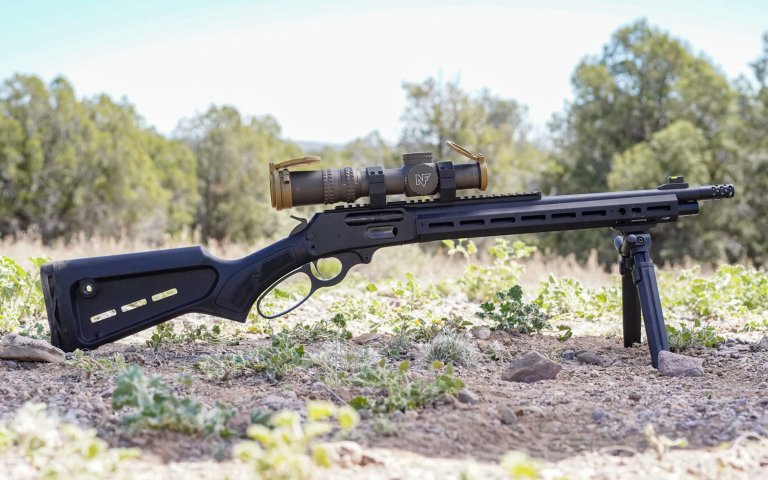
Marlin 1895
Pros
- The new Ruger-made Marlin 1895s are the finest factory-produced Marlins in history.
Cons
- Prices are relatively high
Key Features
- Caliber: .45/70 Govt
- Capacity: 6+1
- Stock: Gray Laminate
- Material: Stainless Steel
- Sights: High-Vis Tritium fiber optic with an adjustable ghost ring
- Weight: 7.3 pounds
- Length 37.25 inches
- Barrel: 19.1 inches, cold-hammer forged, threaded 11/16-24
- Twist: 1:20
- Cost: $2,110
When Ruger resurrected Marlin, the first model they brought back was the 1895 SBL. This was a smart move because the SBL, with its gray laminate furniture, stainless steel metal, threaded barrel, oversized lever loop, and picatinny rail was one of the sexiest and most sought-after iterations of this classic lever action.
I had good things to say about the Marlin 1895 SBL when it was reintroduced in late 2021, and that opinion hasn’t shifted. It is the best lever action rifle produced under the Marlin brand—at least in the modern era. Packing 6+1 rounds of .45/70 Gov’t in its magazine, it brings a formidable level of firepower to the party which is why it has garnered a lot of interest from hunters in bear country, as well as with everyday sportsmen in more sedate parts of the U.S.
Marlin has also introduced two new versions of the 1895 worth considering, a Model 1895 Trapper and a Model 1895 Guide Gun. The Trapper comes with a Skinner peep sight, no picatinny rail, and is a bit more compact (34 ¼ in. vs. 37 ¼ in.) than the SBL. It, too, is chambered in .45/70 and has a 5+1 magazine capacity. The Guide Gun (model GBL) is slightly less expensive than the SBL ($1,239 vs. $1,479), has traditional semi-buckhorn sights, blued steel, is chambered in .45/70, and a 6+1 capacity.
Smith & Wesson 1854
Smith & Wesson 1854
See It
Pros
- Solid value, and excellent craftsmanship
Cons
- None worth noting.
Key Features
- Caliber: .44 Mag.
- Capacity: 8+1
- Stock: Synthetic
- Material: 410 Stainless Steel
- Sights: Ghost ring on a Picatinny rail
- Weight: 6.43 pounds
- Length 33.4 inches
- Barrel: 16.3 inches
- Twist: 1:20
- Cost: $1,299
In 2024, Smith & Wesson made a big splash in the lever-gun world with their model 1854. It was first introduced in .44 Magnum, and .45/70 models followed suit in 2025, along with options in the venerable .30/30 Winchester and .45 Colt.
We were immediately impressed by the first Model 1854 rifles we got our hands on. These lever guns, which are relatively complex pieces of machinery, were superbly executed — with excellent fit and finish and smooth operation. They feature both side-gate and magazine tube loading, and are available in blued/wood and stainless/synthetic trims. Both are generally classic-looking styles, but the synthetic version offers modern perks like a picatinny rail, M-Lok slots on the fore-end, and a threaded muzzle. Since introduction, Smith & Wesson have also introduced a Stealth Hunter model with black-on-black finish, a longer optic rail, tactical-style handguard with multiple M-Lok slots, and threaded muzzle — specifically for optics, lights, and a suppressor.
We’ve tested several of the Model 1854 rifles as they’ve rolled out and have been consistently impressed with the quality of build, smoothness of operation, and reliability of these guns. We rank them among the finest factory lever guns made today.
Henry Lever Action Supreme
Henry Lever Action Supreme
See It
Pros
- Great classic looks
- Uses standard AR magazines
- Suppressor ready
Cons
- None worth noting.
Key Features
- Caliber: .223/5.56 NATO (tested), 300 BLK, .450 Bushmaster
- Capacity: Uses AR magazines
- Stock: Synthetic
- Material: 410 Stainless Steel
- Sights: Adjustable sights on barrel
- Weight: 6.10 pounds
- Length 38.25 inches
- Barrel: 18 inches
- Twist: 1:8
- Cost: $1,092
One of the slickest, funnest lever guns we’ve ever run is the Lever Action Supreme from Henry. This rifle combines the nostalgia and classic good looks of a lever gun with some features that a lot of modern shooters will find appealing. It’s offered in both 5.56/.223 and .300 Blackout, and its most notable characteristic is that it feeds from standard AR-15 magazines. Since it’s introduction, it’s also been updated to include the popular .450 Bushmaster. This isn’t simply a design that Henry adapted to work with these mags and cartridges. They started from scratch.
The Lever Action Supreme cycles very smoothly and uses an AR-style rotating bolt head and the bolt body does not protrude from the rear of the receiver as with many other lever guns when cycled. It also sports a floated barrel that provides good accuracy and while it has a classic look when bare, it’s equipped to accommodate modern accessories like suppressors, scopes, and red dot optics. You can read Snow’s full review of the Lever Action Supreme for a more detailed look.
Henry All-Weather Picatinny Rail .45/70 Side Gate
Henry All-Weather Picatinny Rail .45/70 Side Gate
Pros
- Affordable, available and versatile.
Cons
- None worth noting.
Key Features
- Caliber: .45/70 Govt
- Capacity: 4+1
- Stock: Stained hardwood
- Material: Hard chrome with a stain finish
- Sights: Ghost ring on a Picatinny rail
- Weight: 7.1 pounds
- Length 37.5 inches
- Barrel: 18.43 inches
- Twist: 1:20
- Cost: $1,598
It didn’t seem that long ago that Henry Repeating Arms was only making Golden Boys chambered in pistol cartridges and .22s. But these guys have been busy, and as the company embarks on its second quarter century, they have added an impressive number of products to the lineup.
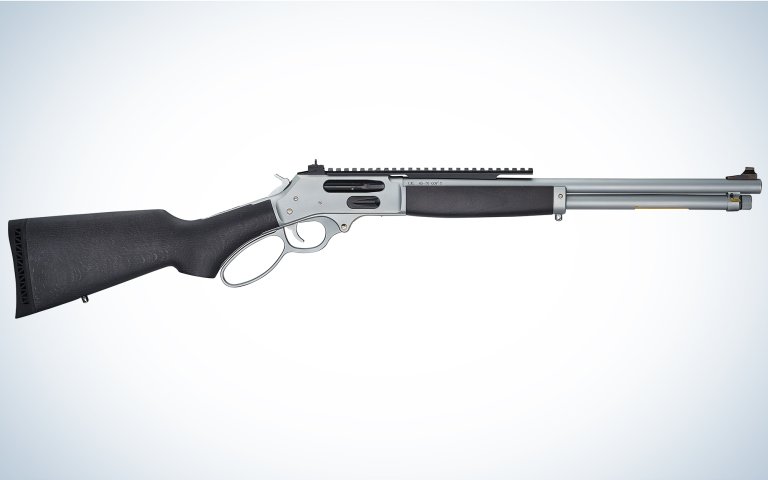
One of the flagship hunting rifles is the All-Weather Picatinny Rail .45/70 Side Gate, which is Henry’s version of a do-everything guide gun. As the name implies, it is built for the elements. The metal has a hard-chrome satin finish. The stock is a stained hardwood.
It has an aperture peep sight mounted at the rear of the substantial Picatinny rail. Henry outfitted it with an oversized lever loop. With the 18.43-inch barrel, the overall length is 37.5 inches and it has a 4+1 capacity. The rifle can be loaded either through the side gate on the receiver or by dropping rounds into the tubular magazine.
This is a versatile and capable thumper that is equally at home in bear country or in a deer stand overlooking a food plot.
Winchester Model 94
Winchester Model 94

Pros
- Arguably the most iconic of deer rifles. A true classic.
Cons
- Expensive
Key Features
- Caliber: .30/30 Win.
- Capacity: 8+1
- Stock: Grade V/VI Walnut, 22 lpi checkering
- Receiver: Case color hardened
- Sights: Marble adjustable semi-buckhorn
- Weight: 7.5 pounds
- Length 42.5 inches
- Barrel: 24 inches
- Twist: 1:12
- Cost: $1,280
The Winchester Model 1873 might have been The Gun that Won the West—a great bit of marketing by Winchester executives—but the Model 94 is undeniably the rifle that won the hearts and minds of generations of deer hunters. If you polled long-time hunters regarding their choice as the top lever action rifle, there’s little doubt the Winchester 94 would win the vote.
This was the most prolific of Winchester’s lever actions, being the first sporting rifle in the U.S. to sell a million units. Prior to the end of its domestic production in 2006, more than seven million Model 94s were produced.
Model 94s are still being made for Browning/Winchester by Miroku Corp. in Japan and are available in several different grades. These run from the basic Carbine (1,309)withitsplainwalnutstockandbrushedpolishedbluedmetal,totheDeluxeSporting(2,230), which has case color hardened metalwork, upgraded wood, nicely executed checkering, and a half-round, half-octagonal deeply blued barrel.
Currently, the 94 is being offered in .30/30 Win., .38/55 and .450 Marlin.
Browning BLR
Browning BLR

Pros
- All-purpose versatility. Handy takedown.
Cons
- In some shooters’ eyes has never attained “classic” status.
Key Features
- Caliber: .30/06
- Capacity: 4
- Stock: Laminate, 18 lpi checkering
- Receiver: Aluminum alloy, matte nickel finish
- Sights: Marble adjustable with Tru-Glo fiber-optic front
- Weight: 7.25 pounds
- Length 43 inches
- Barrel: 22 inches
- Twist: 1:10
- Cost: $1,480
The Browning BLR is one of the most versatile lever actions on the market. It is available in both short- and long-action lengths and because it feeds from a detachable box magazine it is able to run pointy spitzer-style bullets in cartridges usually associated with bolt guns.
The Lightweight ’81 Stainless Takedown is the most utilitarian BLR of them all, making it the best lever action rifle in the BLR family. It breaks down into two pieces for easy transport and is built on a lightweight aluminum receiver and sports a stainless steel barrel for excellent weather resistance. At about 7.25 pounds (depending on the specific chambering) it has a very nice balance and feel. Combined with its smooth lever system, which uses a clever gear and pinion design, the BLR embodies the lithe, fast-handling characteristics that lever action fans admire. (I’d be remiss if I didn’t give a nod to the legendary Winchester Model 88, which was a game-changing lever action from which the BLR drew lots of inspiration.)
The Lightweight ’81 Takedown is currently chambered in .243 Win., 6.5 Creedmoor, 7mm-08 Rem., .308 Win., .300 WSM, .30/06, and .300 Win. Mag. Several other cartridges are available in other BLR models as well.
Marlin 336

Pros
- Wonderful craftsmanship. Quintessential brush gun.
Cons
- Going to be scarce for a while.
Key Features
- Caliber: .30/30 Win.
- Capacity: 6+1
- Stock: Black walnut
- Receiver: Blued alloy steel, CNC machined from forgings
- Sights: Adjustable semi-buckhorn
- Weight: 7.5 pounds
- Length 38.6 inches
- Barrel: 20.25 inches, cold hammer-forged
- Twist: 1:12
- Cost: $1,239
It’s difficult for me to express how happy I am to include the Marlin 336 among the top lever action rifles currently made. I know I’m not alone in this. I cut my teeth hunting deer with a Marlin 336 in .35 Remington so, as with countless other hunters, the 336 was my first love.
We’ve handled and put a few rounds through one of the new 336’s, which will initially be chambered in .30/30 Win., and its quality was spot-on. As with the 1895s, the 336s have excellent fit and finish, run smoothly, and are aesthetically pleasing.
Henry Golden Boy
Henry Golden Boy

Pros
- Slick, fun, handy. Consummate plinker.
Cons
- As long as it fits your budget, there is absolutely nothing wrong with this rifle.
Key Features
- Caliber: .22 LR
- Capacity: 16+1
- Stock: Black walnut
- Receiver: Polished Brasslite
- Sights: Adjustable semi-buckhorn
- Weight: 6.75 pounds
- Length 38.5 inches
- Barrel: 20 inches, octagon blued steel
- Twist: 1:16
- Cost: $636
As you history buffs probably know, the original Henry lever action was the first commercially successful lever action rifle. Originally chambered in .44 Rimfire, it was one of the most advanced firearms to see action during the Civil War and was fielded in limited numbers by Union Troops.
Confederate Colonel John Mosby is credited with cursing it as “that damned Yankee rifle that can be loaded on Sunday and fired all week,” after fighting against troops wielding it in battle. That unintentional endorsement stuck and helped propel the Henry to everlasting fame.
Henry makes a “New Original Henry” chambered in either .44-40 WCF or .45 Colt, though the most popular (and affordable) homage is the Henry Golden Boy rimfire, which can be had in .22 S/L/LR, .22 Mag., or .17 HMR.
In .22 LR, the most popular configuration, the rifle holds 16 rounds, the same as the original. It has a 20-inch octagonal barrel that is nicely blued and contrasts sharply with the bright “Brasslite” finished receiver and brass buttpad and barrel band.
The receiver comes drilled and tapped for a scope, but before you mount an optic on yours spend some time running it with semi-buckhorn sights, as the Creator intended.
These Golden Boys run like a scalded squirrel and can digest ammo by the brick over the course of an afternoon.
As a first gun for a youngster, it has no real equal. But its appeal is so strong that no one will fault you for buying one for your grownup self first.
Savage Revel
Savage Revel
Pros
- Well-balanced, easy takedown, nice wood furniture
Cons
- No major cons
Key Features
- Caliber: .22 LR
- Capacity: 12+1
- Stock: Walnut
- Receiver: Powder-coated aluminum
- Sights: Adjustable semi-buckhorn
- Weight: 6.1 pounds
- Length 36.5 inches
- Barrel: 18 inches, blued
- Twist: 1:16
- Cost: $417
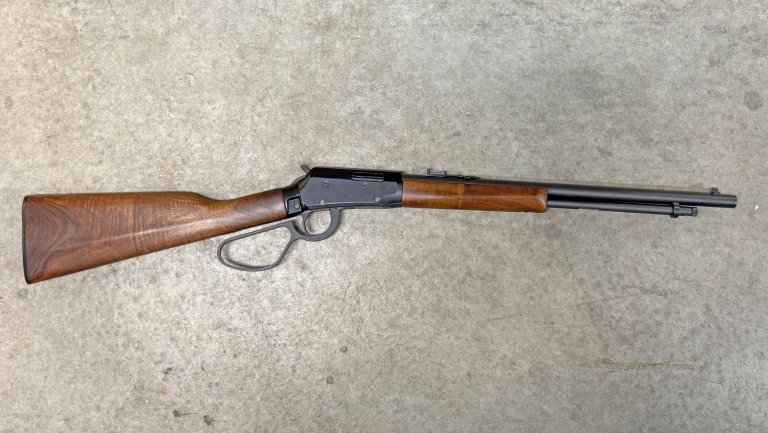
In 2024, Savage introduced the Revel, a rimfire lever-action chambered in .22 LR, .22 WMR, and .17 HMR. Considering their modest price, these are great little lever actions. They come in three trims: Classic, DLX, and Tactical.
I’ve had one of the classic Revels for a couple years and it’s a wonderful balance of traditional looks, performance, and modern features. It’s got handsome walnut furniture with a couple of modern lines and nice ergonomics. The steel has a matte blued finish, and the aluminum receiver is coated in black as well. The DLX has wood furniture with some modern M-Lok slots and the gun has a threaded muzzle. The Tactical version has black synthetic furniture.
The classic version I’ve been shooting has traditional dovetailed sights and the slightly heavy weight of the barrel, in conjunction with the buttstock design, makes the rifle quick to the shoulder and steady pointing. The receiver is unique in that it features two push pins that can be used to take the rifle down in seconds for stowage or cleaning. A lot of our .22 LR ammo is excessively waxy, and that can gum up lever guns pretty easily so easy takedown is helpful.
The Tactical Revel comes with a Picatinny rail for mounting an optic, but the other models are drilled and tapped to accommodate a scope. These are some of the nicer rimfire lever guns you’ll find for the money today.
Marlin 1894

Pros
- Based on the samples I’ve seen, should be as well made as other Ruger Marlins.
Cons
- As with other Marlins, will be difficult to find.
Key Features
- Caliber: .44 Mag./.44 Spl.
- Capacity: 10+1
- Stock: Black walnut
- Receiver: Blued alloy steel, CNC machined from forgings
- Sights: Adjustable semi-buckhorn
- Weight: 7.25 pounds
- Length 38.5 inches
- Barrel: 20.25 inches, cold hammer-forged
- Twist: 1:20
- Cost: TBD
The Marlin 1894 was hot stuff when it was introduced back in the day. It was the first lever gun with a flat top, side-eject design that anticipated the eventual wide-spread adoption of telescopic sights on rifles. This innovation gave it a leg up (on paper anyway) compared to the Winchester 1894 which debuted at the same time, though the fact that the Winchester came in the potent .30/30 versus the less powerful offerings in the Marlin gave Winchester’s 1894 a decisive advantage.
The Marlin 1894 has been chambered in a variety of mostly pistol-caliber cartridges over the decades, the most common of which (in the modern era) included the .44 Spl./.44 Magnum. .38 Spl./.357 Magnum and .45 Colt. I have a North Haven, Conn., built 1894 in .44 Magnum and it is one of my favorite carbines. (Though if I could snap my fingers and conjure any 1894 it would be one chambered in the quaint and now obsolete .218 Bee.)
Ruger announced the return of the Marlin 1894 this spring, so we will hopefully have hands-on range time with one soon for a full review. Expect to see the first offerings in the cartridges mentioned above, but as details become available we’ll update this information. (Note: the rifle pictured above is one of the older Marlin 1894s).
Rossi R95 Laminate

Pros
- Smooth cycling
- M16-style extractor
- Weather resistant
- Good value
Cons
- Fit of stock fore end could be better
- receiver is over polished
Key Features
- Caliber: .45/70
- Capacity: 5+1
- Stock: Laminated wood
- Receiver: Stainless steel
- Sights: Brass front bead, adjustable rear peep
- Weight: 7.25 pounds
- Length 36.75 inches
- Barrel: 18 inches, threaded 5/8-24
- Twist: 1:12
- Cost: $1,084
Rossi has recently, with the R95, become a true contender in the .45/70 lever gun space. Their stainless-steel R95 Laminate .45/70 is a high-quality gun that incorporates some modernized features and is better quality than even some of the previous Marlin models. This model has a polished stainless receiver — that is honestly a bit over-polished — and laminated wood furniture. They seem durable and weather-resistant in our testing, but we’d prefer the fit of the fore end to be a bit better. The sides of it aren’t fully against the magazine tube and can flex and potentially crack.
This new .45/70 lever gun features a modernized M16-style extractor and a threaded muzzle for accepting a suppressor. Staff writer Tyler Freel put a lot of ammo through his sample and it ran beautifully. You can read his full review here. Priced below some of the top-shelf lever guns like the new Marlin, Henry, and Smith & Wesson rifles, it’s affordable but still very good quality.
Rossi Rio Bravo Gold

Pros
- Affordable
- Easy to maintain
- Many models available
- Accurate
Cons
- Quality and finishes aren’t as nice as higher-end .22 lever guns
Key Features
- Caliber: .22 LR
- Capacity: 14+1
- Stock: Wood, unspecified
- Receiver: Aluminum
- Sights: Buckhorn
- Weight: 5.6 pounds
- Length 36 inches
- Barrel: 18 inches
- Twist: 1:16
- Cost: $376
Another great Rossi lever gun is the Rio Bravo .22 LR. This is available in a number of configurations, but we really like the wood/gold variant. This is a lever gun with good looks that isn’t priced to be a safe queen. Staff Writer Tyler Freel put one of these to the test with his son and you can read his full review here.
The Rio Bravo has an aluminum receiver with a top cover that’s held in place with four Phillips-head screws. It’s easily removed for cleaning and maintenance — something that’s important to keep rimfire lever guns working correctly. It’s an accurate rifle that works well with a variety of ammunition and holds 14 rounds in its tubular magazine. If you want to mount an optic, you can use the narrow dovetail atop the receiver with tip-off rings, but this gun is most fun with iron sights.
Best Lever Action Rifles: The Classics
This list could have been much longer, but in the interest of brevity I’ve only highlighted a few notable classic lever guns. Before getting to those, however, I do want to highlight a couple important honorable mentions.
The Spencer repeating rifle is one. It was the first military repeating rifle that used self-contained metallic cartridges and is the forefather of all lever actions. Though the Spencer was produced for only a short time (1860 to 1869) and in relatively limited numbers, it was the steppingstone upon which the lever action rifle, specifically Winchesters, was built.
The Winchester 1895, which gained prominence as Teddy Roosevelt’s “Big Medicine” in .405 Winchester is an iconic lever action whose fame outstrips its actual benefits. From a technical standpoint, its most distinguishing element is that it was the first Winchester lever action fed from an internal box magazine.
Winchester 1886
Winchester 1886

Pros
- The first real lever action for big game cartridges.
Cons
- Hard to find and a bit spendy.
Key Features
- Caliber: .45/70 Gov’t.
- Capacity: 8+1
- Stock: Grade III/IV Walnut
- Receiver: Steel color case hardened
- Sights: Semi-buckhorn
- Weight: 9.75 pounds
- Length 43 inches
- Barrel: 24 inches, octagonal
- Twist: 1:20
- Cost: $1,930
This was the first big-boy lever action in history. The Winchester 1886 changed the game because its strong locking-block action was able to handle proper rifle cartridges, rather than the pistol rounds that previous lever action designs were limited to.
It was originally chambered in .45/70 and .45/90, two rounds you can still get it in. Over the years it was loaded for other hard-hitting rounds like the .50/110 Winchester and .33 WCF.
Those rounds, combined with its excellent handling characteristics, made the Model 1886 the first true big-game capable lever action. Today, you can order it in a Saddle Ring Carbine configuration (1,630)witha22-inchbarrel,in“ShortRifle”trim(1,450) with a 24-inch round barrel, or go all out with the fancy Deluxe Case Hardened model ($1,930) with a 24-inch octagonal barrel, upgraded walnut and color case hardened receiver.
Savage Model 99
Savage Model 99
See It
Pros
- One of the top candidates as the lever action GOAT. It is both timeless and ahead of its time.
Cons
- You’re going to pay through the nose for one in good condition.
Key Features
- Weight: 6.6 pounds
- Capacity: 5 rounds (.308 Win.)
Arguably the finest lever action ever (and if there’s one thing lever gun fans like to do its argue about which is best), the Savage Model 99 was a revolutionary addition to the American sporting scene when it was trotted out in 1899.
It had an elegant, hammerless design, used an innovative rotary magazine that allowed the rifle to safely chamber cartridges with spitzer-style pointed bullets, and a stock silhouette that oozed sexiness and speed decades before such aesthetics became the hallmark of art deco industrial design.
First called the Model 1899, it officially changed to the Model 99 in 1921 when the .300 Savage was introduced. Initially, the 1899 was chambered in .303 Savage and .30/30 Win. Soon, Savage added other cartridges to the lineup—the most iconic of which was Charles Newton’s speedster, the .250-3000 Savage, in 1915. Later in life, the Model 99 added the .243 Win., .308 Win., 7mm-08 Rem., .375 Win. and others to the mix.
My Model 99 is a particularly lovely rifle. It was given to me by my father-in-law before he passed away and is a takedown model chambered in .300 Savage that includes a .410 bore barrel that it shoots single-shot.
The rifle was sold by Abercrombie and Fitch to legendary car maker Carroll Shelby, who eventually gave it to my father-in-law as a gift. It’s still in its original case of leather and wood lined with purple velvet. I rarely shoot it—but admire it frequently.
Winchester Model 88
Winchester Model 88

Pros
- One of the most significant evolutionary designs in lever action history.
Cons
- Its looks and feel weren’t for everyone, but enough hunters took a shine to it to make it the third-best selling lever action in Winchester’s history.
Though it never gained the following of the Savage 99, the Winchester Model 88 is similar to the Savage in that it incorporated a lot of technical innovation in its design and caused hunters and shooters to reassess the lever action platform.
Winchester unveiled it in 1955. It had a short lever throw and used a rotating three-lug bolt that smoothly stripped rounds from the detachable box magazine. The Model 88 was chambered in a handful of cartridges that were new at the time, specifically the .308 Win., .243 Win., .284 Win. and the .358 Win., which was a particularly terrific brush round that is sadly all but forgotten these days.
The Model 88 has a hammerless design and side eject, which allows for easy mounting of an optic on the receiver. One particularly clever feature is how the trigger moves with the lever loop, eliminating the possibility of a pinched finger or snagged glove when working the action.
Marlin 39A
Marlin 39A
See It
Pros
- The best rimfire lever action rifle ever.
Cons
- Ruger isn’t making them—yet. Used 39A’s command a premium.
I don’t think there’s a rimfire lever action as beloved as the Marlin 39A. It tops many shooters’ lists as the best .22 LR ever produced. The legacy of the 39A is fascinating. It started as the Model 1891 and was the first .22 LR lever action produced. Its legendary accuracy was demonstrated by Annie Oakley who used one in her shooting exhibitions. The Model 39A held the distinction of being the longest continually produced shoulder-fired firearm in history. That streak was broken when the dimwits who purchased Marlin and placed it under the Remington umbrella decided to move Marlin’s production facilities from North Haven, Conn., to Ilion, New York—at which point the production of all Marlins ground to a (predictable) halt.
My sincere hope is that we’ll soon—as in the next couple years—be able to reclassify the 39A under the “Best Lever Action Rifles Being Currently Made” category since it seems Ruger is doing such a fabulous job reviving Marlin since they purchased it.
Winchester 1873
Winchester 1873

Pros
- The gun that won the West. Nuff said.
Cons
- A genuine used one is going to cost dearly. Newer imports don’t have the same cachet.
Key Features
- Caliber: .44-40 WCF
- Capacity: 14+1
- Stock: Grade V/VI Walnut
- Receiver: Steel color case hardened
- Sights: Semi-buckhorn
- Weight: 8 pounds
- Length 43 inches
- Barrel: 24 inches, half octagon/half round
- Twist: 1:36
- Cost: $2,190
When you think “cowboys” and the “Old West” the first rifle that comes to mind is this beauty. The Winchester 73 really was the right gun for the right time—being the first rifle chambered for the .44-40, which is said to be the first centerfire cartridge developed. Whether it deserved to be called “The Gun that Won the West” as Winchester touted, there’s no denying that the Model 73 was used to send a whole bunch of men—both good and bad—to their maker, and accounted for innumerable deer and other game to boot.
The Model 1873 was produced until 1923 but has enjoyed a revival since the sport of cowboy action shooting sprang up. Uberti makes replicas chambered in .357 Mag. and .45 Colt, while Winchester, which worked with their Japanese partner Miroku, has been importing ’73s since 2013. Those are available in .357 Mag., .45 Colt, and .44-40 WCF.
FAQs
What is a .357 lever-action good for?
Since the barrel of a lever action is longer than that of a handgun, cartridges like the .357 Mag. and .44 Mag. get a significant performance boost in terms of velocity that makes them more capable on animals like deer and hogs.
In addition, a lever-action chambered in .357 can run .38 Spl. rounds, which are economical and have little recoil making it a great option for plinking and practice.
Are lever-action rifles practical?
Yes. They are fast-handling, quick-shooting, easy to wield and carry, hold good quantities of ammo, are available in a wide range of cartridges for different applications, and are legal in most all jurisdictions. Whether you’re on horseback with one in a scabbard or have a take-down model in a bug-out bag, lever-actions are an excellent choice.
Are lever-actions effective on dinosaurs?
Absolutely. The Marlin 1895 SBL carried by Chris Pratt’s character—dinosaur whisperer Owen Grady—in Jurassic World, would be a top choice as a dino stopper, provided it was loaded with heavy, hard-hitting ammo like Buffalo Bore’s 380-grain mono-metal WFN dangerous-game load.
Are lever-actions good for home defense?
Certainly. A carbine-length lever action chambered in a pistol cartridge like .357 Mag. or .44 Mag. would be a highly effective option for home protection. Even a rifle chambered in .22 Win. Mag. can be a formidable home-defense gun when loaded with ammo like Federal Punch.
Final Thoughts on the Best Lever Action Rifles
Usually when one compiles a “best of” list—whether talking deer rifles, elk cartridges, or sniper rifles—there is significant push-back with the selections. Everyone has deeply-held convictions on such matters.
With lever action rifles, it is a bit different. There are many rifles that are universally agreed upon. No one in their right mind is going to say that a Savage 99 isn’t one of the best lever action rifles of all time. The same goes for the Model 94, Marlin 336 and others.
I think we rally around lever actions because they are the quintessential American rifle. Yes, we make the best bolt-actions in the world, and the same can be argued with other firearms platforms—but the lever action is distinctly ours. Though some are made abroad and imported, the lever action is, and always will be, America’s rifle.
The post Best Lever Action Rifles of 2026 appeared first on Outdoor Life.