District Magazine Ban Ruled Unconstitutional by D.C. Court of Appeals
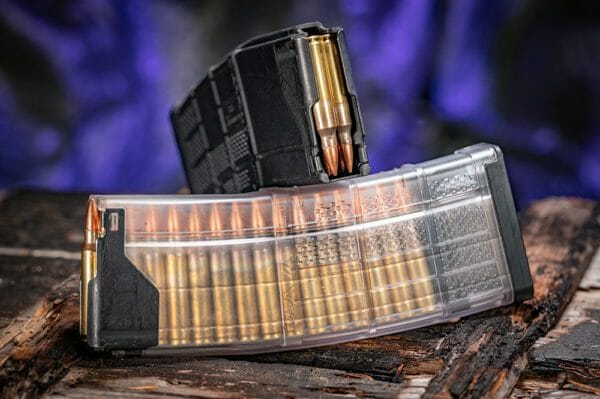
In a 2-1 ruling which is already raising questions about its importance, and eyebrows over what it could mean for federal cases challenging similar state laws, the District of Columbia Court of Appeals—not to be confused with the U.S. Court of Appeals for the District of Columbia Circuit—has struck down the district’s ban on magazines which hold more than ten cartridges.
Via email, Kostas Moros, director of Legal Research and Education for the Second Amendment Foundation, told Ammoland it is “hard to say” how important this ruling may be.
“But at minimum,” Moros said, “it’s a very persuasive ruling striking down magazine capacity limits coming from a usually-antigun court.”
The case is known as Benson v. U.S. Plaintiff Tyree Benson was convicted of violating the District’s ban on so-called “large-capacity magazines” (LCMs) after police found him in possession of an unregistered semiautomatic firearm equipped with a loaded 30-round magazine.
Alan Gottlieb, chairman of the Citizens Committee for the Right to Keep and Bear Arms, told Ammoland via email, “This is a major Second Amendment ruling. You could say that it is the ‘second shot heard around the world.'”
Writing for the majority, Associate Judge Joshua Deahl, a Donald Trump appointee, noted that the federal government had reversed its position in the case and “concedes that this ban violates the Second Amendment.”
Meanwhile, the District continues to defend the ban.
Deahl is joined by Associate Judge Catharine Friend Easterly, a Barack Obama appointee.
“Magazines capable of holding more than 10 rounds of ammunition are ubiquitous in our country,” Judge Deahl wrote, “numbering in the hundreds of millions, accounting for about half of the magazines in the hands of our citizenry, and they come standard with the most popular firearms sold in America today. Because these magazines are arms in common and ubiquitous use by law-abiding citizens across this country, we agree with Benson and the United States that the District’s outright ban on them violates the Second Amendment.
“We therefore reverse Benson’s conviction for violating the District’s magazine capacity ban,” he continued. “And because Benson could not have registered, procured a license to carry, or lawfully possessed ammunition for his firearm given that it was equipped with a magazine capable of holding more than 10 rounds, we likewise reverse his convictions for possession of an unregistered firearm, carrying a pistol without a license, and unlawful possession of ammunition.”
Later, Judge Deahl reiterates, “That brings us to the critical question of whether 11+ magazines are in common and ubiquitous use. They are. These magazines facilitate armed self-defense and law-abiding citizens possess hundreds of millions of them in this country.”
Then, 35 pages into his 54-page opinion, Judge Deahl observes, “In any event, the logical force of the District’s argument is limited in cases like this one, where the District is an outlier in putting any capacity limits on magazines. There are no magazine capacity limits federally nor are there any in the vast majority of states.”
In her dissent, Chief Judge Anna Blackburne-Rigsby, a George W. Bush appointee, argues, “In Heller II, the D.C. Circuit noted the popularity of 10-round magazines and acknowledged that there ‘may well be some capacity above which magazines are not in common use[.]’ In my view, 30+ round magazines exceed that capacity and are not in common use for a lawful purpose.”
In closing her dissent, Judge Blackburne-Rigsby contends, “I would uphold the District’s LCM ban and affirm each of Mr. Benson’s convictions. The LCM ban is analogous to our nation’s historical tradition of regulating weapons that are particularly capable of unprecedented lethality and are not in common use.”
This is probably not the end of the Benson case, or the surrounding debate, although SAF’s Moros stated in his email, “(This) may up the pressure on SCOTUS to grant cert in a hardware case.”
In his lengthy discussion of the ruling, Moros dissects pertinent sections. Referring to a line on Page 11 of the decision—”So long as something is a bearable arm, it is covered—at least as a threshold matter—by the Second Amendment’s plain terms.”—Moros observed, “ANYTHING that is a bearable arm is covered, and restrictions must be justified by history. Some gun laws may be quite easy to justify with history because they have tons of historical analogues similar to them, like disarming violent criminals. But you don’t get to skip the historical analysis by claiming an arm is not an arm. Yet that is exactly what many courts have done.”
The District could ask for an en banc hearing. That should be known within days.
DOJ Declares DC Magazine Ban Unconstitutional in Stunning Reversal
New Legal Strategy Challenges ATF’s Interpretation of the 1986 Hughes Amendment Machine Gun Ban
About Dave Workman
Dave Workman is a senior editor at TheGunMag.com and Liberty Park Press, author of multiple books on the Right to Keep & Bear Arms, and formerly an NRA-certified firearms instructor.