DOJ Fights Broader NFA Relief After Letting Suppressor Ruling Stand
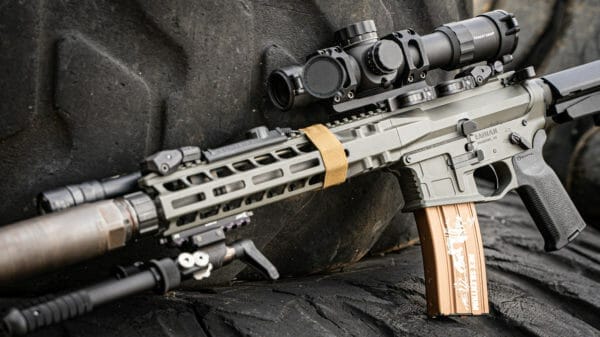
For Americans who own suppressors and short-barreled rifles, the unfinished fight is about who receives enforceable protection from the federal government’s registration scheme.
The October 7 filing comes in the consolidated Brown v. ATF and Missouri ex rel. Hanaway v. ATF litigation before Chief U.S. District Judge Stephen R. Clark.
The NFA’s Taxing-Power Foundation Has Already Failed in Texas
As AmmoLand previously reported, DOJ formally confirmed that it would not appeal the Silencer Shop Foundation ruling.
Judge James Wesley Hendrix held on August 5 that the challenged NFA provisions exceeded Congress’s enumerated powers after Congress reduced the making and transfer taxes on suppressors, short-barreled rifles, short-barreled shotguns, and “any other weapons” to zero.
Washington could no longer justify that regulatory machinery as an exercise of the taxing power. Hendrix also rejected the effort to preserve it under a different congressional power that Congress had not invoked when enacting those provisions.
The Texas opinion did not decide the Second Amendment claims because the enumerated-powers ruling supplied the relief.
Its injunction protects the plaintiffs and, where applicable, their agencies, political subdivisions, members, and customers, including current and future members and customers. It does not automatically protect every American. The Jensen plaintiffs’ relief also excludes AOWs.
DOJ Opposes Relief Covering All State Residents
In its supplemental brief, the DOJ invokes Trump v. CASA to challenge universal relief and argues that states cannot sue the federal government on behalf of their residents under parens patriae standing.
DOJ separately seeks dismissal of Georgia, Kansas, Oklahoma, South Dakota, and Utah on claim-preclusion grounds: they already litigated the same claims to final judgment in Texas.
It also argues that the ten added states supplied no evidence supporting direct governmental injury. Missouri alone attempted to substantiate that theory, DOJ says. The department nevertheless acknowledges that Missouri’s amendment appears procedurally compliant.
These are DOJ’s arguments. Clark has not resolved them in the orders discussed here.
Missouri Challenges Registration and Federal Permission
The amended complaint names Missouri, ten additional states, and individual plaintiff Dave Marshak. It challenges the regulation of untaxed NFA firearms under Congress’s enumerated powers and separately argues that the restrictions on suppressors and short-barreled rifles violate the Second Amendment.
The complaint describes registration, fingerprints, personal information, advance approval, and the threat of criminal prosecution as burdens on lawful ownership. Marshak alleges that he values his privacy and would acquire covered firearms but for the registration requirements.
That is the human consequence behind this procedural fight. Peaceable ownership becomes subject to a federal permission system, with private information surrendered as the price of exercising a right.
The Second Amendment protects the people. Lawful gun owners should not have to enter a federal registry to possess protected arms.
October 22 Conference Will Address What Comes Next
In his October 6 order, Clark noted that the October 5 deadline to appeal the Texas injunction passed without an appeal.
He scheduled a Zoom status conference for October 22 at 10 a.m. CDT, or 11 a.m. Eastern. Counsel must address the Texas judgment’s effect, the five states’ standing, and the validity of Missouri’s amended complaint.
The Texas victory remains consequential. But gun owners outside its protection still need enforceable relief. Constitutional rights belong to every American, and dismantling the NFA’s registration and permission requirements remains unfinished work.
ATF Guidance Could Reshape the Fight Within Days
The next major development could arrive before the October 22 conference. AmmoLand expects ATF’s long-awaited NFA guidance within the next day or two, and its contents could dramatically change the practical impact of this fight for gun owners and dealers.
If ATF adopts an approach extending beyond the people expressly protected by the Texas injunction, that could substantially reduce the immediate uncertainty over how untaxed suppressors and short-barreled firearms are handled. If the agency limits its instructions to covered plaintiffs, members, and customers, the battle for broader court protection becomes even more consequential.
Agency guidance cannot expand a court’s injunction, and it does not carry the same protection as a binding court order. Its release could nevertheless reshape the implementation questions facing both courts and the firearms industry.
The Texas victory is a major step toward dismantling the NFA. ATF’s next move will help determine how far that victory reaches in practice. Gun owners deserve the restoration of their rights, clear instructions, and lasting protection from the federal government’s registration scheme.
About Duncan Johnson:
Duncan Johnson is a lifelong firearms enthusiast and unwavering defender of the Second Amendment—where “shall not be infringed” means exactly what it says. A graduate of George Mason University, he enjoys competing in local USPSA and multi-gun competitions whenever he’s not covering the latest in gun rights and firearm policy. Duncan is a regular contributor and editor-in-chief for AmmoLand News and is responsible for AmmoLand’s daily gun-rights reporting and industry coverage.