Fascinating Failure: The .45 Winchester Magnum
Though it’s been about a century and a quarter since John Browning first graced us with the .45 ACP, it’s not tremendously difficult to see why it’s still with us. While some gravitate to the cartridge due to nostalgia or a connection with America’s military past, just as many people recognize its efficacy as a proven fight-stopper.
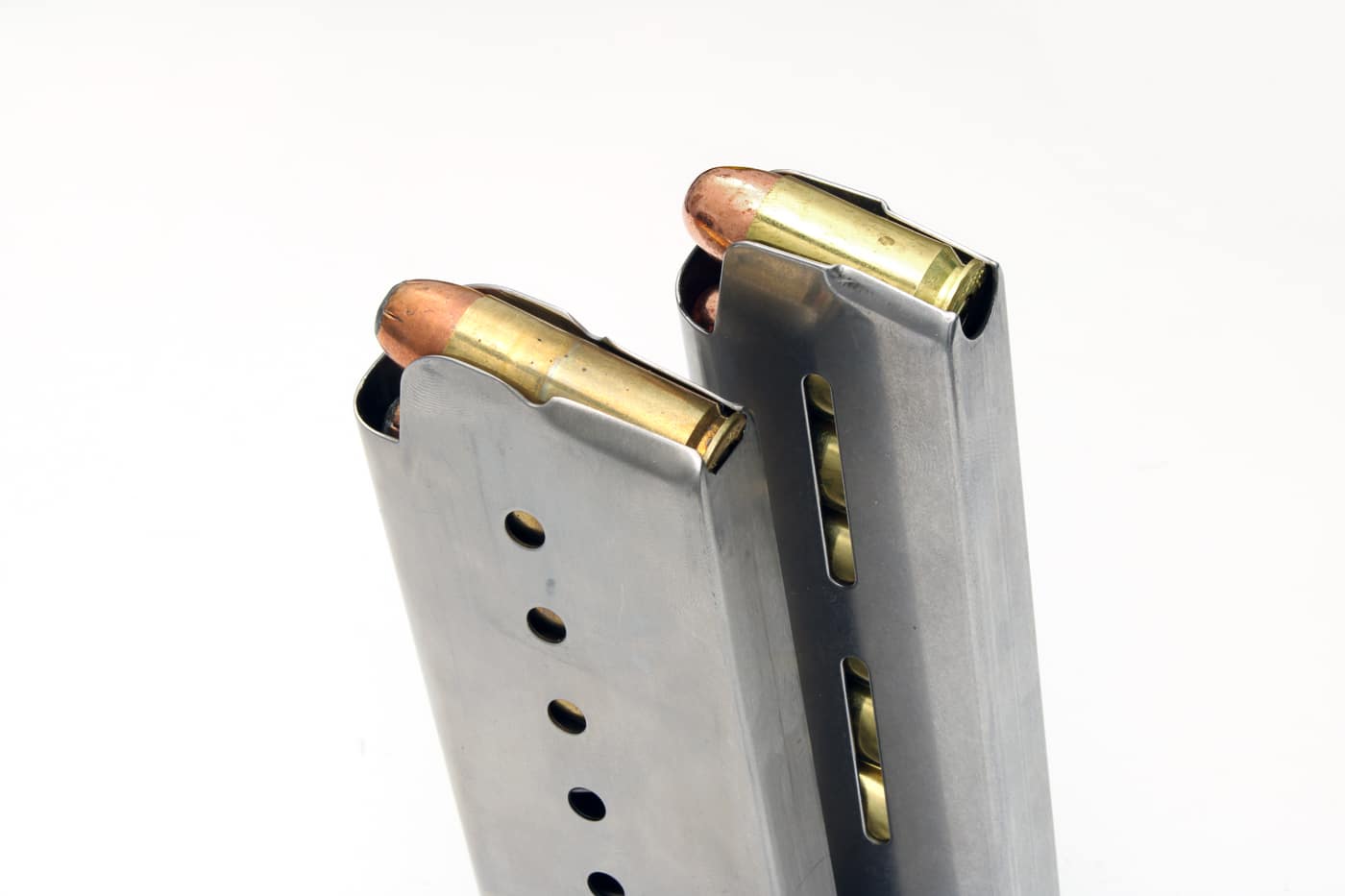
Anecdotally, I’ve found that when a shooter chooses to master the .45-caliber semi-auto, it symbolizes them moving from a novice shooter to the next level. While the additional recoil over a 9mm is undeniable, it isn’t painful and quickly ceases to be intimidating. When those fat slugs punch big holes in targets or throw around steel with a greater degree of authority, it’s hard not to see the charm.
This all begs the question: if the .45 ACP is compelling precisely because it’s more than the 9mm, what’s the next step up? Is there something that’s even more of a .45 than the .45? A .45 magnum, perhaps? Well, indeed there is. (Or, for most purposes, was.)
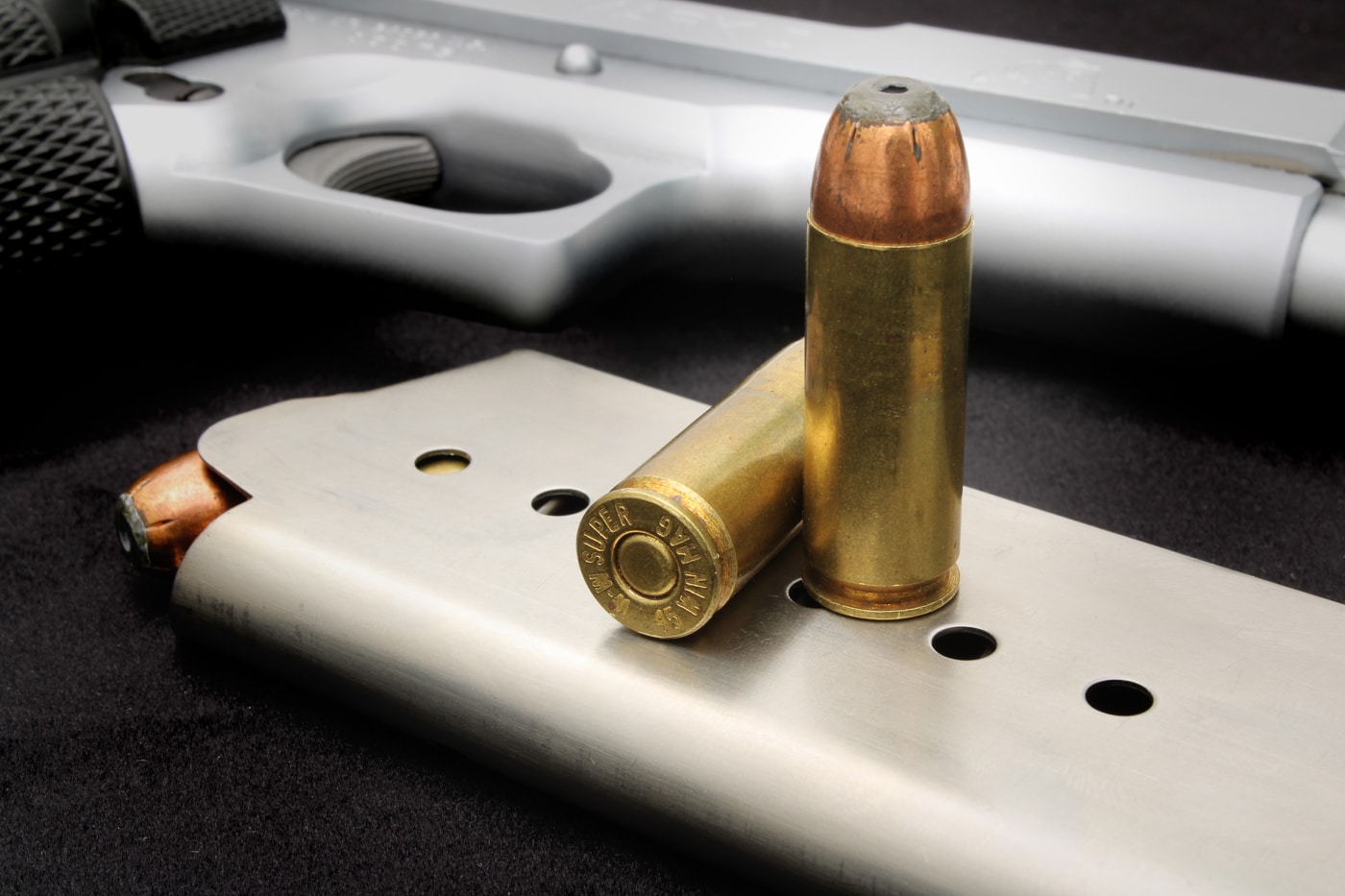
Today, we look at the .45 Winchester Magnum; often, it’s affectionately referred to as the .45 Win Mag, which is how I’ll refer to it from here on out. By the time we’re through, you’ll understand the why of the .45 Win. Mag.—and just as importantly, the why not.
In the Beginning
The origin of the .45 Win. Mag. goes back to a curious piece of history known as the NAACO Brigadier. The brainchild of the North American Arms Corporation of Ontario, Canada, the Brigadier was essentially a P-35 “Hi-Power” look-alike enlarged to accommodate a much larger .45-caliber cartridge. In 1948, NAACO had their heart set on pitching the Brigadier to the Canadian military as the country’s next sidearm. As NATO-member countries saw the benefit of standardizing cartridges, however, the Brigadier’s fate was sealed, and NAACO shuttered in 1951.
The specs on the gun and the cartridge, however, were wild. The .45 NAACO didn’t simply offer a modest performance boost above the typical .45 ACP hardball load of 230 grains at about 850 feet per second (fps) — it utterly eclipsed it. NAACO claimed its round could push the same 230-gr. projectile to claimed velocities of 1,600 fps. That’s just shy of four times more kinetic energy than the GI load.
If that wasn’t enough, NAACO also shopped around their idea for the “Borealis” model, which thanks to an attachable folding stock and extended barrel, would turn the Brigadier into a full-auto submachine gun. Considering there’s one whole photo of the Brigadier on the internet, and only one prototype known to have been produced, the Borealis meets the very definition of firearms “vaporware.”
Past that, and even without the push for NATO standardization, it’s hard to imagine the Brigadier would have been too compelling to the Canadian military. The weight of the prototype was reportedly in excess of four pounds, a problem in a market where every ounce matters.
Here, I’m reminded of another also-ran military magnum: the Gabbett-Fairfax Mars. That particular model launched a .45 bullet at a reported 1,200 fps from a three-pound platform, and did eventually make its way to military testing in the United Kingdom. Those trials produced one of the more quotable lines in firearms history, thanks to the words of one naval officer: “No one who fired once with the pistol wished to shoot it again.”
The .45 Win. Mag. is Born
From the late 1960s to early 1970s, a few different movements were afoot in the world of handgunnery. The first was the magnum craze that followed in the wake of the movie “Dirty Harry” being released. Suddenly, just about every semi-serious shooter and their mother wanted to figure out where the ceiling was to magnum performance. At the same time, the sport of handgun silhouette shooting was coming into its prime. When one is trying to knock down steel plates at 100 yards and beyond, more power is a handy thing to have.
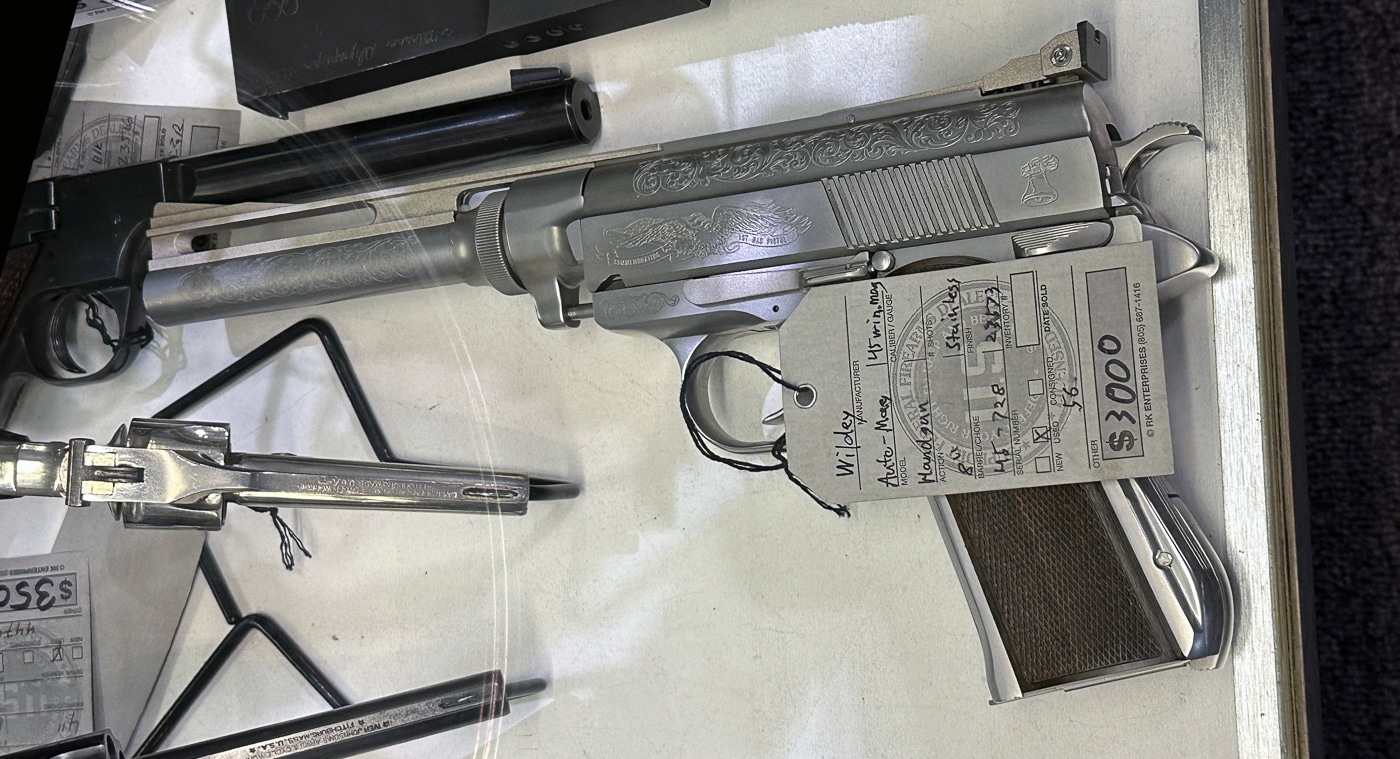
Along the same lines, a number of engineers found themselves asking a similar question: wouldn’t it be neat if that kind of power was available in a semi-auto? Undoubtedly, the most influential of those thinkers with respect to the .45 Win. Mag.’s development was Wildey Moore. Not only did Moore have his own vision for a big-bore, gas-operated semi-auto by the early 70s, he had both the practical know-how and the connections to make it a reality. In fact, Moore worked as a weapons mechanic for the Air National Guard, a design consultant for the Carl Gustav firm, and was a sales representative for Winchester for more than a decade.
Moore brought his prototype to Winchester and let them know that if they supplied the ammo, he’d be able to bring the gun to market by the end of the decade. An agreement was struck, and the first batches of .45 Winchester Magnum began to hit the market in 1979 — a full year before the Wildey Magnums were ever offered for sale.

Live The Armory Life. The latest content straight to your inbox plus an automatic entry to each of our monthly gun giveaways!
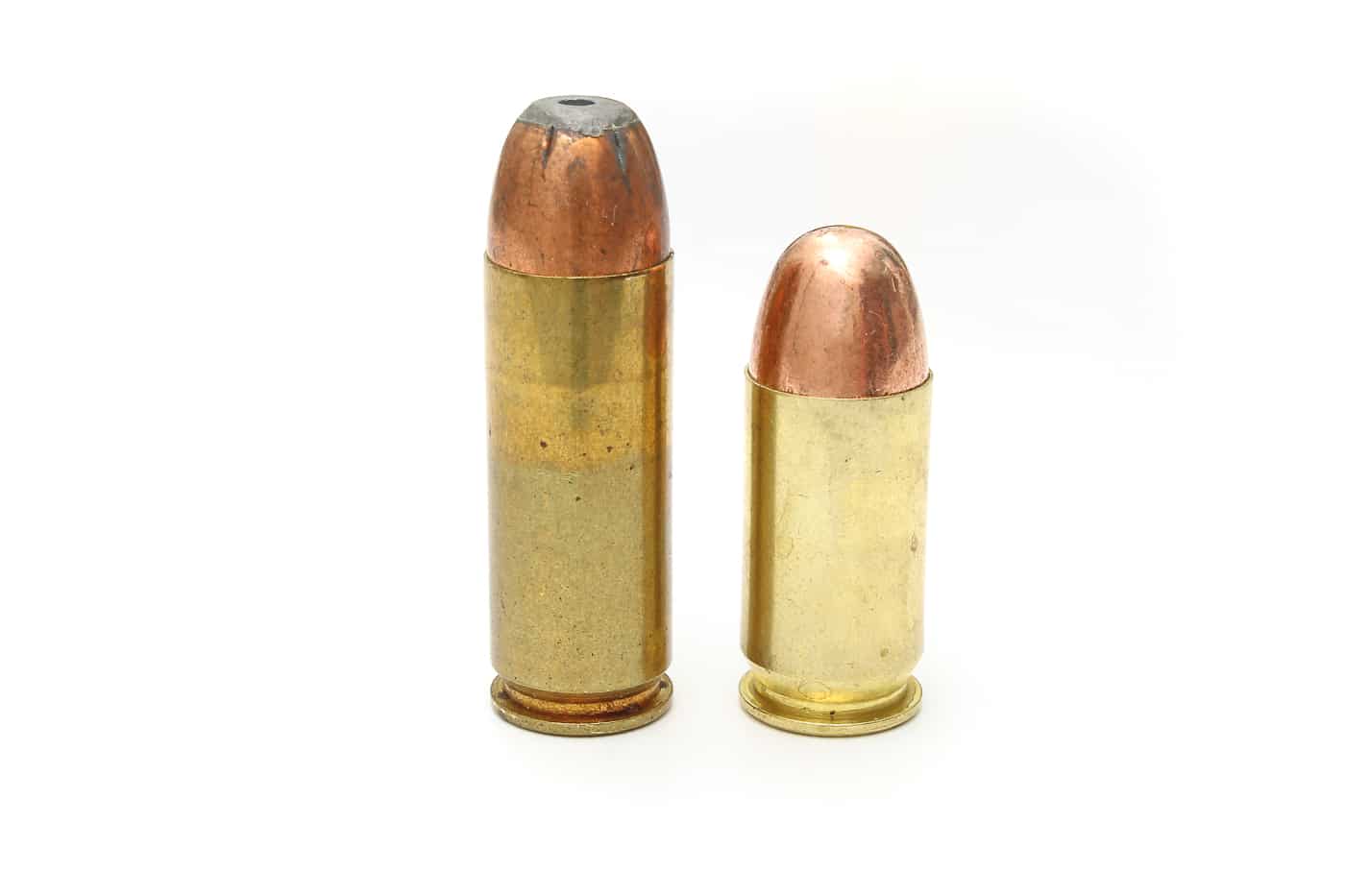
I have read and agree to the terms & conditions.The .45 Winchester Magnum was nearly identical to the .45 NAACO in dimensions and specifications, pushing a 230-gr. bullet to about 1,600 fps. I can confirm this by the eyeball test of what few pictures exist of the .45 NAACO; the last single round moved at auction for more than $800, mind you, so getting my hands on one wasn’t a realistic possibility. I also invite readers to note that the .45 Win. Mag. isn’t exactly a stretched .45 ACP case. It’s close, but as pictures will reveal, it has a markedly different extractor groove. It also boasts a thicker rim and thicker case walls that allow a SAAMI maximum pressure of 41,500 psi.
As for the Wildey Magnum, troubled production limited its popularity, even once ammo was available. Along the way, a number of other handguns — albeit not a glut of them — were chambered in .45 Win. Mag. In its earliest years, interested ballisticians could order a single-shot barrel for the Contender platform, but eventually AMT offered the Automag IV in the caliber, along with LAR’s Grizzly Magnum.
In the Hand
I’ve seen a grand total of one Wildey Magnum “in the wild,” and the firearm was certainly a beast. I’ve never once seen an Automag IV in my lifetime. However, when I had the opportunity to acquire a really nice used example of the LAR Grizzly, I didn’t pass it up.
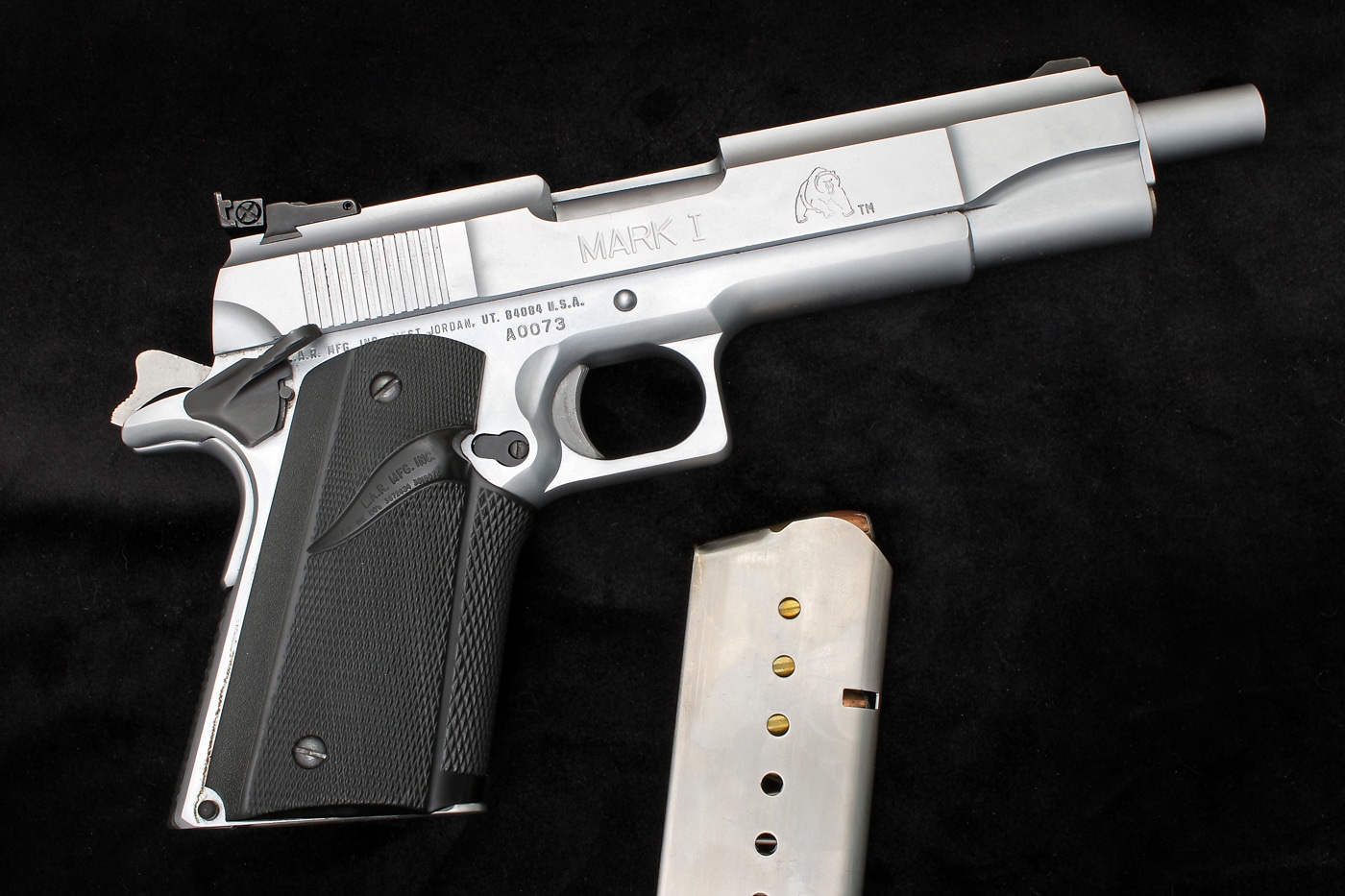
The Grizzly can charitably be described as a 1911 from hell. Surprisingly, a number of its parts interchange, from the fire control components to its safeties and grip screws. The biggies, however, like the frame, slide, barrel and trigger, all have to be made bigger and/or longer to accommodate the length of the .45 Win. Mag. In the magnum caliber, the Grizzly utilizes a 27-lb. recoil spring (as opposed to the 16-lb. spring present in most factory 1911s). At 48 oz. unloaded, the Grizzly is also about 20% heavier than most 1911s.
Let me state something here for the record: the LAR Grizzly is a big gun. As a small-handed guy, I nevertheless find it easy to work with, which gives me another point of data in my overall conclusion that 90% of guns will work well enough for about 90% of the various hands that are out there. Because there’s so much real estate on the side of the grip frame, it gives the weak hand a generous patch to press into and anchor under recoil.
Fit and finish of my Grizzly is very good. These were essentially semi-custom guns made to a high quality standard. Of the goofy magnum semi-autos of the 1980s and 1990s, they’re known to be fairly reliable.
At the Range
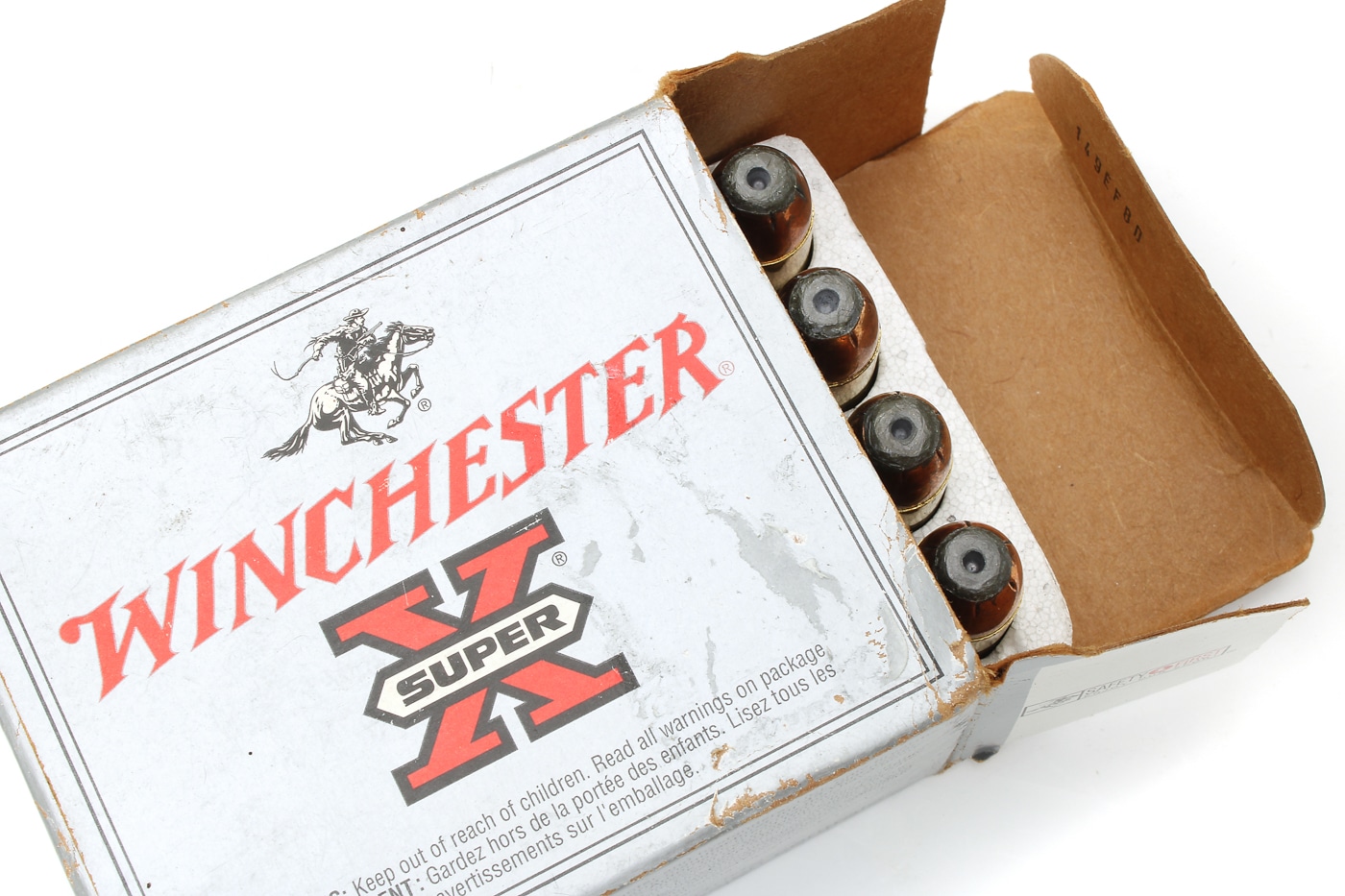
As one would expect, touching off the .45 Winchester Magnum is quite the experience. I fired the gun with Winchester’s factory “Super X” cartridges, the most common factory loads one will likely encounter — and even then, it takes quite a bit of scrounging and special ordering to find a box.
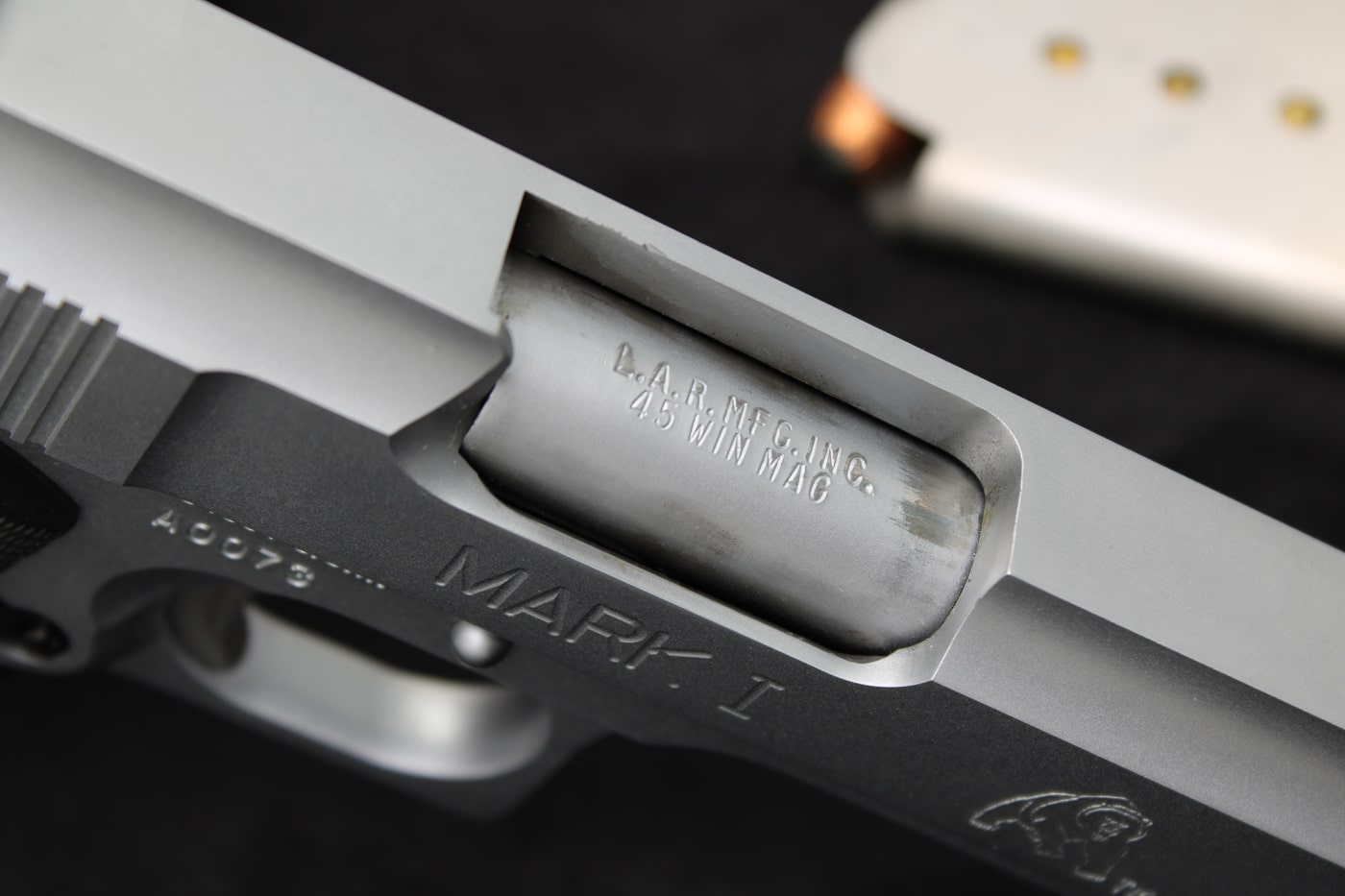
Felt recoil out of the platform is about that of a .44 Magnum. I never felt the gun was going to jump out of my hands, and my palms weren’t left stinging from the experience. That said, this is definitely one of those guns where people around you will stop what they’re doing to see what’s producing the pyrotechnics before them.
The Grizzly throws a blinding flash of light that turns into a gust of flame, and the boom is massive. Most loads produced prior to the 2000s were not models of ballistic efficiency: it’s clear a great deal of the powder is being turned into flash and noise.
Mind you that the gun itself appears absolutely ready to digest as many rounds of .45 Win. Mag. as I care to feed it. To place rounds accurately, however, is a battle with one’s own startle reflex and demands a level of concentration and recoil tolerance well beyond the capabilities of all but the most seasoned handgunners. This isn’t an impossible task for me, but it’s certainly one I need to be in the right mood for!
Why Not More?
Put all of the pieces together, and it’s not hard to see why the .45 Win. Mag. — and by extension, any gun chambered for it — are such rarities. The cartridge is so high-performance that most people won’t enjoy shooting it a lot. It requires a semi-auto engineered to handle that level of power, which translates to large and expensive guns aimed primarily at collectors and big-bore enthusiasts.
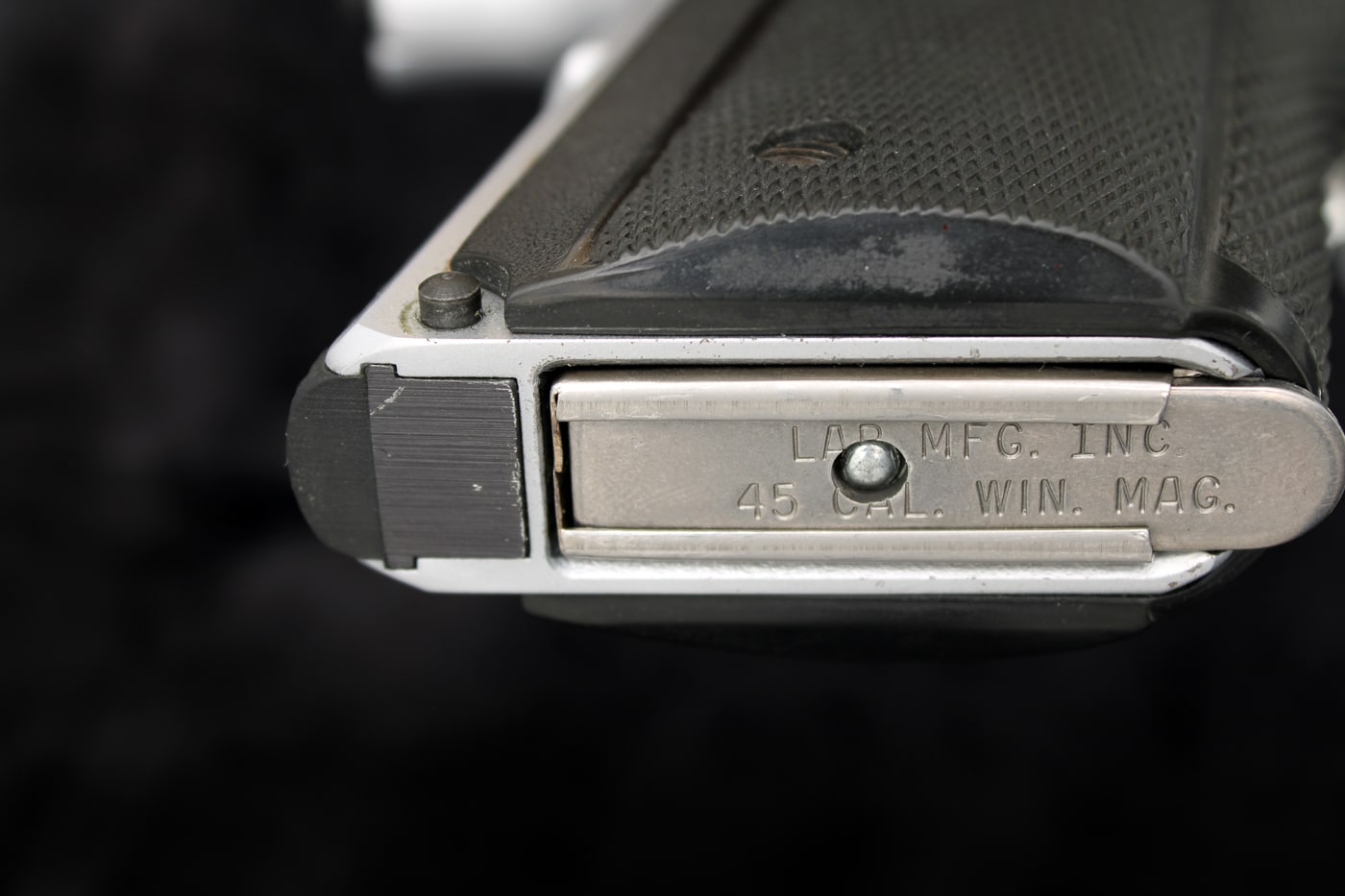
Given the relatively small size of the mega magnum market and the previous fates of those who entered it, companies (wisely) remain leery of entering the space, which makes it unlikely we’ll see guns or ammo produced at scales that produce value to the consumer. Unless one takes up the discipline of handloading, one can expect to pay about three dollars to touch off a single round of .45 Win. Mag.
Compared to the .45 ACP, the .45 Winchester Magnum is absolutely, unequivocally too much. And yet, for many proponents of magnum handgunning, that’s precisely the point!
Editor’s Note: Please be sure to check out The Armory Life Forum, where you can comment about our daily articles, as well as just talk guns and gear. Click the “Go To Forum Thread” link below to jump in and discuss this article and much more!
The post Fascinating Failure: The .45 Winchester Magnum appeared first on The Armory Life.