Federal Judge Upholds Texas Carry Bans at Bars, Sporting Events & Racetracks
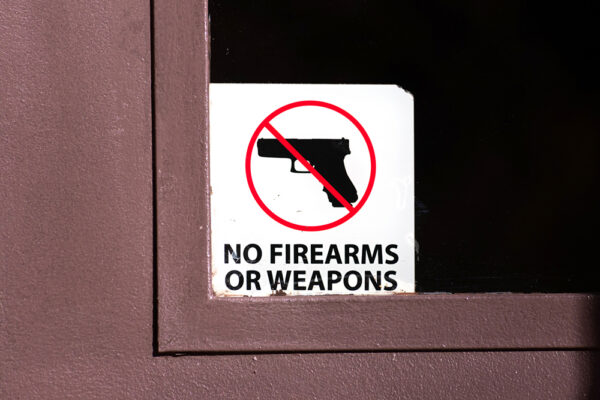
A federal judge in Texas has upheld three longstanding state firearm restrictions, handing gun-rights advocates a disappointing decision in a case challenging whether Texas may continue treating bars, racetracks, and certain sporting-event venues as so-called sensitive places after N.Y. State Rifle & Pistol Ass’n v. Bruen.
U.S. District Judge Mark T. Pittman ruled in Ziegenfuss v. Martin that Texas may continue banning the carry of firearms at racetracks, at businesses that derive 51 percent or more of their income from on-premises alcohol sales, and at premises where high school, collegiate, professional, or interscholastic sporting events are taking place. The court granted Texas’s motion for summary judgment and denied the plaintiffs’ motion.
FPC LEGAL UPDATE: A Texas federal judge has upheld the state’s ban on carry in bars, racetracks, and sporting events while saying that Texans are “arguably among the most prominent protectors of our Second Amendment liberties.” You can read it here: https://t.co/X72s097g0h
— Firearms Policy Coalition (@gunpolicy) March 24, 2026
The plaintiffs in the case were Charles Ziegenfuss, David Montgomery, Brian Robinson, and Firearms Policy Coalition. They brought a facial challenge under the Second and Fourteenth Amendments against Texas Department of Public Safety Director Freeman Martin, arguing that the state’s location-based bans violate the right to bear arms for immediate self-defense in public. Judge Pittman acknowledged that the conduct at issue does fall within the plain text of the Second Amendment, which should have put the burden on the government to justify the restrictions under Bruen’s history-and-tradition test.
That is what makes the ruling so frustrating for gun owners. The court did not say the Second Amendment stops applying in these locations. In fact, Pittman expressly wrote that “there is no carve out” for sensitive places from the Bruen framework. But after recognizing that the right is implicated, the court still concluded that Texas had shown enough historical analogues to keep the bans in place.
On interscholastic events, the court leaned on the proposition that schools are already recognized as sensitive places and then extended that logic outward. Pittman wrote that because schools are sensitive places, interscholastic events are as well. From a gun-rights perspective, that kind of reasoning is exactly the problem: once a court starts treating anything adjacent to a protected category as interchangeable with the category itself, the “sensitive places” doctrine becomes elastic enough to swallow large areas of ordinary public life.
The ruling on alcohol-serving businesses followed a similar pattern. The court said bars, restaurants, and other settings that predominantly serve alcohol have historically been treated as sensitive places, while also admitting places are not sensitive merely because they are crowded. Pittman pointed to what he described as two historical themes: restrictions in certain social settings and regulations involving the combination of firearms and alcohol.
At the same time, the opinion rejected some militia-related alcohol laws as weak support, noting those measures were about keeping militiamen fit for service, not disarming ordinary citizens. Even so, the court still found enough analogous history to uphold the Texas 51% rule.
The most concerning part of the decision for the broader Second Amendment fight may be the court’s treatment of professional sports stadiums and racetracks. Pittman conceded those places are not sensitive simply because they are crowded, but upheld the bans by analogizing them to historical restrictions in fairs, markets, ballrooms, circuses, shows, and other “social places of amusement.” The opinion even pointed to post-Civil War concerns that gambling and horseracing could heighten tensions and increase the risk of violence. That kind of reasoning gives governments a roadmap to defend carry bans almost anywhere people gather for recreation, entertainment, or commerce.
There was also an unusual procedural wrinkle. Texas initially chose not to defend the merits of the challenged laws, arguing justiciability instead. Because the state declined to mount a merits defense of the Legislature’s enactments, the court appointed Professor Eric Ruben and former Fifth Circuit Judge Gregg Costa as amici curiae to defend the statutes. Those amici then supplied the historical defense the court ultimately accepted.
To be fair, the opinion does contain language gun owners can point to on appeal. Pittman recognized that sensitive-place laws likely fall within the plain text of the Second Amendment and therefore must still satisfy Bruen’s historical test. He also emphasized that Founding-era evidence should carry the most weight, with Reconstruction-era material serving only as secondary confirmation. One of the central appellate questions going forward will be whether the analogies used here are truly rooted in 1791 history or whether the court allowed later-era public-order regulations to do too much work.
Ironically, one of the strongest pro-gun passages in the opinion is the part explaining how courts are supposed to read history. Pittman admits the Second Amendment should be understood mainly through the Founding-era public meaning in 1791, not through whatever lawmakers were doing decades later in 1868. He also acknowledges that later evidence is only secondary and cannot contradict the original scope of the right. That is a serious point, because if Texas’s modern carry bans survive only by stacking up later public-order laws about fairs, shows, gambling, and drinking establishments, then the state is not really proving an original American tradition of those bans. It is asking the court to broaden the exception until it starts swallowing the rule.
The decision effectively blesses a method of constitutional analysis that starts with a real right, admits the right is burdened, and then broadens the “sensitive places” category through increasingly generalized analogies. Once a court says a school event can be treated like a school, a sports stadium can be treated like a fairground, and a modern racetrack can be treated like a historic public amusement venue, the limiting principle becomes hard to see.
Pittman closed by invoking judicial restraint and suggesting that if Texans dislike these prohibitions, they can change them through the political process. That may sound modest, but constitutional rights are not supposed to depend on whether lawmakers feel like honoring them. Courts exist precisely because some rights need judicial protection when legislatures refuse to provide it.
Here, the district court chose deference over a harder-edged reading of the right to bear arms. Unless a higher court reverses, Texas’s bans at these locations remain in force.
The timing of the ruling also makes the policy stakes impossible to ignore. On March 1, 2026, a gunman opened fire at and around Buford’s on West Sixth Street in Austin, killing and wounding many others before police shot him. Authorities publicly investigated whether the attack had a terrorism nexus.
The Austin attack exposes the weakness in the government’s broader theory. Violent criminals and mass killers do not avoid bars, entertainment districts, or crowded public venues because the law calls them “sensitive.” Disarming the peaceable does not magically make those places safe.
What the Austin shooting does show, in the real world, is that these are exactly the kinds of places where innocent people may suddenly need the means of immediate self-defense most.
Virginia Democrat Says You Don’t Need a Gun to Fight a Gunman While Backing More Citizen Disarmament