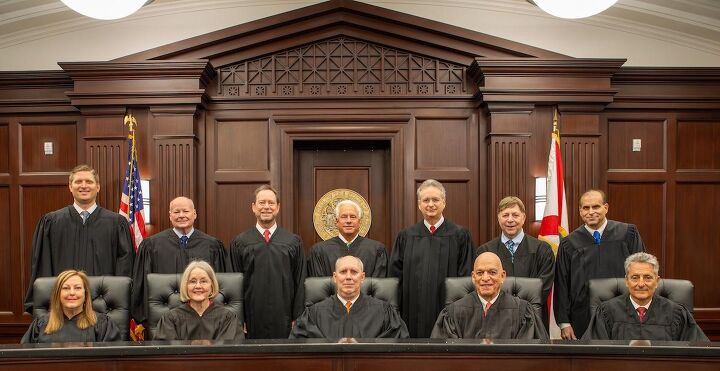
Florida's ban on concealed carry for adults aged 18 to 20 is gone. On June 17, 2026, the state's Fourth District Court of Appeal ruled in Eubanks v. State that section 790.06(2)(b), Florida Statutes, is facially unconstitutional as to young adults ages 18 to 20. That's the provision in the licensing law that set the floor at 21. A unanimous three-judge panel said the age cutoff can't be squared with the Second Amendment, and the state's own Attorney General agreed.
That last part matters more than the ruling itself, and I'll get to why.
How we got here
The case started the way a lot of these cases do: Not with a test plaintiff and a polished legal team, but with an ordinary arrest. In 2024, Broward County officers responded to a call about someone pulling a handgun near a vehicle. They detained 18-year-old Jaylen Eubanks, who matched the description, patted him down, and found an unholstered pistol on his waist.
The state charged him with carrying a concealed firearm and improper exhibition, and he pled no contest to both. But he reserved the right to appeal the concealed carry charge on Second Amendment grounds after the trial court refused to dismiss it.
The appeal is where it got interesting.
The Bruen problem
Here's the legal machinery, kept as painless as I can make it.
Since New York State Rifle & Pistol Ass'n v. Bruen (2022), courts can't just decide a gun law is a good idea and wave it through. The Supreme Court threw out the old "does this serve an important government interest" balancing test. Now the government has to clear a two-step bar. First, does the Second Amendment's plain text cover the conduct? If yes, the conduct is presumptively protected. Second, the state has to prove the regulation fits this nation's historical tradition of firearm regulation.
The Fourth District Court of Appeal walked straight through that framework.
Step one: Are 18-to-20-year-olds part of "the people" the Second Amendment protects? The court said yes, and it wasn't a close call. Going back to Heller, "the people" means all members of the political community, not some subset somebody decides to carve out later. The panel pointed out that 18-year-olds vote, assemble, petition, and get Fourth Amendment protection like any other adult. You don't get to treat them as full citizens for everything except the one right that involves a gun.
Step two is where the state usually scrambles to find a dusty statute that looks close enough. It came up empty. The court found no founding-era law that categorically barred young adults from carrying for self-defense. If anything, the history cuts the other way. The Militia Act of 1792 required able-bodied men to enroll in the militia and arm themselves at 18. That law passed about five months after the Second Amendment was ratified, which is roughly as close to original intent as you'll ever get. The court's read, borrowed from the Third Circuit: Young men obligated to show up armed for militia duty were obviously understood to be allowed to keep and bear arms.
The three-judge panel wrote: “Eighteen- to 20-year-olds can defend the country without restriction but can only utilize their Second Amendment right to self-defense with severe restrictions. This burden on law-abiding 18- to 20-year-olds’ right to public carry—and specifically here concealed carry—which is not applicable to any other adults, is a burden that is facially unconstitutional as to 18- to 20-year-olds.”
The defense of the statute didn't come from the AG, who'd already conceded the case. It came from a separate amicus brief filed by the local State Attorney's Office, which ran two arguments. One: At the founding, you weren't a legal adult until 21. The court's answer was basically, sure, and at the founding "arms" meant muskets, and we don't limit the Second Amendment to muskets either. We define adulthood by the world we live in now, where 18 is the age of majority for voting, military service, contracts, and everything else. Two: 18-to-20-year-olds commit a disproportionate share of gun crime. The court didn't dispute the statistic so much as say it doesn't matter under Bruen. You can't disarm a whole category of law-abiding adults on a "they might be irresponsible" theory. Rahimi already shut that door. As the panel noted, no historical analogue puts young adults in the same bucket as felons, the mentally ill, or domestic abusers.
The court vacated Eubanks' concealed carry conviction and sent the case back down.
The part that makes this stick
A court striking down a gun law isn't unusual these days. What makes this one land is that Florida Attorney General James Uthmeier wasn't fighting it. His office conceded the point, and after the ruling he announced on X that the state would not seek further review and would work with the Department of Agriculture and Consumer Services to put the order into effect.
When the state's top law enforcement officer declares a statute unconstitutional and declines to defend it, the odds of another district court or the Florida Supreme Court reviving it drop close to zero. Practically speaking, this is now the law statewide.
So what does this actually mean if you're 18 to 20 in Florida?
Florida has been a constitutional carry state since July 1, 2023, which means you don't need a permit to carry concealed as long as you'd otherwise qualify for a license. The age-21 requirement was baked into those qualifications. Strip it out, and an 18-to-20-year-old can now carry concealed on the same terms as everyone 21 and up. No permit, no special hoops.
A few things that have not changed:
- Location restrictions still apply. Schools, courthouses, polling places, the secured side of airports, the part of a bar licensed for on-premises drinking, and the rest of the prohibited-places list under 790.06(12) is off-limits to everybody, your age notwithstanding.
- Prohibited persons are still prohibited. Felons, people under domestic violence injunctions, and the other disqualifying categories don't get a pass.
- Private property owners still call the shots on their own land.
One quick caution: The ruling isn't technically final until the court disposes of any rehearing motions, and the AG's office and FDACS are still squaring away the administrative side. If you're in that age bracket, it's worth letting the dust settle before you start carrying, just so you're not the next test case.
The wrinkle nobody's talking about
Here's where it gets weird. You can now carry a handgun at 18 in Florida. You still can't walk into a gun store and buy one.
Federal law bars licensed dealers from selling handguns to anyone under 21. On top of that, Florida's post-Parkland law set 21 as the floor to purchase any firearm, long guns included. The Eleventh Circuit upheld that purchase-age law en banc, 8 to 4, in NRA v. Bondi. The Fourth DCA was careful to distinguish that case: Bondi was about the capacity to contract and buy, not the right to keep and bear. So both can be good law at the same time, which leaves us with a young adult who has a constitutional right to carry a handgun and no way to buy one over the counter.
It's not a total dead end. Florida's purchase ban blocks buying, not possessing, and it specifically leaves the door open to receiving a firearm as a gift. So an 18-to-20-year-old can be handed a pistol by a parent, own it, and now carry it legally. They just can't be the one who buys it. Strange place to land, but that's the state of the law.
And it may not last. Uthmeier has already said that if the NRA takes the purchase-age fight to the Supreme Court, he'll direct his office not to defend that law either. Out in the Fifth Circuit, Reese v. ATF struck down the parallel federal handgun purchase ban for young adults in early 2025. That ruling doesn't bind Florida, but it means the federal courts are now split, and a split is exactly the kind of thing that eventually pulls the Supreme Court in. For now, the carry right and the purchase restriction point in opposite directions, and somebody's going to have to reconcile them.
The bigger picture
Florida's been on a Second Amendment run lately. Last September, the First DCA struck down the state's open carry ban in McDaniels v. State, and the AG again declined to appeal, so open carry quietly became legal statewide. Now the concealed carry age floor is gone too. Two of the state's longstanding carry restrictions have been dismantled inside a year.
It's also part of a national pattern. The Eighth Circuit knocked down Minnesota's young-adult carry ban in Worth v. Jacobson, and the Supreme Court declined to hear the state's appeal, leaving that ruling in place. The Third Circuit reached the same result in Lara v. Commissioner. The courts keep arriving at the same conclusion: if 18 is old enough to be an adult for every other purpose, it's old enough for the Second Amendment.
This is a developing legal situation and not legal advice. Carry laws change fast, especially prohibited locations and the still-unsettled purchase-age question. If you're 18 to 20 and planning to carry in Florida, confirm the current rules with a Florida attorney before you do.