Welcome back to Front Line Friday. This week is a gear week, and the topic is medical gear an individual patrol officer can carry on the body to extend capability in the minutes before EMS arrives. Front Line Friday is brought to you by Dead Air Silencers, whose support keeps this column going every week.
This is not about the big in-car trauma kit. Week 20 covered that: the bag in the trunk, the tourniquets, the wound packing, the kit configuration for a serious bleed. This piece is narrower. It is about what rides on your belt, your vest, or in a cargo pocket, and what it buys you when you are first on scene with a clock running and no ambulance in sight yet. Narcan, glucose, a basic airway adjunct, and the things people keep forgetting until they need them.
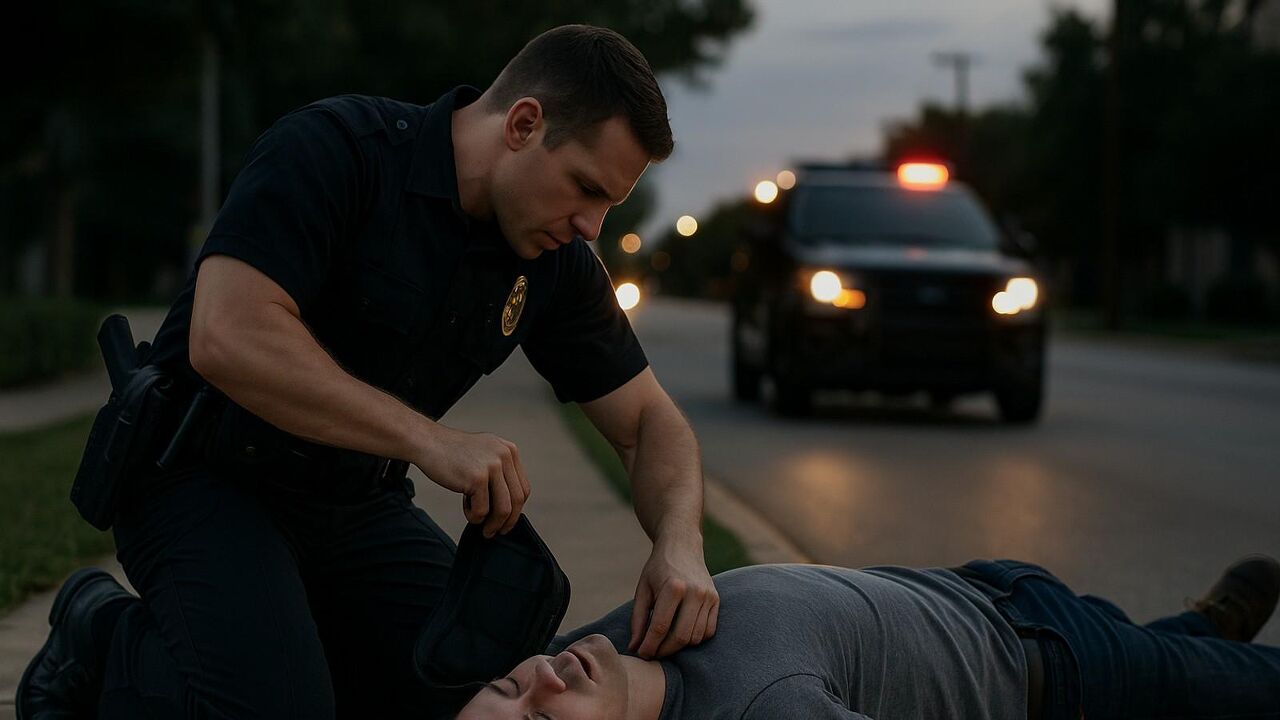
Here is the gap this piece is about. The institutional assumption is that medical is EMS's job and the officer's job is to secure the scene and wait. The reality on a lot of calls is that you are alone with a dying person for six, eight, twelve minutes, and the thing in your pocket is the only intervention that exists in that window. The difference between a good outcome and a bad one is often decided before the first paramedic sets a foot on the pavement.
One disclaimer up front, because it matters. Nothing here is medical instruction, and nothing here overrides your agency's medical protocol or your state's scope-of-practice law. What you are legally allowed to carry and administer varies by jurisdiction, and in some places, it depends on whether your agency has a standing order signed by a medical director. I will flag the policy questions. I will not tell you to administer anything your protocol does not authorize. Check with your training division and your agency's medical director before you add a single item to your person.
Why the Officer Is the First Medical Asset, Not the Scene Guard
Response times tell the story. In many suburban and rural jurisdictions, median EMS response runs eight to eleven minutes from dispatch to patient contact. In rural counties, it can stretch past fourteen. Officers, by contrast, are often already in the area, and on many calls they beat the ambulance by several minutes because they self-dispatch or find the problem first. That gap is not dead time. It is the window where a reversible death happens, or doesn't.
Consider the specific numbers that make this real. For opioid overdose, brain injury from oxygen starvation begins within about four to six minutes. For a severe hypoglycemic event, a diabetic can go from confused to seizing to unconscious inside that same window. For an airway obstruction, you have a few minutes, full stop. None of those clocks care about your ETA. They run from the moment of collapse, and your arrival time is the only variable you can affect.
The failure mode here is structural, not motivational. Agencies train officers to think of themselves as scene security because that role fits the liability model: EMS is licensed and protocol-bound, and keeping officers out of it limits the agency's exposure. That is a reasonable instinct for the lawyer in the room. It is a bad fit for the person bleeding out on the floor while a trained, equipped, present human being stands by waiting for someone else. The fix is not heroics. It is giving officers a small, defensible, protocol-backed set of interventions and the authority to use them.
The career-long consequence is what makes this worth the trouble now. An officer who carries and uses this gear across a twenty-year career will be first on scene for dozens of these calls. The downstream effect of being equipped on those calls compounds into lives saved that no single dramatic save captures. That is the case for building capability early, before you need it, rather than reacting after the call when you have nothing.
Naloxone (Narcan): The Highest-Yield Item on Your Belt
If you carry one medical item beyond a tourniquet, make it naloxone. Overdose calls are frequent, the intervention is simple, the failure modes are forgiving, and the upside is a person who was not breathing starting to breathe again in front of you. Nothing else in the small-kit category has that simplicity-to-payoff ratio.
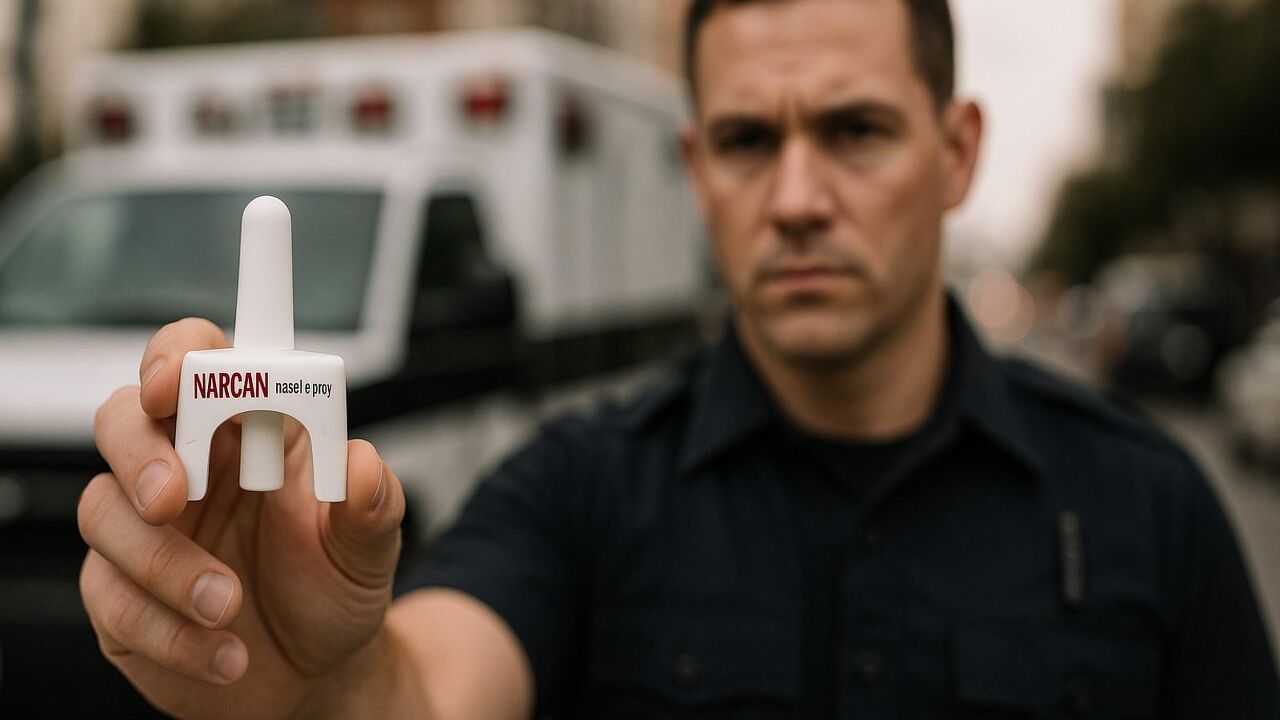
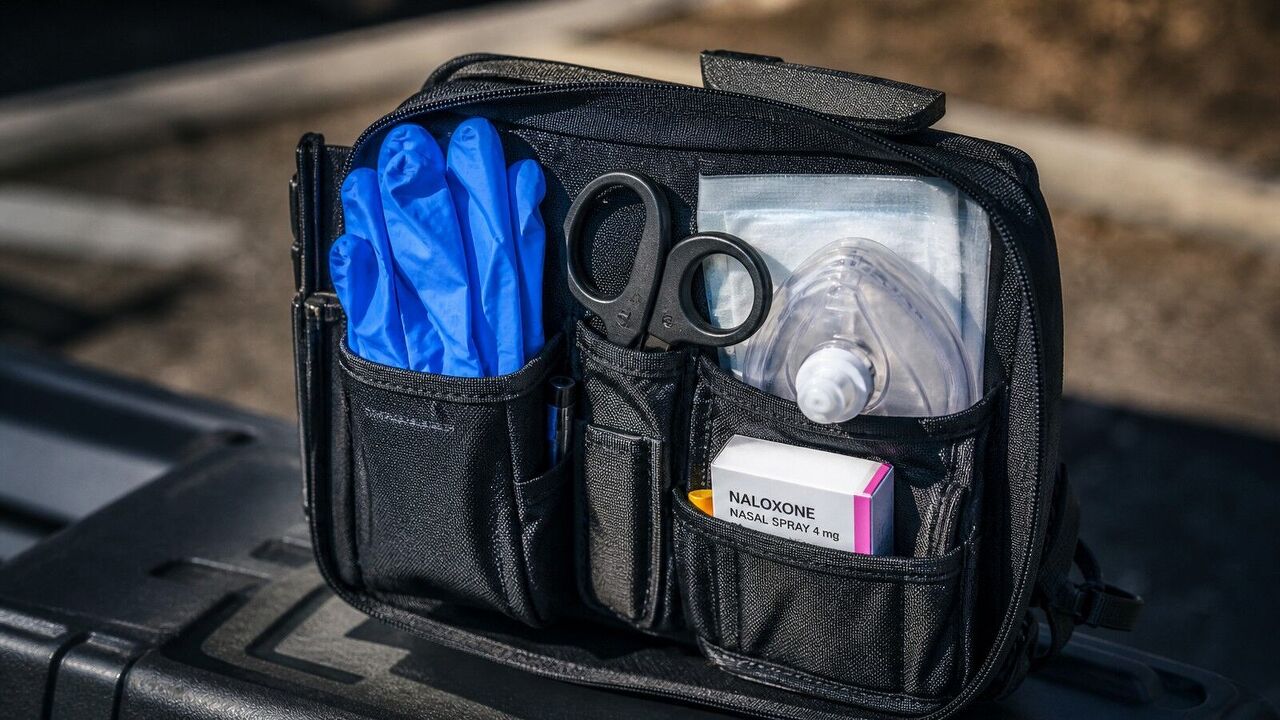
What it does. Naloxone is an opioid antagonist. It knocks opioids off the receptors in the brain and reverses the respiratory depression that is what actually kills people in an overdose. The nasal formulation, sold as Narcan among others, comes in a single-use sprayer. You put the tip in a nostril and press the plunger. There is no needle, no dosing math, no reconstitution. The common dose is 4 mg per sprayer.
The manufacturer describes the nasal product as a "ready-to-use, needle-free delivery system requiring no assembly." Short version: you take it out of the box and spray it, and that is the entire operation. That simplicity is the whole point for a patrol application, because the officer may be using it for the first time in their life, in the dark, with a crowd forming.
Where it fails. Two things. First, it wears off. Naloxone's effect lasts roughly 30 to 90 minutes, and many opioids outlast it, which means a person can be revived and then slide back into respiratory depression after you have moved on. That is why naloxone is a bridge to EMS transport, not a treatment that ends the call. Second, with the potent synthetics now common on the street, a single 4 mg dose is sometimes not enough. Carrying two is not overkill; it is planning for the actual drug supply. The operational consequence of carrying only one is that you can run out mid-reversal on the exact call where it matters most.
Who it fits. Every patrol officer in a jurisdiction with any meaningful overdose volume, which at this point is most of them. Most states carry naloxone under broad Good Samaritan and standing-order provisions that specifically cover law enforcement, and many agencies already issue it. If yours does not, that is a policy conversation worth starting, because the barrier is almost never cost (public-health programs frequently supply it free) and almost always inertia.
Glucose: The Call Everyone Mistakes for Something Else
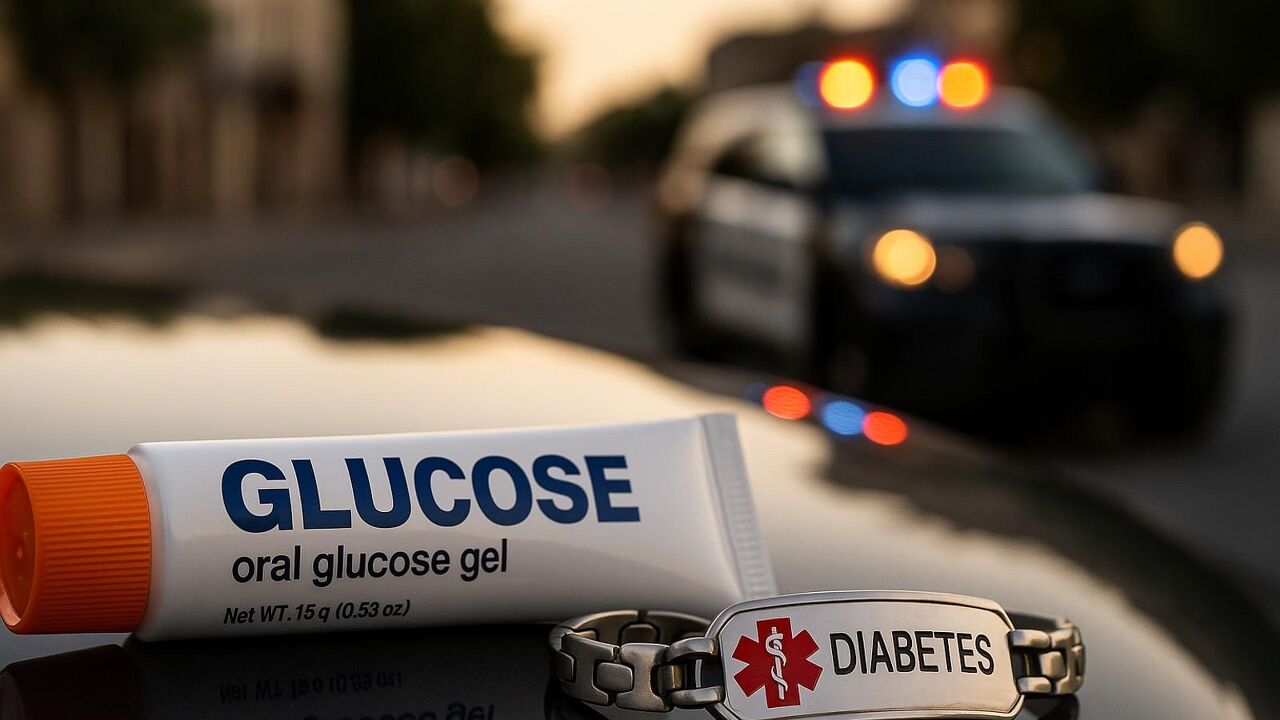
A diabetic in severe hypoglycemia looks drunk, looks high, looks combative, looks like a dozen things that are not a medical emergency. That misread is the whole problem. An officer who treats a low-blood-sugar patient as a resisting subject is fighting a dying person, and the person they are fighting cannot explain what is wrong because they have lost the capacity to. Oral glucose is a cheap, simple intervention that can turn that call around.
What it does. Oral glucose gel is fast-acting sugar in a tube, usually 15 grams per tube. For a conscious patient who can swallow and protect their airway, squeeze it between the cheek and gum; the sugar absorbs through the oral tissue and into the gut. A confused, sweating patient can come back to coherence within several minutes. Insta-Glucose and the generic store-brand gels are functionally identical, so buy based on price and expiration date.
Where it fails. The limitation is that glucose only addresses the low-sugar emergency. It does nothing for a stroke or a seizure from another cause, which is why confirming the patient is actually diabetic (medical alert jewelry, bystander report, an insulin pump) matters before you reach for it.
Who it fits. Any officer who works a beat with a residential population, which is all of them. Glucose gel is cheap, shelf-stable for a year or more, and takes up almost no space. The policy question is lighter than naloxone because oral glucose on a conscious patient is low-risk and widely authorized, but confirm your protocol still covers it rather than assuming. The operational consequence of not carrying it is that you have no tool for one of the most common and most misread medical calls you will run.
Basic Airway: The One That Needs Training, Not Just Equipment
Airway is where the small-kit conversation gets serious, and where carrying equipment without training is worse than carrying nothing. An unconscious patient's biggest immediate threat is their own tongue falling back and closing the airway. Simple tools can manage that. They also require you to actually know how to use them.
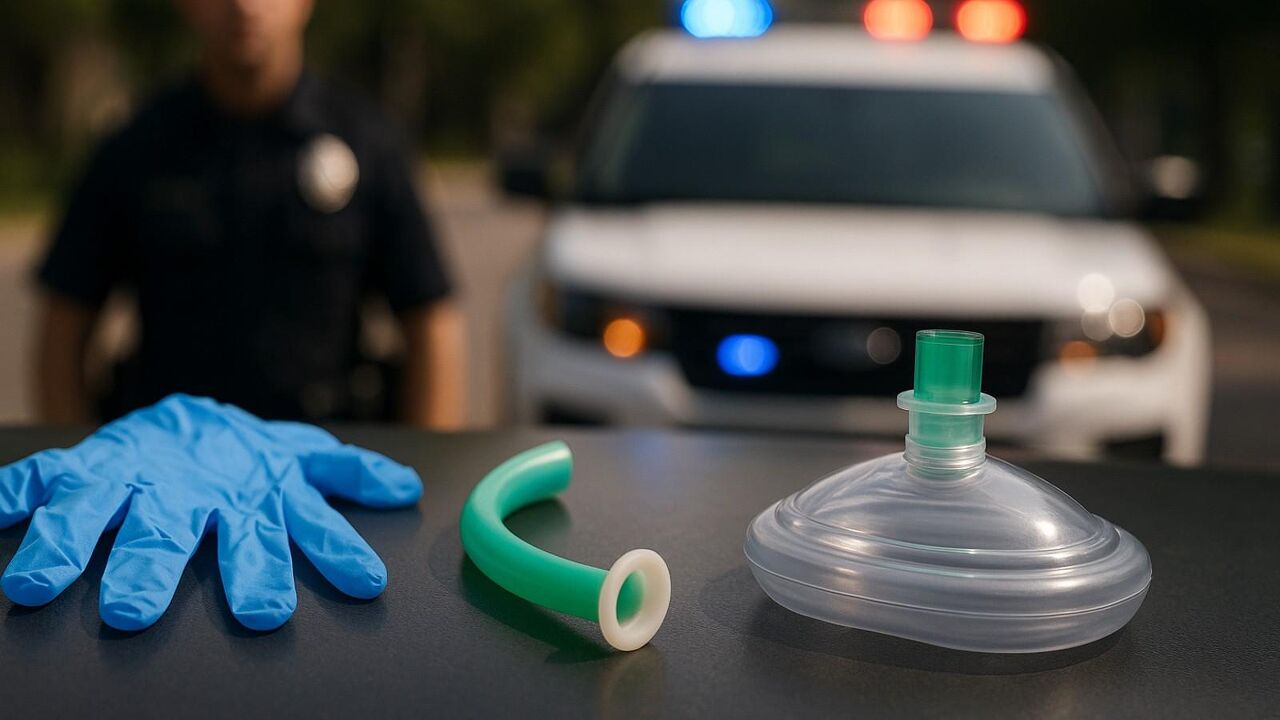
What it does. The two realistic items for a patrol officer are the nasopharyngeal airway (NPA) and a barrier CPR mask. The NPA is a soft rubber tube you lubricate and insert through the nostril to hold the airway open on an unconscious patient who still has a gag reflex. The CPR pocket mask is a one-way-valve barrier that lets you deliver rescue breaths without mouth-to-mouth contact, which matters for infection control and because you will do it more willingly if you are not putting your face on a stranger. A manufacturer will describe the NPA as providing "a patent airway in semi-conscious and unconscious patients." Short version: it keeps the tongue from blocking the pipe so air can still get through.
Where it fails. The NPA is the one item in this whole piece I would not touch without hands-on training, because sizing and insertion matter and the contraindications are real. Sizing matters: too long and you stimulate a gag or hit the esophagus; too short, and it does nothing (you can train regularly with them and learn how to adjust them). The CPR mask is far more forgiving, but even there, rescue breathing without chest compressions in a cardiac arrest is backward, and the training has to put the two together. The failure mode is an officer who bought a kit off the internet, never trained on it, and then either does nothing with it or does the wrong thing fast.
Who it fits. Officers whose agencies will fund the training that comes with the gear. A barrier CPR mask I would put on nearly everyone, because CPR is within almost every officer's scope and the mask just makes you more likely to do it. I would reserve the NPA for officers in agencies with a real medical first-responder program, a medical director's sign-off, and recurring hands-on refreshers. Buying the tool without the system around it is the cosplay version of medical readiness, and it will not hold up under the stress of a live arrest.
The Stuff Everyone Forgets Until They Need It
The high-profile items get the attention. The small supporting gear is what determines whether the high-profile items actually work when you reach for them, and it is exactly the stuff that quietly disappears from a kit over a year of shifts because nobody checks it.
Nitrile gloves come first, and not as an afterthought. The medical-specific point is redundancy and access: keep at least two pairs on your person, not just in the car, because the one time you need them is the one time you cannot walk back to the trunk. Everything else in this piece involves another person's blood, vomit, or needles, and gloves are the thing that keeps their bad day from becoming your hepatitis panel.
Trauma shears earn their keep by being the tool you use on nearly every medical call and almost never think about. You cannot treat what you cannot see, and clothing hides the wound. A pair of cheap shears clipped where you can reach them one-handed is worth more on the average medical call than expensive items, because you use them first and every time. They also do a great job cutting flex cuffs and seatbelts.
Then there is the maintenance problem, which is really the whole ballgame for small medical gear. Naloxone typically has a shelf life of 18 to 24 months, and it degrades faster in a hot car, where interior temperatures can hit 130 degrees Fahrenheit or more in summer. Glucose gel expires. The CPR mask valve can crack. A kit that was complete the day it was issued isn't the kit you have eighteen months later, and nobody notices until the call when the sprayer is two years past date, and the gloves have dry-rotted. The failure mode is silent expiration; the fix is a scheduled check, not hope. Treat the medical pouch like you treat your magazines: rotate it, verify it, don't assume it.
A word on where to carry all of it, because placement is a system decision and not a preference. Scattering these items across random pockets means that under stress you search instead of act. A dedicated belt or vest pouch, set up the same way across a shift or a whole agency, turns four separate "where did I put it" problems into one known location. That standardization is the same force-multiplier argument this column makes about every piece of kit: consistent placement reduces the cognitive load on the worst day, and the worst day is the only day any of this matters.
The Fire/EMS Parallel
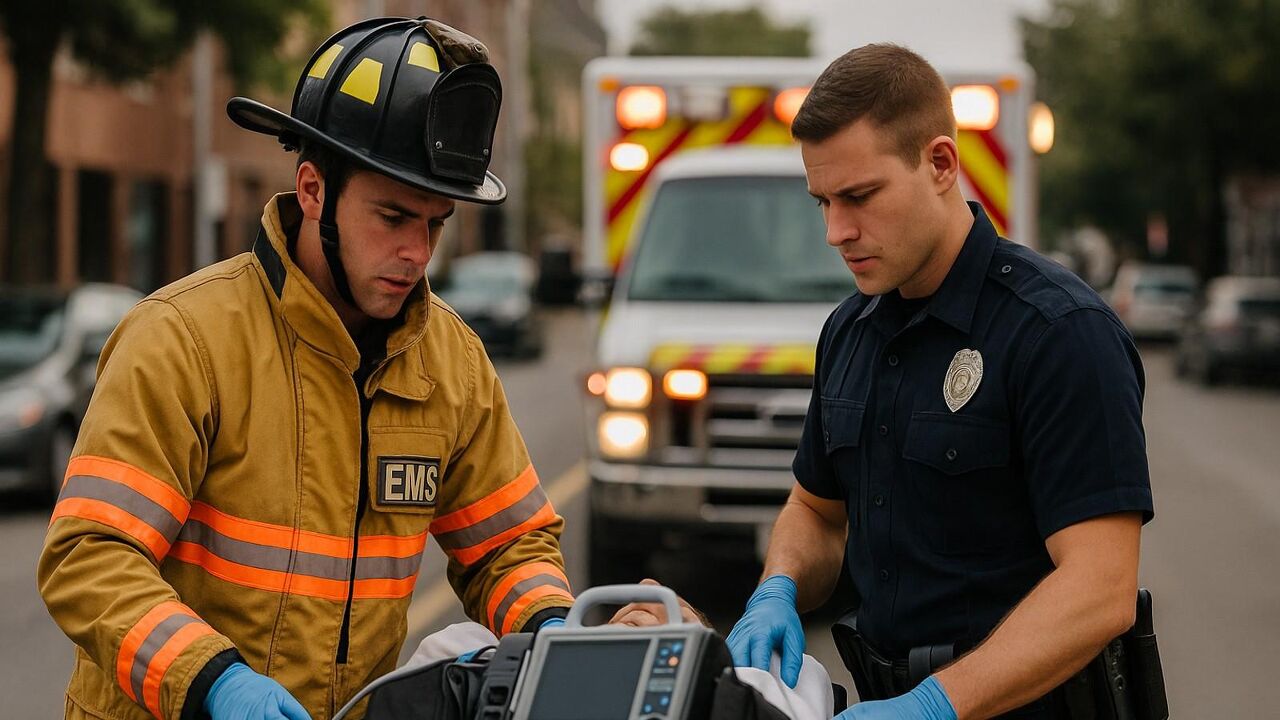
Fire and EMS solved the credentialing side of this a long time ago, and law enforcement can borrow the structure. On the fire side, even a basic firefighter carries Emergency Medical Responder or EMT certification, and the medical gear they carry is tied directly to a defined scope and a medical director's standing orders. Nothing is freelance. The medic knows exactly what they can do, what equipment supports it, and who signs off on the protocol.
The lesson for law enforcement is not to turn every cop into a paramedic. It is to copy the system that makes fire's medical response defensible: a defined scope, matching equipment, a medical director who owns the protocol, and recurring training that keeps the skill alive. When an agency issues naloxone without training, a medical director, or a refresh schedule, it has copied the gear without copying the system that makes the gear work. That is the part worth stealing.
Bottom Line / What to Do Monday
- Individual officer, this week: Confirm what your protocol authorizes you to carry and administer, then check the expiration dates and condition of anything medical already on your person or in your car. If you're issued naloxone and don't have it on your body, move it from the trunk to your belt.
- Individual officer, this week: Carry two pairs of nitrile gloves and a pair of trauma shears where you can reach them one-handed. These are the items you use first on nearly every medical call, and they are the ones most likely to be missing.
- FTOs and supervisors: Put medical pouch checks on the same rotation as magazine and equipment checks. Silent expiration is the failure mode, and a verified rotation is the only fix. Spot-check that officers can locate each item without looking.
- FTOs and supervisors: Don't let anyone carry a nasopharyngeal airway without hands-on training and current refreshers. Equipment without training is worse than nothing on an airway call.
- Agencies and procurement: If you issue medical gear, issue the system with it: a medical director's standing order, a defined scope, and a recurring training schedule. Budget for replacement cycles tied to shelf life, because a kit is only complete the day it ships.
- Fire/EMS note: You already run the credential-and-protocol model. When you share scenes with law enforcement, push for joint familiarization so the officer who arrives first knows what a proper handoff looks like and can take the right first steps.
That's Front Line Friday for this week: the officer is often the first medical asset on scene, and a small, protocol-backed kit of naloxone, glucose, a barrier airway, and the gloves and shears that make them usable is the highest-yield gear most patrol officers don't carry on their bodies. Check your expiration dates before Monday.