For generations, the classic starter deer rifle in North America was an army surplus gun—an old SKS or Mosin-Nagant or Mauser in the U.S., an old Lee-Enfield in Canada. But a long time ago, when money was scarce and people used what they could find, an even more antiquated rifle was commonly used—the Springfield trapdoor .45-70. And in an upcoming Poulin Auction, you’ll have the chance to buy a surplus Springfield with a particularly interesting history, including ties to Custer’s Last Stand.
Fudd Friday: Buy A Classic Surplus Rifle With A Twist
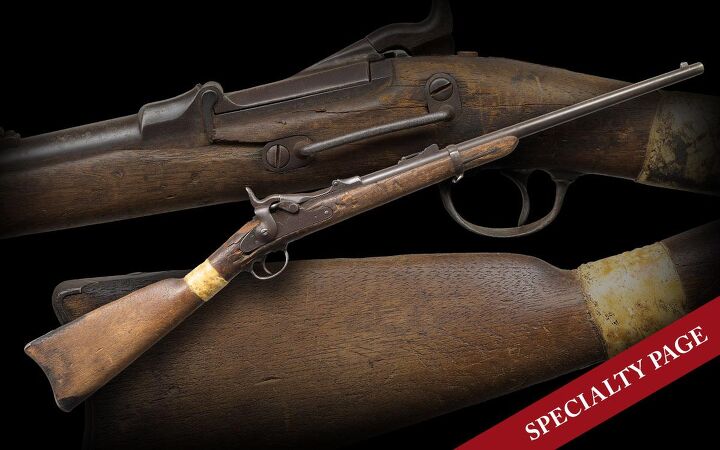
Poulin has this unique sporter rifle for sale at an upcoming auction
Mil-Surp @ TFB:
Springfield rifles tamed the West and filled the pot
Despite the marketing success of the Winchester ‘73, the Springfield trapdoor rifle was more likely the rifle that really tamed the Wild West. The U.S. government equipped its cavalry and other troops with these robust, hard-hitting rifles. A repeater like Winchester or the competition sold might have been more desirable, but the single-shot Springfield was still capable of a faster rate of fire than old muzzleloaders, and the cartridges were much more reliable and easy to deal with than a cap-and-ball carbine. The Springfield made peace with the warring factions in the West — natives and non-natives alike — and it kept the peace.
The U.S. military bought more than half a million of these rifles, back when that represented a significant chunk of the American population, and that’s why so many hunters used these rifles once the army was done with them. Guys like Lanny Benoit, a New England deer hunting legend, had stories about how these rifles were their first big game gun when they were kids.

That’s how the trap-door Springfield got its name, kids — the shells load in through that “trap door” on the receiver.
In case you wondered, that’s partly why factory .45-70 loads are so dialed-down; a modern rifle in this chambering is typically capable of far stouter loads than what Winchester sells over the counter. But Winchester and Federal and the rest of the industry are worried about shooters buying hot new rounds and putting them into stiff old rifles that blow up as a result. Except for companies like Buffalo Bore, as a general rule, you must roll your own ammunition if you really want to take advantage of the .45-70’s capabilities.
This rifle here
The rifle in these photos is not your typical cut-down sporterized Springfield. It was military surplus in that the original user was certainly done with it, but it wasn’t sold at an Army-Navy store. Instead, this rifle is for sale at an upcoming Poulin auction and is advertised as a battlefield pickup from Custer’s Last Stand.

The Sioux would have used this rifle for hunting and for fighting after its capture from the U.S. cavalry.
Over the years, the rifle’s backstory has been told in a collector’s book. Here’s part of Poulin’s description of this Springfield:
“This rifle is discussed in the book “Documenting the Weapons used at The Little Bighorn” by Wendell Grangaard. Grangaard sourced information states this rifle was picked up by “Kicking Bear” from Private Edward Kennedy of Company C, 5th Cavalry. The carbine was placed into Sioux cache & Kicking Bear marked the rifle with burn damage as seen around buttplate & predominantly on left side. Another possible marking is the “star” marking on left side buttstock.”
The photos show an obvious repair to the stock, held together by rawhide, which appears to have been done during its time in the possession of the Sioux tribe. The rifle was at one point owned by collector Dr. Kenneth O. Leonard, who’d bought it from Tribal Judge Frank Zahn, who was associated with the Standing Rock Reservation—Leonard ran a medical clinic in Garrison, North Dakota, and collected native American weapons and other artifacts during that time.
Chances are that it was Zahn who realized its true importance in history (Zahn served in the U.S. military during World War I and acted in films as well as working as a go-between for the U.S. federal government and the reserves). In the generations since the Battle of the Little Bighorn, where U.S. cavalry general George Armstrong Custer led hundreds of troops to their death, the conflict has been widely studied, which would explain the rifle’s association with a specific warrior and soldier from opposite sides of the skirmish.

Is that scorch mark an identifying tag from the 1800s?
The auction house doesn’t list any details about the rifle’s history before Zahn got his hands on it. Based on its condition, it seems likely this would have been used by the natives for fighting but also for wilderness survival for years before it was taken into a private collection. It doesn’t have butchered scope bases or the other typical signs of milsurp sporter rifles. It still has its 22-inch barrel, with a pinned blade front sight and a tangent ladder rear sight that graduates out to 1200 yards. This Springfield got the job done in the 1870s and for who knows how many decades afterwards. It’s historic enough that its hunting days are over now, though, especially after it fetches a pretty price at the November auction—see more details on that here.
All photos: Poulin Auctions
Related Topics: