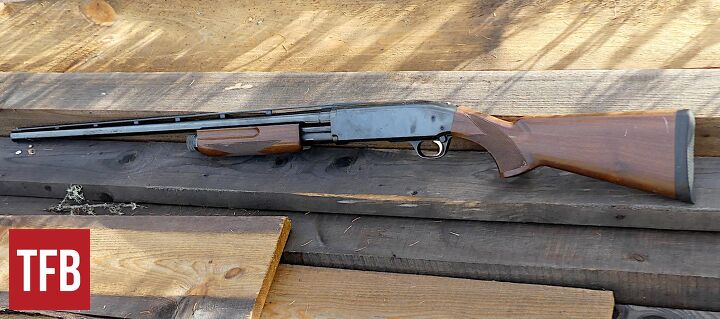
We live in a weird time, where some of the finest hunting firearms ever made have been deemed irrelevant. Old rifles that craftsmen made by hand, with careful fitting of all the internals, are now considered inferior to a low-cost, budget-priced bolt-action with plastic stock and insta-rust finish—and to a certain point, that makes sense. Modern rifles typically shoot better with cheap ammo and a cheap scope than your granddad’s old Remington Model 81 with its semi-buckhorn sights. In the rifle world, accuracy talks; everything else walks.
But what about the world of shotgunning, where long-range accuracy isn’t an issue? Here, old shotguns are also considered irrelevant, but I think a lot of shooters are ignoring shotguns that aren’t outdated at all, not from a practical standpoint. Instead of turning Granddad’s old Model 12 into the pawn shop for beer money, take another look at it—it’s still very usable.
Classic scatterguns @ TFB:
The “short shell” question
The market is filled with shotguns that were made for hunting, but are no longer used for that purpose, for two reasons. The first is that they only fire “short shells” (as my neighbors like to put it).
When my neighbors talk about “short shells,” they mean standard, non-magnum loads; older shotguns are often only chambered for 2.75-inch 12-gauge or 20-gauge cartridges. This wasn’t as big a deal back before the days of steel shot and hyper-commercialized turkey hunting. But when non-toxic loads became mandatory for waterfowl hunting and long-range mega-performance became the standard for turkey busting, those old 2.75-inch cartridges started to look tired. Hunters thought they needed all the pellets and velocity they could stuff into a shotshell, and the 2.75-inch cartridges obviously had less volume than a 3-inch shell. And some high-performance turkey loads don’t even come in a 2.75-inch option.
The reality is that the limitations of 2.75-inch loads are not as great as hunters imagine. In the waterfowl world, if you’re shooting over decoys, the “short shells” will get the job done easily. In turkey hunting, you can still find high-performance rounds like Apex TSS in 2.75-inch. You can bust birds just fine with 2.75-inch loads, and I have personally done so for many years.
Obviously, when you move to 3.5-inch shells, there’s a much greater performance gap—but if you’re that concerned about performance, then I would contend you should consider a 10 gauge anyway, which is a whole different conversation.
I’m not convincing you to shoot 2.75-inch shells over 3-inch shells, but I am telling you that if your gun only handles 2.75-inch shells, there’s no need to scrap it. If you look at Winchester Xpert and Federal Speed-Shok ballistics, there’s barely any difference between their 3-inch and 2.75-inch loads; I doubt any casual hunter would ever notice a difference in performance.
The choke question
Another big reason that hunters have moved away from older shotguns is their fixed chokes, especially fixed full chokes. They want the versatility of switching between open chokes for up-close shots and tighter chokes for longer-range shots, and they also are worried that non-toxic loads will destroy a tight shotgun choke.
These are not imaginary problems. Switchable chokes are obviously preferable if you’re a serious shotgunner who puts in the time to pattern your gun at different ranges. And a too-tight shotgun choke can indeed split due to steel shot—my brother-in-law put a four-inch crack at the end of his Winchester Model 120 as he was blasting away at sea ducks on a bitterly cold January day.
However, if a hunter is not going to pattern their shotgun at various ranges, with different loads, then I’d contend any real advantage of the switchable choke is going to be lessened, if not negated entirely. Roughly speaking, it’s like buying a high-power optic and then never shooting your rifle past 100 yards.
And as for the steel-shot-splitting-a-full-choke question: Any time I’ve seen or heard of this happening, it was sea duck hunting in winter. You can judge for yourself as to potential causes based on these factors. From my entirely unscientific observations, my friends and I have shot many, many birds with steel shot through full chokes. We never had issues with smaller-pellet loads in our 12 gauges (#6 or even #4), and I fired many goose-busting #2 or BB loads through a full-choked H&R 10 gauge without any problems. From what I’ve heard from other hunters, I think their experiences shooting smaller steel-pellet loads in a full choke are the same as mine.
I would shy away from most steel shot in a full choke nevertheless, at least for a nicer shotgun, and especially in a double or in a 20 gauge. But it’s easy enough to find a gunsmith to ream open a choke, and if you want to pay more, they can install a thin-wall choke system from Briley or another manufacturer. Gunsmiths have been opening chokes for years; it ain’t rocket science.
Otherwise, also remember that you can find non-toxic loads for waterfowl that aren’t steel (they’re pricey, but they exist) and most other wingshooting doesn’t require non-toxic pellets … yet. Maybe you can’t shoot your old Remington Model 31 at mallards, but it’s still a perfectly good pheasant gun.
You can use it on snowshoe hares and ruffed grouse and Huns and whatever else is in your neck of the woods. Even if you do have a practical need for a modern shotgun in your duck blind, that doesn’t mean your older shotgun is useless.