Glock: How The Polymer Pistol Changed the Handgun Market Forever
By Ryan Hodges •
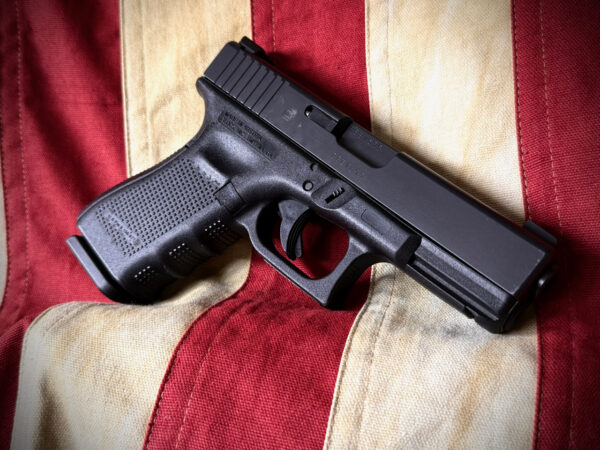
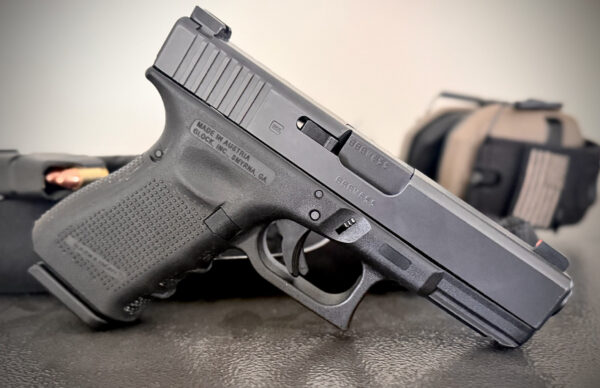
Glock helped change what shooters expected from a modern service pistol: lighter weight, higher capacity, fewer controls, and rugged reliability. IMG Ryan Hodges
In today’s firearms market, it’s almost impossible to imagine a time before Glock. When polymer-framed semi-automatic pistols were not the norm.
Modern shooters can choose from an enormous variety of calibers, modular grip frames, optics-ready slides, and specialized features tailored for military service, law enforcement, self-defense, and recreational use. But turn the clock back to the mid-1980s, and the handgun landscape looked entirely different.
From the early 19th century onward, the revolver was America’s dominant handgun. Beginning with black-powder six-shooters and continuing through Samuel Colt’s 1873 “Peacemaker,” revolvers earned a reputation for mechanical reliability, cost-effective manufacturing, and cultural significance. These traits kept revolvers relevant well into the 20th century, even as many European nations transitioned to semi-automatic pistols. Law enforcement agencies continued issuing revolvers through the 1980s—typically short-barreled Smith & Wesson models chambered in .38 Special or .357 Magnum. While these guns lacked the ammunition capacity of contemporary semi-automatics, their simplicity and reliability kept them in police holsters for decades.
Manufacturers still built most semi-automatic pistols around traditional hammer-fired designs. They often featured heavy steel frames, blued finishes, and wood grips. Gunmakers treated them as finely machined mechanical tools—often beautifully crafted, but rooted in long-established design conventions. Companies such as Colt, SIG Sauer, Beretta, and Smith & Wesson dominated the market. Yet shifting law enforcement needs, evolving military requirements, and the unconventional thinking of an Austrian engineer would soon disrupt the handgun world forever.
By the late 1970s, the Austrian Army realized it needed a replacement for its aging World War II-era Walther P38. The new pistol needed to exceed the P38’s performance while meeting strict criteria: higher ammunition capacity, a maximum weight of 28 ounces, a light and consistent trigger pull, and a total parts count of no more than forty. These requirements pushed far beyond the standards of most handguns of the time.
Enter Gaston Glock. At the time, Glock operated a small manufacturing business in Vienna. Using a secondhand Russian metal press, the company produced brass door and window fittings before securing military contracts for field knives and bayonets. During visits to the Austrian Defense Ministry, Glock overheard discussions about the military’s search for a new service pistol. He instantly recognized an opportunity. But what did a curtain rod manufacturer know about designing firearms? Nothing—and that was precisely where Glock found success.
Unlike traditional firearms manufacturers, Glock was not constrained by decades of design convention or industry assumptions.
Glock later explained, “That I knew nothing was my advantage.”
Glock approached the challenge with methodical intensity. He purchased and disassembled a variety of modern handguns—including the Beretta 92F, SIG Sauer P220, CZ 75, and Walther P38—to study their strengths and weaknesses. In May 1980, he invited several firearms experts to his vacation home in Velden, Austria, and asked a simple question: “What would you want in a pistol of the future?” Their insights helped shape a revolutionary handgun design.
Rather than relying on traditional manufacturing techniques, Glock focused entirely on meeting the Austrian military’s performance requirements.
Simplicity, durability, light weight, and reliability became the guiding principles behind the pistol.
Glock’s use of a polymer frame became one of the pistol’s most significant innovations. Having worked with high-strength polymer materials while producing handles and sheaths for his military knives, Glock recognized the material’s potential for firearms manufacturing. Polymer construction dramatically reduced weight and manufacturing cost compared to the steel-framed pistols dominating the market.
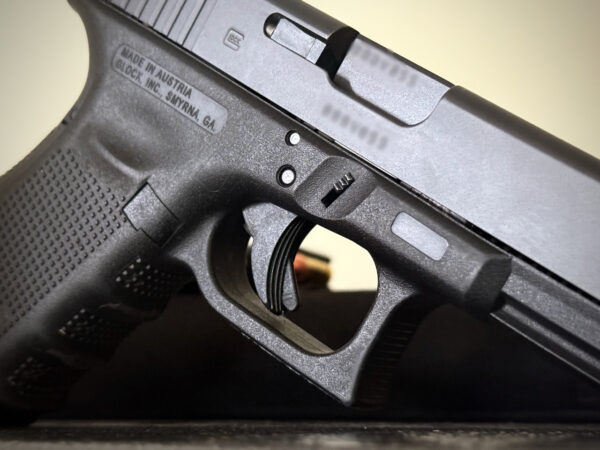
Glock also broke from convention with his “Safe Action” trigger system. Instead of an external hammer and manual safety, the pistol used a striker-fired mechanism and a trigger-mounted safety lever. This design reduced snagging during the draw and lowered the chance of accidental discharges caused by drops or improper handling.
“Safe Action” trigger system. IMG Ryan Hodges
Development moved remarkably fast. Within a year, Glock produced a working prototype. On April 30, 1981, he filed a patent application for the seventeenth iteration of his design, which Glock simply named the Glock 17.
The Austrian Trials
The Glock 17’s unconventional design immediately drew skepticism. A polymer-framed pistol with no manual safety, no external hammer, and a striker-fired system seemed radical—especially coming from a manufacturer with no firearms pedigree.
During the Austrian trials, Glock’s pistol competed against established giants including Heckler & Koch, SIG Sauer, Beretta, Fabrique Nationale, and Steyr. The tests were grueling. Testers subjected each handgun to heat, ice, sand, mud, and a 10,000-round endurance test. Officials also evaluated the pistols on weight, capacity, and parts count.
The Glock 17 excelled in the tests. It malfunctioned only once during the firing trial and weighed just 23 ounces, making it the lightest pistol in the competition. The polymer frame and rolled-steel slide held up to abuse far better than skeptics expected.
Although the Glock lacked traditional aesthetic appeal, its utilitarian design perfectly matched the Austrian military’s requirements. Impressed by its performance and low manufacturing cost, the Ministry of Defense ordered 20,000 Glock 17 pistols in 1983. What began as a military contract would soon reshape the global handgun market.
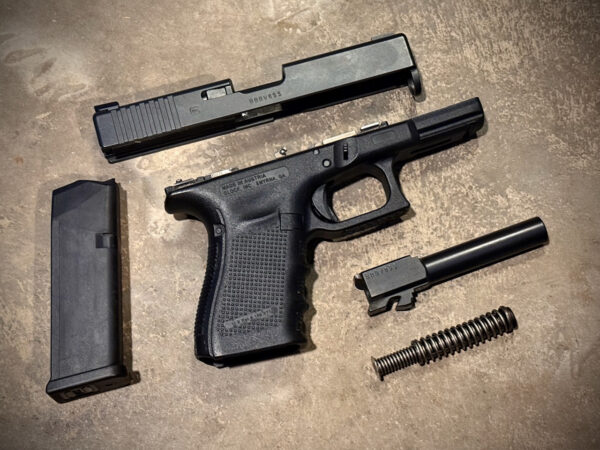
Glock 19 Gen 4 Field Stripped. IMG Ryan Hodges
Glock Comes to America
Winning the Austrian trials was only the beginning. To reach its full potential, Glock needed to break into the American market.
While on a business trip in 1984, Austrian-American firearms salesman Karl Walter first encountered the Glock 17 and became intrigued by its design. At the time, many U.S. police departments still relied on revolvers, and Walter quickly recognized the Glock as a modern solution to growing law enforcement challenges.
Walter and American gun writer Peter G. Kokalis soon arranged a meeting with Gaston Glock. The conversation proved fruitful, and their partnership led to the establishment of Glock’s U.S. operations in Smyrna, Georgia, in 1985.
However, Glock’s introduction to the American market proved rocky from the start. Media outlets fueled fears about the “plastic gun,” claiming it could evade X-ray machines and pose a significant threat to aviation security. Congressional concern soon followed. Ultimately, authorities debunked the claims—but the controversy generated massive publicity. Ironically, the negative attention benefited Glock enormously. Millions of Americans suddenly became familiar with the strange Austrian pistol made largely from polymer. Law enforcement agencies took notice, and civilian shooters did too.
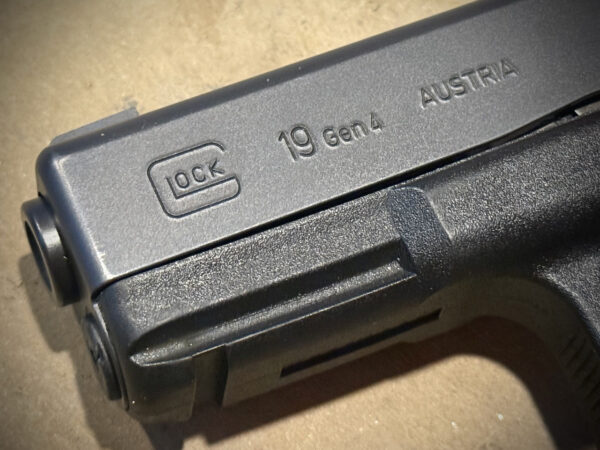
Glock 19 Gen 4. IMG Ryan Hodges
The Shift in Police Sidearms
The 1980s saw a sharp rise in violent crime in the United States. Drug trafficking, gang violence, and heavily armed criminals created increasingly dangerous encounters for police. Many departments realized their six-shot revolvers were becoming outmatched.
The turning point came with the infamous 1986 FBI Miami shootout, which left two agents dead and five wounded. Several agents armed with revolvers found themselves badly outgunned during the firefight. The incident accelerated the nationwide shift toward higher-capacity semi-automatic pistols.
The Glock 17 arrived at exactly the right moment. Lightweight, simple, durable, and offering 17+1 rounds, it provided a practical and affordable solution for agencies seeking modern sidearms. The Miami Police Department became one of the first major adopters, ordering 1,100 pistols. Soon, departments across the country followed.
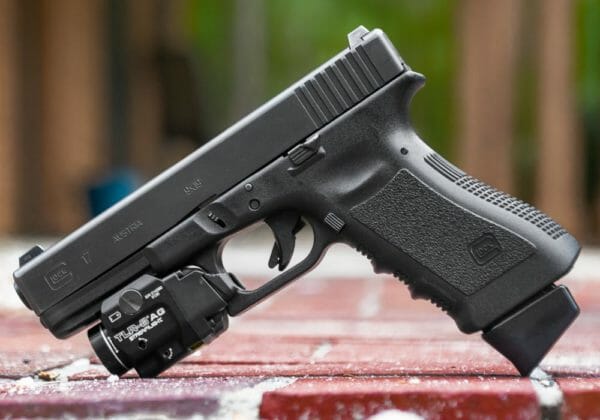
While not the newest gun by Glock, the Gen 3 G17 is still a formidable pistol. IMG Jim Grant
From Duty Holster to Household Name
As Glock pistols spread through American law enforcement, their reputation grew. Shooters appreciated their reliability, simplicity, and ease of maintenance. The pistol’s distinctive appearance and rising popularity also made it a fixture in American pop culture.
Glock reached full pop culture status in Die Hard 2: Die Harder when Bruce Willis’ character John McClane shouted at an airport security guard, “That punk pulled a Glock 7 on me! You know what that is? It’s a porcelain gun made in Germany. Doesn’t show up on your airport X-ray machines, here, and it costs more than you make in a month!”
Nearly every detail in the quote was wrong—but the Glock name had officially entered the American lexicon. Soon, Glocks appeared in action films, television dramas, and rap lyrics. The brand became synonymous with the modern semi-automatic pistol.
Meanwhile, civilian shooters embraced the platform as well. Competitive shooters, instructors, and concealed carriers valued its durability and modularity. A massive aftermarket industry emerged, offering custom sights, triggers, holsters, and slide modifications. By the late 1990s, Glock had become one of the dominant handgun platforms in America.
The Polymer Revolution
Glock’s success did more than create a popular handgun—it changed the direction of the entire firearms industry. Before Glock, shooters viewed polymer-framed pistols with skepticism, and most manufacturers treated striker-fired systems as unconventional. Glock proved that a lightweight, durable, high-capacity polymer pistol could not only compete with traditional steel designs, but often outperform them. Combined with Karl Walter’s aggressive marketing strategy and excellent timing, Glock quickly became one of the most recognizable names in the global firearms industry.
Competitors across the industry soon followed. Smith & Wesson, SIG Sauer, Springfield Armory, FN, Walther, and numerous others introduced their own polymer-framed striker-fired pistols, many heavily influenced by Glock’s design philosophy. To this day, Glock’s design remains one of the most influential handgun developments of the modern era. Modular polymer-framed, striker-fired pistols now dominate the handgun market, and Glock pistols remain among the most widely carried law enforcement sidearms in the world.
Glock didn’t invent every concept found in the Glock 17, but the company combined proven ideas into a simple, reliable, affordable package that redefined consumer expectations.
Sources Referenced:
Barrett, Paul M. Glock: The Rise of America’s Gun. New York: Crown Publishers, 2012.
Ryan is an outdoorsman and firearms enthusiast with over a decade of experience in the industry. He holds a B.A. in History with a concentration in Public History from Roanoke College and was an intern at the Cody Firearms Museum in Cody, Wyoming where he contributed to exhibit development and public education initiatives. He later worked with Taylor’s & Co. in Winchester, Virginia for 9 years, building expertise in historical and reproduction firearms.
An avid hunter and shooter based in Northern Virginia and the West Virginia panhandle, Ryan has a deep appreciation for the intersection of history, firearms, and the natural world. His primary area of focus is 19th-century American firearms, particularly those used during the Civil War and the era of westward expansion. Through his writing, he aims to educate and engage readers by connecting the historical significance of firearms with their enduring legacy in the field today.