I Never Took Defensive Flashlights Seriously. Until One Was Used Against Me.
I'll admit something that probably isn't great coming from a guy who works for a concealed carry company: for a long time, I didn't take flashlights very seriously as defensive tools.
Sure, I understood why you carried one. Darkness exists. You need to see things. A flashlight is useful.
But a defensive flashlight?
In my mind, the flashlight itself wasn't doing much to stop anybody. Growing up, my idea of a serious defensive flashlight was basically a giant Maglite. If things went really bad, I suppose you could hit somebody with it.
That was about the extent of the tactical advantage I gave it.
Then we filmed Defense After Dark, and I volunteered to play the bad guy.
That changed my mind almost immediately.
Then Riley Turned the Light On
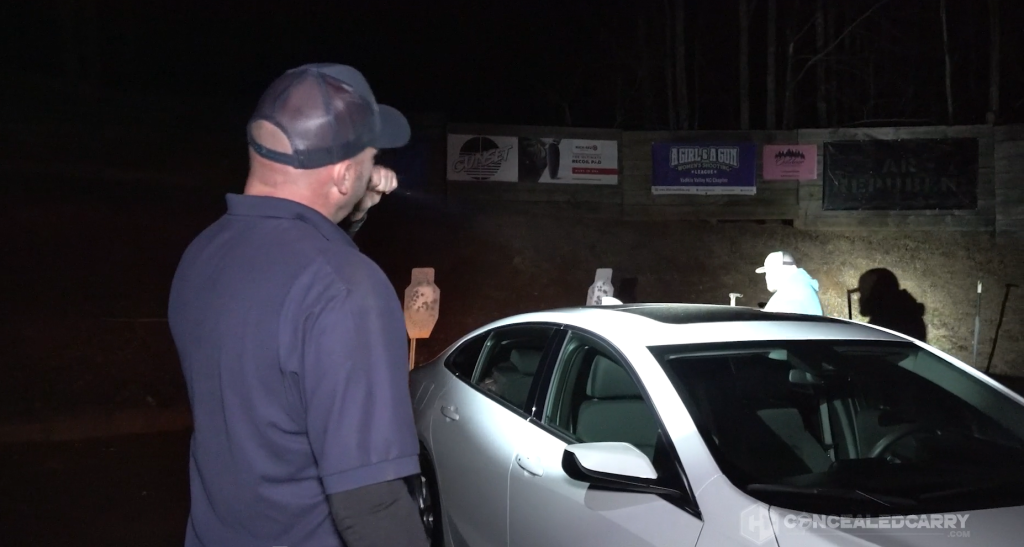
Being on the receiving end of a defensive flashlight changed the way I thought about carrying one. The beam made it extremely difficult to see the person holding the light or even clearly identify my surroundings.
During one of the scenarios, I was on the receiving end of a proper defensive flashlight.
I knew it was coming. This wasn't a surprise attack. I wasn't actually in danger. We were filming a training course, and I knew exactly what was happening.
It still sucked.
When Riley hit me directly with that concentrated beam, my world essentially disappeared behind a wall of light.
I couldn't see him.
I had trouble judging how far away he was.
I was on the opposite side of a vehicle from where Riley was, the vehicle was right in front of me, and I couldn’t even see it’s outline.
More importantly, I suddenly didn't have good information about my surroundings. I didn't know where I could move safely because I couldn't see enough to confidently make that decision. I couldn’t close the distance between myself and the light without running right into something else.
He could see me. I couldn't see him at all. I now know what it feels like to be a “deer in the headlights.”
That imbalance was what finally made everything click.
I'd always thought about a flashlight as something I use to see in the dark.
I hadn't really given much consideration to what a proper defensive flashlight could do to the other person's ability to see me or function while suddenly blind.
A Defensive Flashlight Isn't Just About Seeing
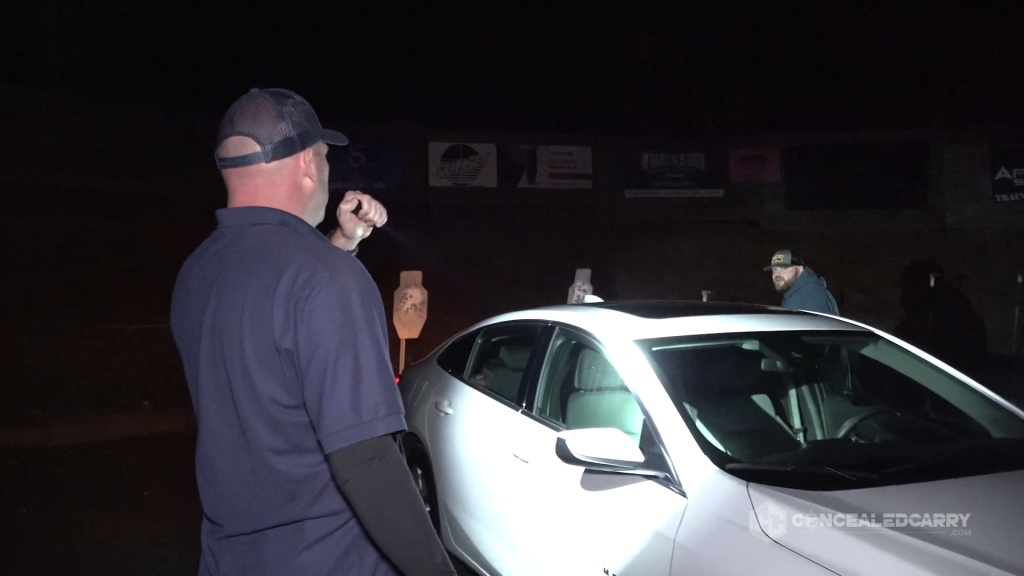
A defensive flashlight can do more than help you see in the dark. It can give you critical information when deciding how to respond to an uncertain situation.
That experience changed the way I think about carrying a light because a quality handheld defensive flashlight gives you something incredibly important in a defensive encounter: information.
I've walked plenty of major-city streets at night. I've had to pass people lurking in shadows who immediately gave me an uneasy feeling. I've encountered people who appeared to be in a drug-fueled psychosis, people having mental breakdowns, and people whose behavior simply made that little voice in the back of my head say, pay attention.
But an uneasy feeling isn't a green light to draw my firearm.
Someone acting strangely isn't necessarily a deadly threat. Someone walking toward me on a dark sidewalk doesn't automatically justify putting my hand on my gun. And I certainly can't point a weapon-mounted light at someone just because I want a better look at them. If I'm using that light to identify someone, I'm also pointing a firearm at a person I haven't even determined is a threat.
A defensive flashlight gives me another option.
Imagine I'm walking back to my hotel at night and someone is moving erratically between parked cars ahead of me. Maybe they're intoxicated. Maybe they're experiencing some kind of mental crisis. Maybe they're looking for something they dropped.
Or maybe they're watching me.
Now they start moving in my direction.
I want information.
Who is this person? What are they doing? What's in their hands? Are they actually approaching me? Is there somewhere else I can move? Is this becoming a threat, or is it just an uncomfortable encounter between two strangers on a dark street?
I don't need to wait in darkness for the answers to those questions.
I can illuminate the scene with a handheld light and get a much better idea of what I'm dealing with. And if that person continues approaching aggressively, a powerful beam directed toward their eyes can also make it considerably harder for them to see me clearly while I'm creating distance, changing direction, or deciding what needs to happen next.
That's the part I didn't fully appreciate before filming Defense After Dark.
The light isn't just helping me see them. It can affect how well they can see me.
As I learned firsthand playing the bad guy, that can be incredibly disorienting. Suddenly the person holding the flashlight has information that you don't. They can see what you're doing while you're struggling to see them and what's around you.
None of that means a flashlight magically stops an attacker. It doesn't turn suspicious behavior into justification for force, either.
What it does is give me another tool between “something doesn't feel right” and “I need my gun.”
It helps me identify. It helps me assess. It may help me create an opportunity to disengage. And if the situation really is becoming dangerous, it can help me make that determination with better information instead of guessing in the dark.
That realization probably changed my opinion of defensive flashlights more than anything else.
I Didn't Know What I Didn't Know About Flashlights
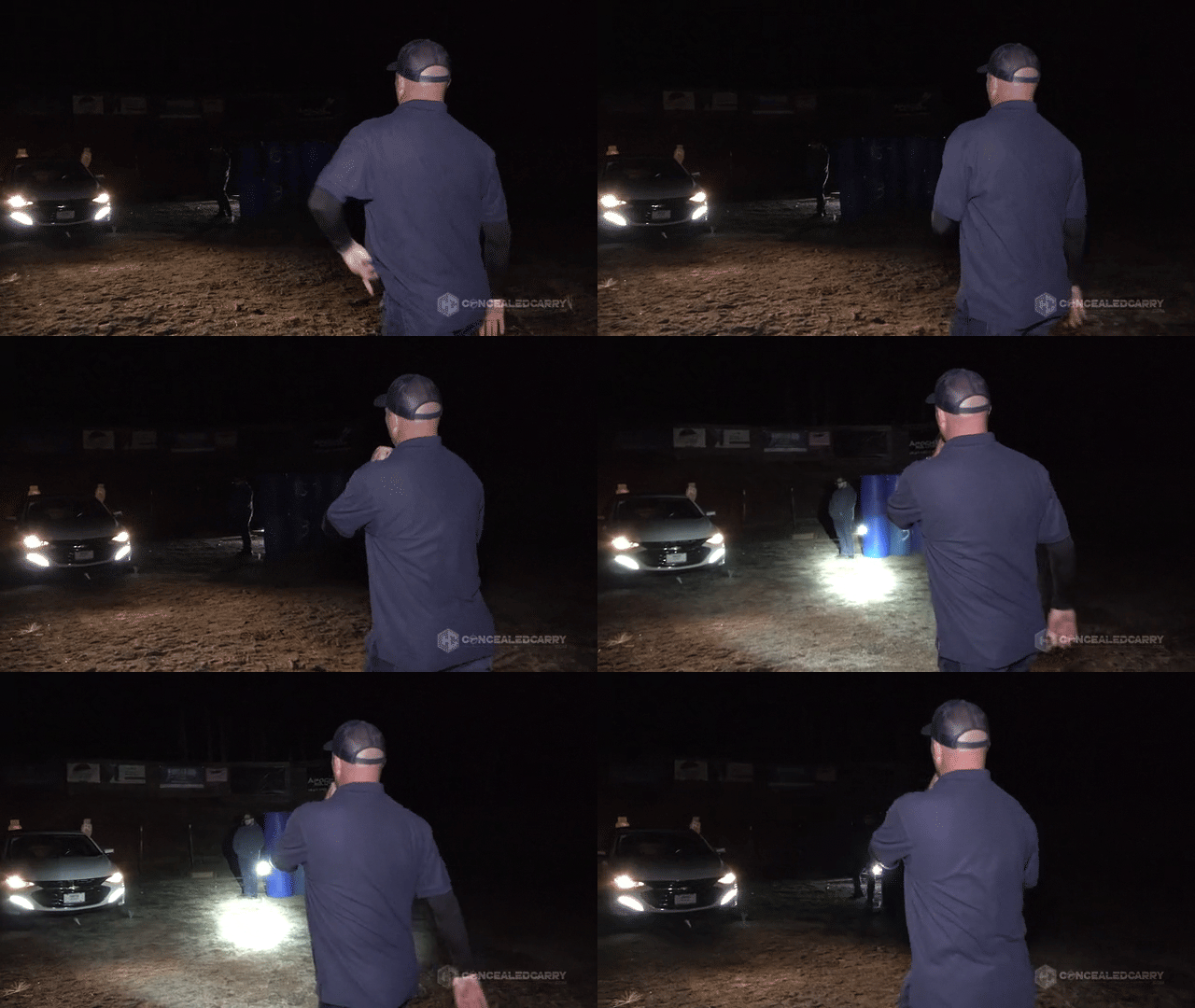
Here's another thing I realized while filming Defense After Dark: I really didn't know much about flashlights.
I had never put much thought into lumens, candela, beam patterns, or what actually separates a good everyday flashlight from a light intended to serve a defensive purpose.
If I saw a flashlight advertised as having 1,000 lumens, I figured that sounded pretty bright. Beyond that, I didn't give the numbers much consideration.
Then we started filming.
Suddenly I was watching different lights behave very differently in the same environments. I was hearing conversations about lumens and candela, how light interacts with the environment around you, and why some of the assumptions I'd casually made about flashlights didn't tell me nearly enough.
I'm not going to pretend I've suddenly become a flashlight expert. I haven't.
But that's actually one of the things I enjoyed about being involved with Defense After Dark. I went into the filming thinking a flashlight was a pretty simple tool and walked away realizing there was an entire side of defensive light that I'd never seriously considered.
And rather than trying to cram everything I learned into this article, that's exactly what the course is for.
If you're like I was and haven't given much thought to what actually makes one flashlight better suited for defensive use than another, Defense After Dark will probably challenge some of your assumptions too.
The Best Defensive Tool Might Be the One You Can Use Before the Gun
There's another reason I've become a believer in carrying a good defensive flashlight.
I can use it constantly.
Think about how often you actually use your concealed handgun.
Hopefully, never outside of training.
A flashlight is different.
You can use it walking across a dark parking lot.
You can use it looking underneath your car.
You can use it during a power outage.
You can use it when something goes bump outside the house.
You can use it to find something you dropped.
And you can use it to investigate something suspicious without immediately introducing a firearm into the situation.
That's an incredibly useful capability for something small enough to disappear into a pocket.
I've spent years thinking about guns, holsters and other equipment related to concealed carry. But I've come to believe the flashlight may be one of the most useful pieces of defensive equipment we carry precisely because it isn't a gun.
It gives us another option.
I Had to Experience It to Understand It
There are certain lessons in firearms training that make perfect sense when someone explains them.
Then there are lessons you don't fully understand until you experience them.
This was one of those for me.
Someone could have explained candela to me.
Someone could have told me that a powerful defensive flashlight can disrupt another person's vision.
Someone could have explained the tactical advantage of controlling who can see what in a dark environment.
I would have understood all of it intellectually.
But standing there playing the bad guy, staring into that beam and realizing I couldn't clearly see the person who could clearly see me?
That made it real.
My flashlight went from being a convenient piece of EDC gear to something I now consider part of my defensive equipment.
Not because I expect it to magically stop every attacker.
Not because carrying a flashlight replaces carrying a firearm.
And not because shining a bright light at somebody solves every problem.
It's valuable because it gives me something I desperately want in an uncertain situation:
More information, more options, and potentially more time before I'm forced to make a much bigger decision.
That's the real value of a defensive flashlight.
And it took having one used against me to finally understand it.