Is Car Carry a Mistake?
The idea of a car gun, especially a dedicated car holster, is very tempting. After all, carrying a defensive pistol with you means adding at least a pound of metal (and possibly plastic) on your waistband everyday, metal which weighs down on your belt and pokes and prods you in many different and uncomfortable ways.
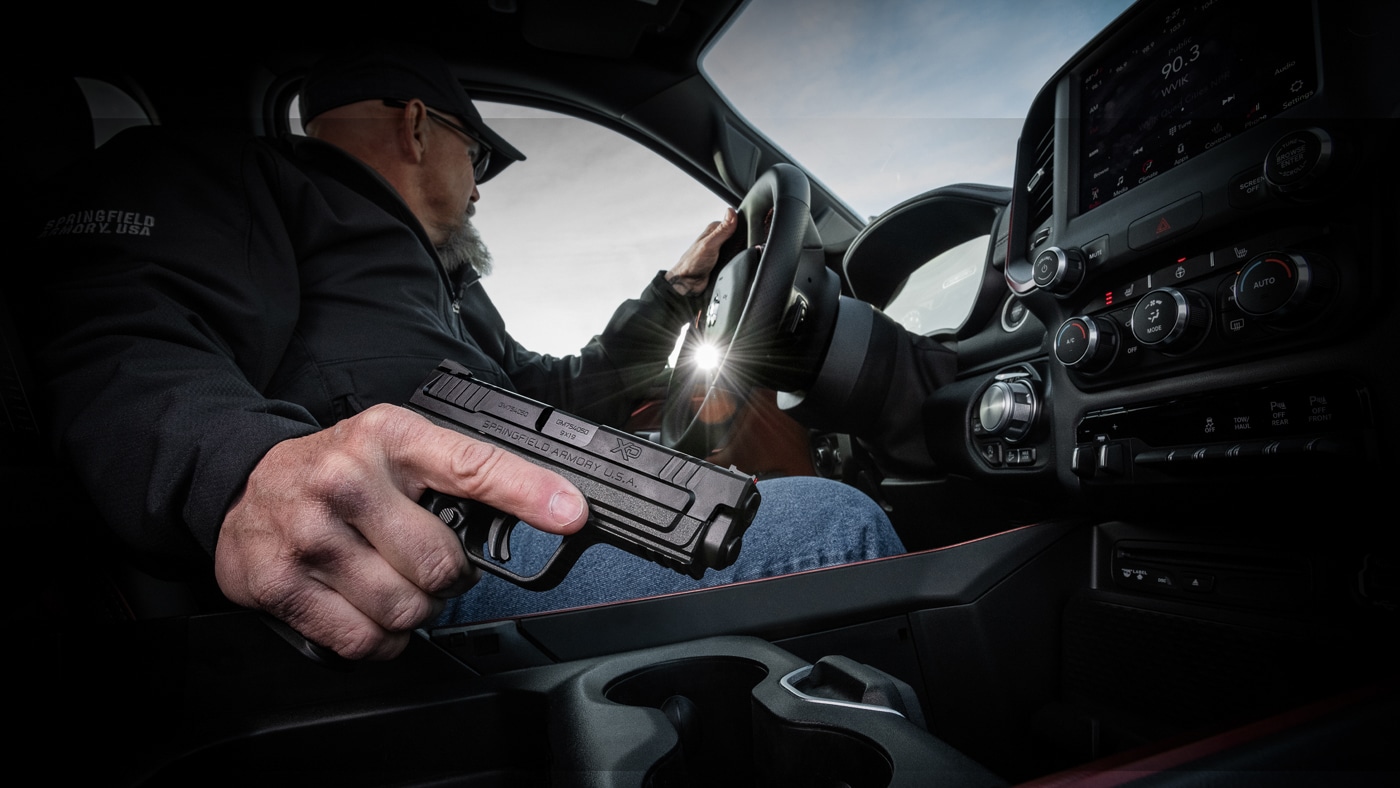
Car holsters come in two flavors: Secure, lockable containers which can be affixed to your vehicle and are a great way to store your firearm if you’re walking into someplace where legally concealed carry is not permitted. Then there is the other kind.
These are pieces of angled aluminum or plastic which are designed to be secured inside the passenger compartment of your vehicle and (in theory) provide you fast, easy access to your gun in the event of a lethal force encounter.
Remember those words “in theory,” because they’ll be important later on.
Right (or Wrong) Move?
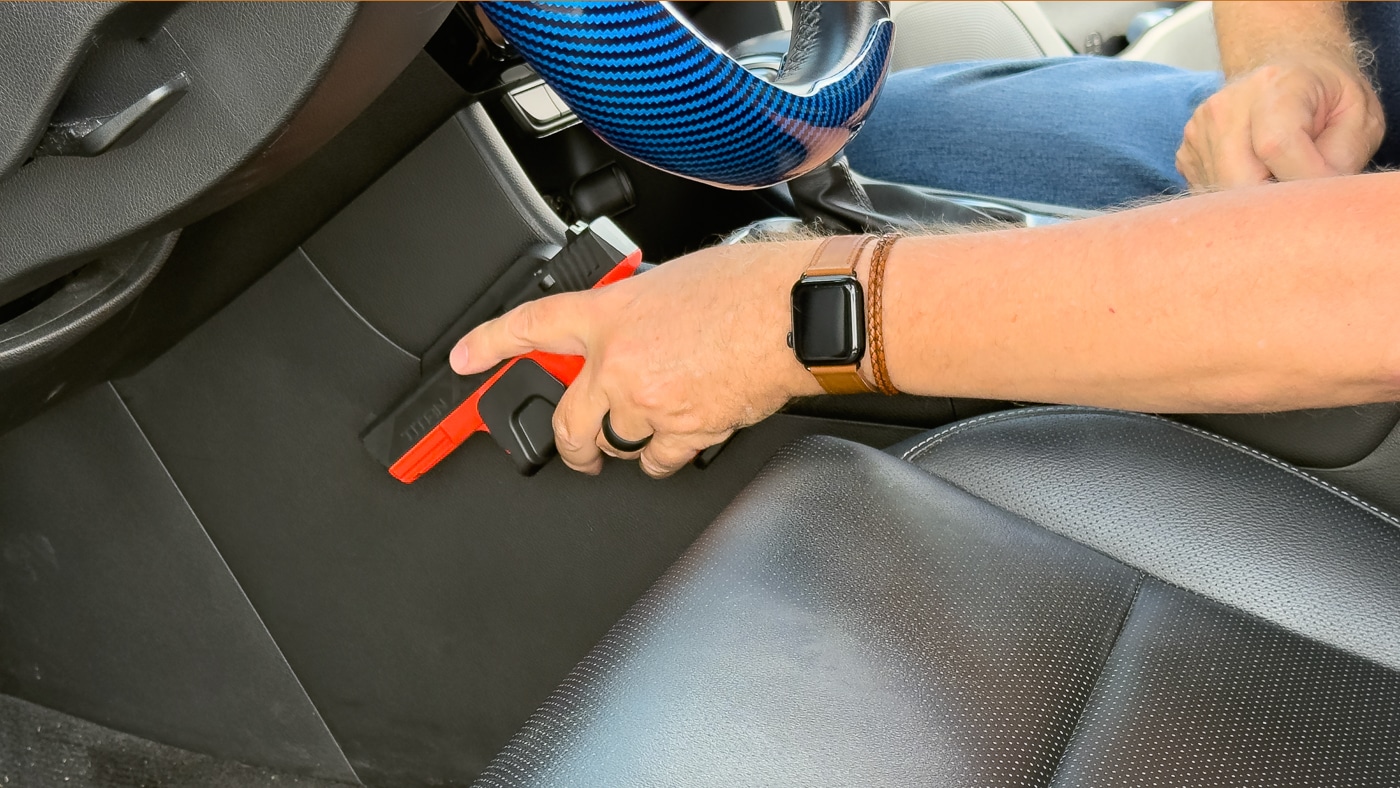
These “car holsters” are usually made of plastic or a lightweight metal of some kind and are meant to be affixed to the interior trim of your car. The holsters retain your firearm by either a strong magnet or mechanical retention (or both), which holds your pistol in place. To test whether or not this is actually true, I ordered a random car holster on Amazon and tried to install it in my car.
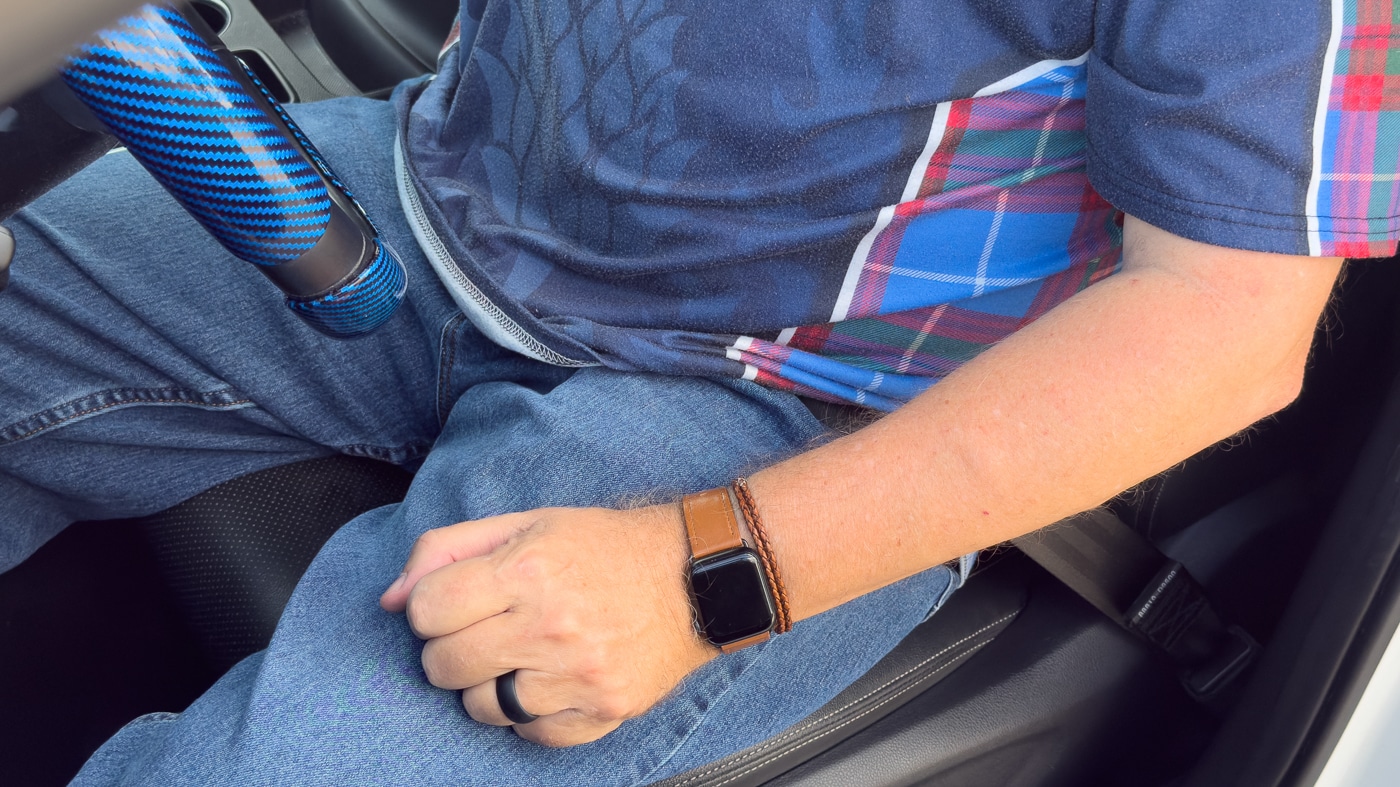
Things started to go wrong when I realized that my car (a small hot hatchback) did not have enough space in the driver’s footwell area for both of my legs and a gun. Plan B was to use my wife’s car for this test, which created a new wrinkle.
The car holster I purchased attached to the interior of my car with (believe it or not) four screws and four drywall anchors. Yes, that’s right, this holster attaches your defensive pistol to your car the exact same way you’d hang a picture on a wall. Not exactly a reassuring thought, but let’s press on.
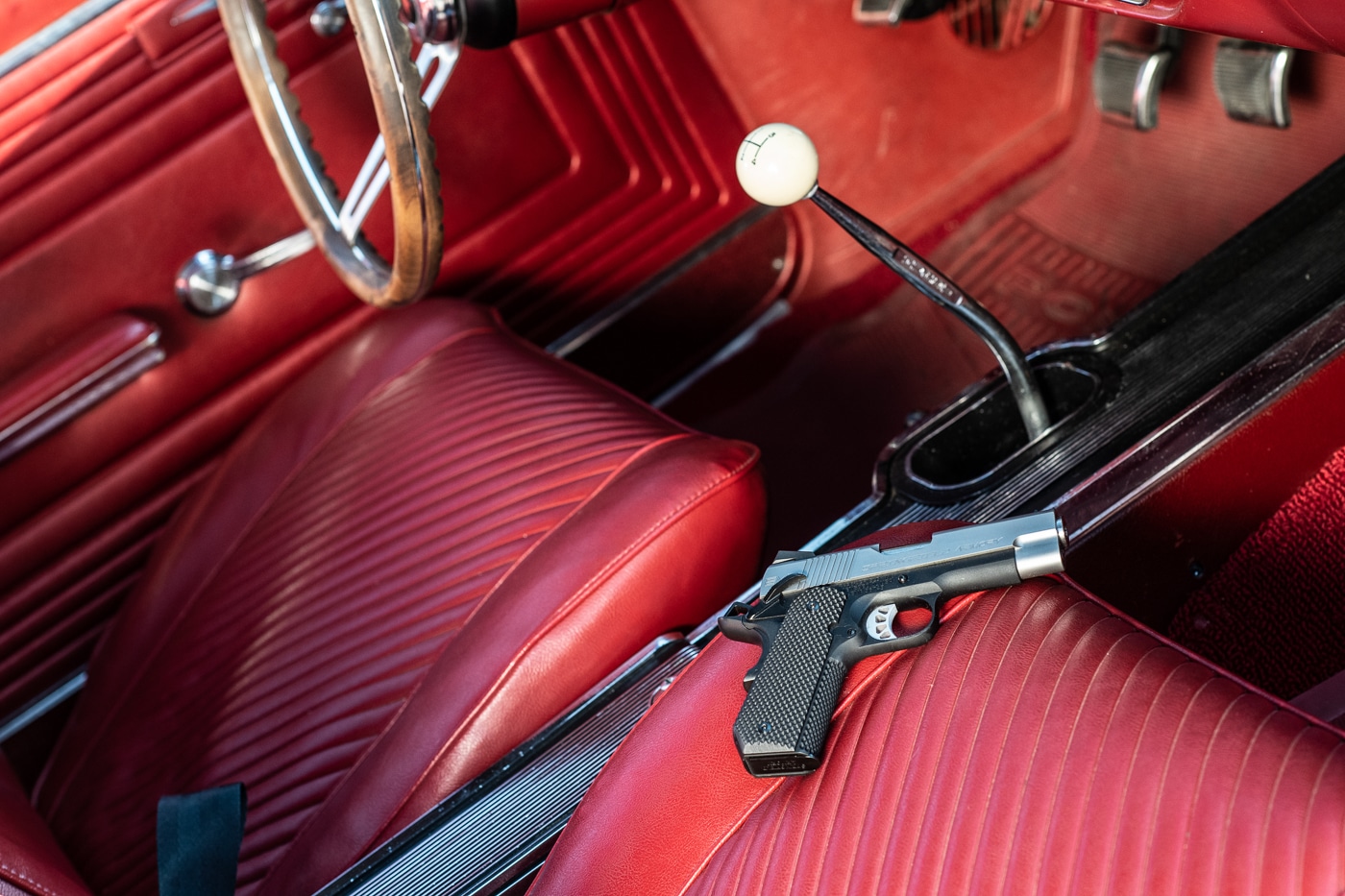
Rather than drill holes into my wife’s car, I attached the car holster to her SUV with a set of high-strength, removable adhesive strips. This also avoided another problem: Drilling a hole into an airbag. Knee airbags are increasingly common, and puncturing one of them in a quest to add a holster to your car is a very bad idea.
Speaking of bad ideas, I wanted to test how quickly I could draw and engage a target from a car holster versus other carry options, which meant tracking my draw time. As sending a round downrange through the windshield of my wife’s car is not an option here, I chose to track my times with a Mantis Titan X training pistol. This inert training gun uses a sophisticated electronic gyroscope to track your draw times, trigger press and other metrics. This will allow me to track my performance without worrying about having to replace a windshield and buy two dozen roses as an apology.
Range Time
With all the pieces in place, it was time to head to the range. I chose four different scenarios using four different carry positions to see how effective a car holster might be. The scenarios are an attacker from the passenger side, an attacker from the front of the car, an attacker from the driver’s side of the car and an attack while I was filling my car up with gas. The carry positions are using the car holster, appendix inside the waistband carry (or AIWB), outside the waistband carry on my strong side hip (or OWB) and off-body carry using a fanny pack, also known as a waistpack.
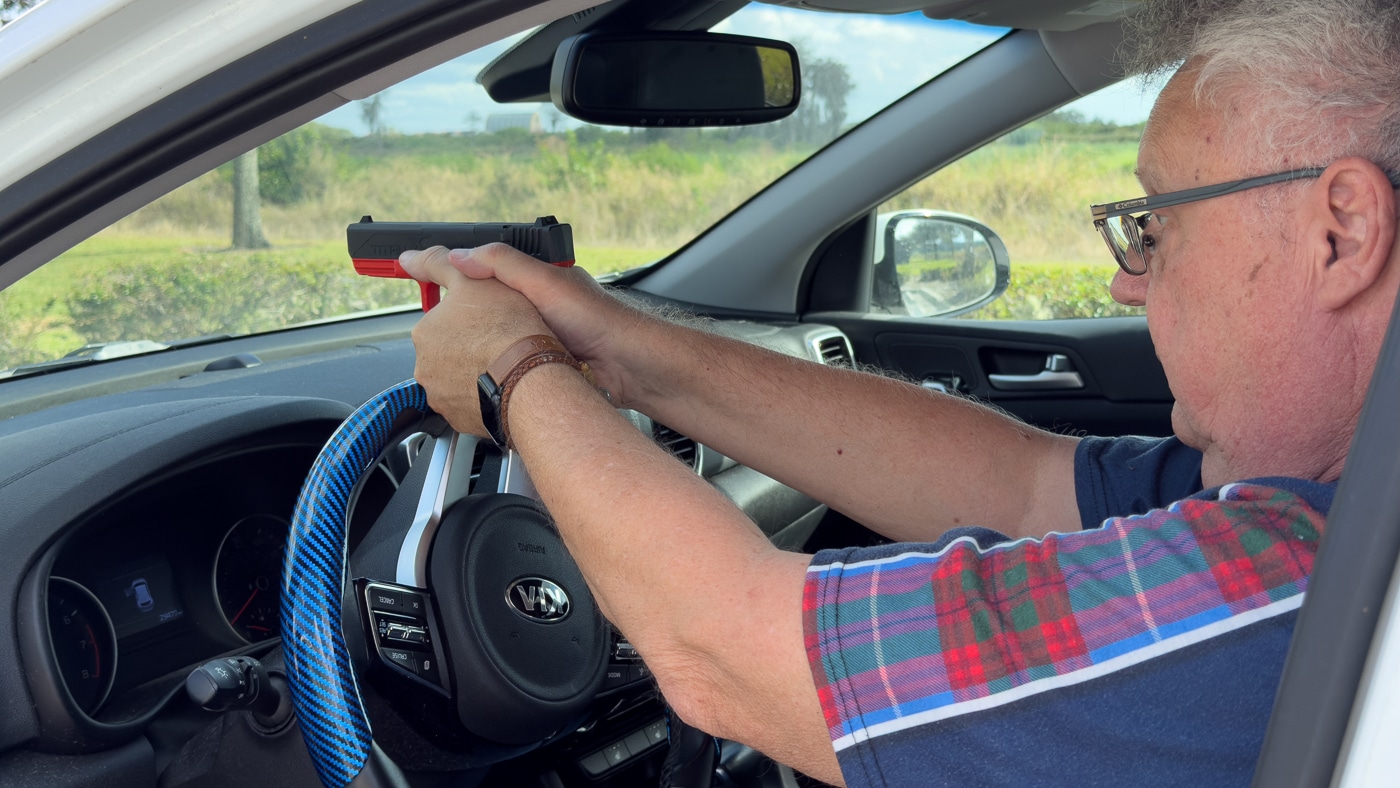
I had no preconceived ideas going into this test. I am not a big fan of the car holster, which I’ll talk about later on. However, I tried my best to come up with a testing protocol, which was an accurate simulation of real-world conditions. Here are my results.
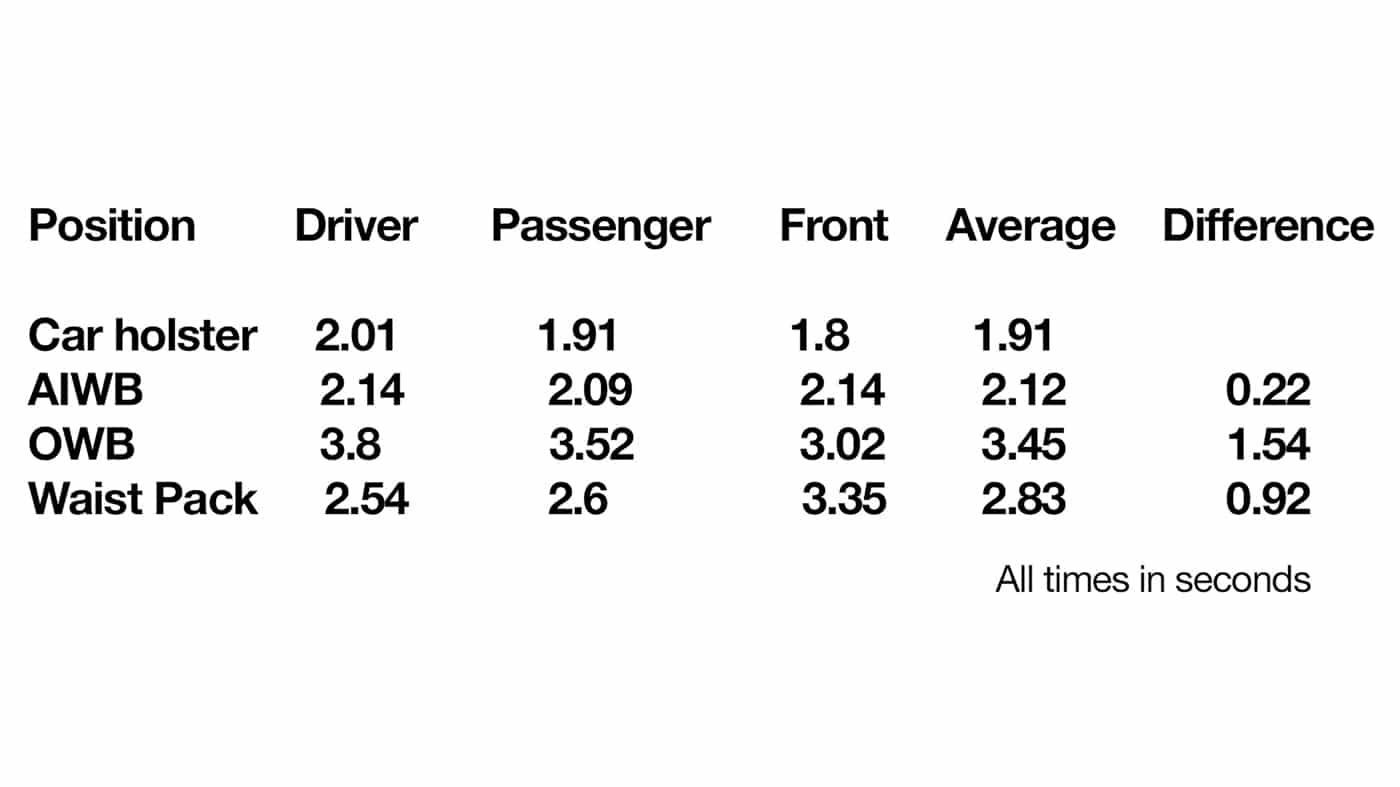
Inside the vehicle, the car holster was quicker than other carry positions, sometimes by over twice as much. What was initially surprising to me was how close the times for AIWB carry was to the car holster times. It makes sense, though. Time is distance, after all, and a pistol in a car holster is farther away from me than a pistol on my person. I have a slow draw. On a good day, I have a 1.5 second draw to first shot at seven yards, so improving that metric outside the car will doubtlessly improve my speed inside the car as well, eliminating any advantage a car holster might give me.

Live The Armory Life. The latest content straight to your inbox plus an automatic entry to each of our monthly gun giveaways!
I have read and agree to the terms & conditions.Things get worse once you step outside of your car. It took over five seconds to access my pistol in its car holster when I simulated a gas station attack versus my glacially slow 2.1 second draw from the appendix holster on my person, and I had to turn my back to my (pretend) attacker to do so. Bad idea. Based on this, I’d say having a gun on you is always better than having a gun near you, especially when you’re not driving around town.
Some Issues
As I mentioned before, mounting a car holster in your vehicle creates a chance you’ll puncture an airbag or do some other sort of significant damage to your vehicle. However, a car holster secures your firearm with just a magnet or maybe some mechanical resistance, neither of which is enough to keep everything safe in a car accident. Don’t make a bad situation even worse, so carry on your person.
Having a gun on you also eliminates another big safety risk associated with carrying a defensive pistol — namely having a negligent discharge as you holster or reholster. The less we have to do this, the safer we’ll be, inside or outside of your car.
This is undoubtedly one of the reasons why law enforcement officers and licensed security personnel carry their pistols on them, not near them when they drive around in their cars. These people understand that taking the time to remove a pistol from a car holster leaves you vulnerable to attack as you holster it. There are also plenty of opportunities to have something go really, really wrong with the process of putting your gun into its holster. Skip the added steps, and carry on your person everywhere you go.
The Right Path?
With that being said, I can see how a waistpack would be useful in these scenarios. Is it my first choice? No, not at all. However, a waistpack is as comfortable to use as a car holster, and it has the added benefit of also being usable when I step outside of my car (albeit once again not as fast as my normal carry position).

It’s that last bit, the attack outside of the car, which really dooms the idea of a car holster in my opinion. I can have all the situational awareness in the world and yet a determined attacker can find the crack in my defenses and attack me. This, of course, assumes I’ll be the target of an attack, and discounts scenarios where the violence is more random. All of this means that there are just too many scenarios I can think of where I’ll need a defensive pistol right away, rather than jog back to my car and retrieve it.
Finally, if you choose to avoid the hazard and hassle of constantly reholstering your pistol as you get in and out of your vehicle, there is the matter of leaving an unattended, unsecured gun in your car. Your car is not a gun safe, don’t use it as one. Always keep your firearms locked up unless they are in use.
When it comes to defensive pistols and car holsters, I apply Claude Werner’s “Can, Should, Must” paradigm. Can you use a car holster? Yes. Should you use a car holster? In my opinion, probably not. Instead, only leave a gun in a car holster when it’s absolutely needed, and when you do, you must keep it secure from the evil elements inside of our society, and put it in a secure, locked container. That’s my take on it.
Editor’s Note: Please be sure to check out The Armory Life Forum, where you can comment about our daily articles, as well as just talk guns and gear. Click the “Go To Forum Thread” link below to jump in and discuss this article and much more!
The post Is Car Carry a Mistake? appeared first on The Armory Life.