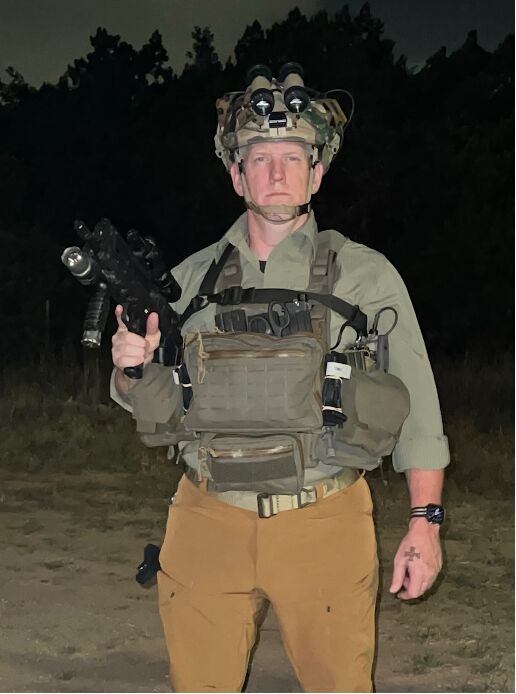
The procurement of individual gear to support military, police, or civil defense has a long, convoluted, but necessary history. Choosing what gear best suits your needs becomes a balance of practicality and assumption. Whether you are riding a tractor, enforcing a warrant, or running the back hills of Helmand Province, choosing the right equipment to support your needs is often a game of perception vs pragmatism.
Where to Begin, It’s About Time
Choosing the right equipment should never rest on what an individual sees in a video game or motion picture; furthermore, the vast array of ninjas permeating the vast selection of videos on YouTube and Instagram should be taken with a grain of salt. The area I start from is based on three primary time frames. Most operations can be categorised into 24 hours or less, 48 hours or less, and 48 hours or more. This is a selection of time frames I pontificated to simplify the decision-making process on how to configure gear and choose what to buy or acquire. The division is based on a simplified list:
- Mission: What am I doing?
- Support: Who do I need?
- Resources: What do I have?
- Viability: Why am I doing this?
The use of METTT-C (mission, equipment, troops, time, terrain, and civilians) is also a part of this, but we are focusing on choosing equipment, not how we plan a mission. Another thing you will notice in this series of articles to come is the lack of discussion regarding plate carriers or armored vests. This article and the others to come in this series is based on the load-bearing systems themselves, not the armor-carrying systems. Every one of the systems I mention can be worn in conjunction with armor, but this will not be part of the discussion for this series.
NOTE: What I point out is my opinion based on my 3 decades of operational and combat experience; my point of view is not gospel. Whatever equipment I mention is a guide; make your choices based on your experience and operational/defensive needs.
Put in a Box
We as humans like to categorise or place everything in a preverbal box. Gear as a base hasn’t changed overall, meaning we still sew stuff together to hold stuff. That said, I have taken the liberty to create four categories of equipment design. These are not binding, nor has anyone else stated this scale; this will allow us to consider the type of platform design. These generations are not bound by age or date, and there can be crossovers of both on different platforms, meaning a Gen 1 system may use parts of a Gen 3 or Gen 4.
- Gen 1: Pre-sewn. This is where the pouches are all sewn into place and little modularity is left.
- Gen 2: ALICE/PLCE. The older 70s and 80s designed modular system that allowed adaptability.
- Gen 3: MOLLE. MOLLE and the newer adaptations of this utilise plastic or nylon strips to mount gear.
- Gen 4: Velcro. This system is a stackable system based on redundant layered Velcro mounting.
These different categories are not binding, and like the generation 1, pre-sewn does not mean it's old technology; the material, manufacturing, and designs have drastically changed, but the adaptation of sewing all parts in place allows for reduced weight and bulk. In some cases, older approaches can be modernised with newer technology.
24 Hours or Less
This time frame will encapsulate the more-sexy gear so many see in videos, games, and motion pictures. The “placard, mini-chest rig, or Rhodesian-style chest rig have become the norm. So often it’s the guy with 3 mags, some chemlights, maybe a radio, and a water bottle with night vision, 16 pieces of macho flair on his carrier, a flannel top, bedazzled jeans, and a pistol. While the litany of variations of this look inspired an entire generation of gamer kids to be mall-ninjas and swap-meet commandos, nothing could be further from reality. The infantry standard across most modern militaries has come out to 7 mags. In my time conducting direct action or hostage rescue missions (training or real), I can say I never needed that much ammunition for direct action. In most CQB (close quarters battle), I would rarely go past 2 AR15 magazines. Part of the reason for this is training to have first-round hits, shooting only at a perceived target (this requires discipline and experience); there is no endless supply of bad guys, and speed is security at this point.
In the realm of short-duration missions, what can a civilian or LEO expect? For a police officer, you will have civil unrest with riots, active shooter(s), and warrants. The historical data with all three is limited to timeframes, and most of the individuals are not a direct threat, so kinetic engagements are highly limited. For the civilian, it's going to primarily be home defense. You may hear something in the early AM, maybe you are defending property, or patrolling your homestead and farm. Regardless, both will likely have limited engagements. In countless cases, when rounds are exchanged on the two-way range, engagements are short-duration and historical data shows the threat normally retreats.
What is needed? The individual needs 3-4 higher capacity magazines (20-40 rounds), your comms (phone or radio), water, medical kit(s), any signalling aids, hand held light, a multitool, screening & distracting devices, and whatever administrative, navigational, or supportive equipment you believe you need. Remember, the kit needed should be a chest rig in many cases; it can be worn with or without a carrier. The idea is lightweight and mobile. Most modern chest rigs are designed to carry 3 to 4 magazines with some basic administrative and supportive pouches. The concept is pack light and move fast, protracted gun fights are not the focus; STOP THE THREAT. That said, look deeply into what works.
24 Hour Options
Choosing your gear is personal. I have seen all kinds of differing opinions, ranging from it was issued, Chinese budget (some very good and most bad), and only name brand/high cost. I will provide a few names and advantages, and you, the reader, can decide. The two smaller chest rigs I have inventoried and have operated with extensively overseas would be Velocity Systems UW Chest Rigs and Helicon-Tex. These chest rigs quickly fill and are vastly limited in use for anything that requires longer-range or extensive time use. Both of these rigs are well-suited to clip into or wear over a plate carrier. Some belt systems (gun belts/ battle belts) can work well in this category, given the limited needs, but we will discuss belts later. There are too many companies to list, but a quick look across the “Wayback Machine” will provide a massive selection.
48 Hours or Less
The 48-hour kit is a bit of a play on words; I refer to this as the infantry kit category. Normally, professionals leave/insert into their environment/area of operation at night and will return at night, so the true 48 hours are the two days of operation and the 3 nights, but the last night is always cut short due to returning. This becomes important for civilians as we have limited transportation, operational support, and severe civilian restrictions when operating in a private property-rich environment in the US. The use of larger chest rigs and load-bearing systems like belt kits, hybrid systems, or vests becomes far more advantageous. The line between belt kits and chest rigs is harder to delineate due to new designs that incorporate the characteristics of both. Even the traditional chest rig has blurred as newer designs bring in updated technology and ideas, changing the historical norms. This point is critical, for short missions, the idea is to not stay on target any longer than is necessary; when patrolling, you are out for a period of time. Mission accomplishment is the obvious measure, but a 2-day patrol is likely going to take 2 days. This means sleeping, drinking, and eating are all based on what you carry.
The Tactical Tailor MAV (Modular Assault Vest), the OG, has long been an origin for most modern longer-range chest rig designs, even if many don’t know it. The real magic was the TT 2-piece MAV, the split chest rig. As things progressed, even the belt kit changed as well, newer designs and different takes developed from both the US ALICE system (782 gear or Duce gear) and the UK’s PLCE (personal load-bearing carrying equipment). The traditional process is on the individual’s hips, from early US and contemporary British, this morphed in the US as we started to wear our belt kits above the hips to opt for more space, higher ammunition, and greater operational duration. This started to change how the kits were worn and evolved into hybrid kits that rode like a chest rig but supported and configured like belts. There are those who argued the validity of packs with these kits, but you simply sucked it up and loaded your sustainment pouches or butt pack accordingly.
Earlier designs from companies like Blackhawk!, Eagle, and London Bridge Trading were some of the first to create a hybrid belt system that was pre-sewn but designed to carry like a belt kit but ride comfortably high or on the hips. The concept truly worked best higher above the hips, maximising operational space. The split chest rig has become a more common use item for longer range kits and the US FLC, a hybrid belt/chest rig design, has grown in popularity with civilian designs also developing their own variants of this; the FLC itself is a direct reflection of these designs. Today, kit designs from Cedar Sewing have taken the newer pattern of the FLC and breathed new life into the design by utilising the latest materials and manufacturing techniques and providing a maximised working surface for operational needs ranging from infantry 48-hour operational needs and allowing it to effectively work as a long-range beyond 48.
Again, chest rigs are not just for short missions, traditionally the Russians and Rhodesians pushed the limits of chest rigs for longer range use. The Type 84, a Russian design, was the blueprint for many chest rigs to follow and became famous in early GWOT. Today the there are many to choose from, but a lesser-known company name, Sewjourn, has created one of the finest. Like the Velocity Systems UW chest rigs and many other companies, the entirety of the pouches is pre-sewn on. The innovation of design and material choices changes the outcome significantly. Now, unlike a 24-hour rig, the 48 is meant to carry significantly more equipment and water. The necessities of living for 48 hours away from support require more than food and water; ammunition should be at least 7 rifle magazines, but no more than 9 mounted. The idea is to support a firefight, but not meant for prolonged displacement. It is prudent to have a few spare magazines, perhaps in a small rucksack. Sleeping and shelter considerations, along with navigation, signalling, communications, and night vision/thermals, are necessities.
48 Options
Some of the options become extensive, and this is where more modular systems can truly shine. Choosing a modular platform can be configured many ways, so, for example, a TT MAV could be outfitted to run simply as a home defense platform or ramped up to a 48-hour configuration, even the Sewjourn SAWS chest rig could be set up for home defense, but its use is well-suited for the infantry 48-hour window. The Cedar Sewing BLISS belt system with corresponding pouches is one of the ultimate 48-hour systems, but could easily be set up to run beyond 48 if the correct pouch selection is implemented. The Full Tang Tactical Kit Bag system is a unique Gen 4 platform, but its highly modular mix of Gen 3 and 4 allows for complete customisation. The US Government issued FLC or TAPS are also viable options that are both affordable and well-manufactured to last. Many would turn their nose up at government issue, but these products were designed to survive 18-year-old men with little regard for the care of the products.
48 Hours or More
This is the category that starts to truly dive into sustained field operations, the reconnaissance and long-range patrols. These rigs are primarily set up for week-long missions, but as a civilian in civil defense, this could be better served in property or area patrols. The importance of retaining up-to-date information on property boundaries or key terrain like bridges, major intersections, or infrastructure will necessitate the need for consistent updates and security. The long-range or reconnaissance patrol will require larger amounts of water and food for sustainment, spare batteries become more prevalent, other navigational and night vision do not change, but the need to have more options to acquire resources or gain access to denied areas becomes mission-critical. This means water purification, solar for recharging batteries, or options for gaining access to city/county resources, as well as navigating over fences or through locks, can mean the difference between mission success or failure. Due to the nature of long-range patrols and the possible distances an individual or team would travel, support as a civilian becomes scarce. This entails the need for more rifle magazines; at a minimum, 12 magazines should be carried on the kit at all times. In Marine Reconnaissance, we carried on us a double basic load plus one in the weapon: 14 30-round AR15 magazines. Our kit became significantly heavy as well as the mission rucks reached 100lbs at times, based on the environment and mission necessary equipment. The 7 P’s should be used in planning to ensure the individual carries what is needed and no unnecessary supplies.
48 and Beyond Options
The long-range or patrol kit, as it's being called now, the jungle kit is primarily a modular system comprising Gen 3 setups. There are those who have found that the older Gen 2 ALICE or PLCE systems offer a lot of quality and combat-proven products for serious savings. There is also a satisfying feeling of knowing something older is not emulated so heavily. I personally have operated in virtually every environment with no issues in my kit when running ALICE gear. I did, however, eventually change out the ALICE clip for zip ties, but that was an issue dealing with salt water and not their ability to function.
Older manufacturers like Blackhawk!, Eagle, and London Bridge all created a similar pre-sewn system that were 8 point harnesses into a padded belt system with a large array of ammo and support pouches with butt packs all configured with no need to source pouches or set up. Their drawback is the heavy material and complete lack of modularity. These systems are robust, well-designed, and proven to work well. They are a combination of the PLCE belt system designed to ride higher American Style and provide a significant load-out capability.
The Cedar Sewing system is also highly tuned for long-range patrol, and with larger admin pouches and the setup for 12 magazines,s the BLISS is more than capable of being an excellent choice, particularly with the Cedar Sewing M69 Butt pack. The Cedar Sewing BLISS allows for maximum MOLLE placement and provides a diverse array of design upgrades to previous platforms it draws from. The precision laser-cut materials are state-of-the-art, and no details are missed.
Finally, there is the Full Tang Tactical Kit Bag system of rigs. This is the ONLY chest rig that I can say will offer more than you know what to do with. The Kit Bag system FTT created is the gen 4 system, which not only allows for full customisation of their products but also allows for the integration of other manufacturers that use Velcro and MOLLE pouches. The FTT Kit Bag system can be configured to easily carry 12 rifle magazines, but at the same time, integrate more internalised storage that one may be left wanting to overpack. A little experience and know-how, and the FTT systems are in a class of their own due to their unique approach of “layering” pouches and attachments.
Side Notes
Given the nature of many official or civilian operations, a rucksack of some sort would be necessary. Despite what many would argue, in many cases (weather/environment dependent), a medium ruck sack is going to provide the best return for the money. Most civilians or other federal agencies are not issuing the larger complicated equipment that militaries will have to carry. That stated, I do recognise that the use of drones will necessitate the need for a large rucksack in order to fit the drone and supporting equipment. Plan accordingly, the old saying “ounces equal pounds” has been arbitrarily and irresponsibly thrown as shade at the webbing or kit we wear to the detriment of durability or design. The real weight derives from what we put into the pouches or ruck sack; just because you have room doesn’t mean it needs to be filled.
Another area that must be reconciled is the need to customise your kit. The individual is capable of doing their own modifications, but the ability to sew and modify kit is largely determined by the ability and skills to sew effectively and create the modifications desired for specific requirements. Conducting a search of your local area can provide different individual businesses. A pro tip would be to use uniform alteration shops if you live near a military base. Most major areas will also have custom gear manufacturers; conduct your due diligence and figure out what your options are. Here in San Antonio, I use 10 West Tactical to facilitate quality gear updates. 10 West Tactical was able to update the harness that needed work on a harness for me.
This broad overview of the 3 time frames for choosing kit designs and the 4 generations of design is meant as a guide to understanding that even the old school is the new tactical fad. With the looming conflicts showcasing the need for old school kit designs based on a lack of support, or the home defense needs showcase the latest hotness from COD or Battlefield, there is a need for the right tool for the right job. Choose your kit based on the practical needs of your areas of responsibility and not what a guy on Instagram says is cool. Take the advice from professionals who have had enough education and training to be considered a “doctor of warfare”, so to speak, and rely on their feedback. Go forth and seek out the Tactical Buddha, ask, and ye shall receive.