Louisiana Lets 18-Year-Olds Carry Guns but Denies Them Permits
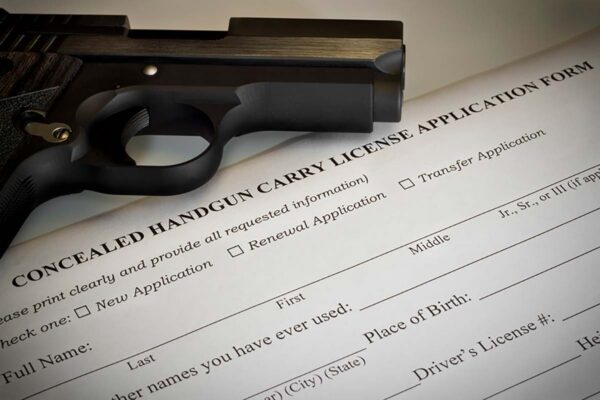
FPC filed Pool v. Hodges on July 22, 2026, in the U.S. District Court for the Western District of Louisiana. The plaintiffs are 19-year-old Ella Pool, 18-year-old Christian McDuffie, and FPC. The lawsuit names Louisiana State Police Superintendent Col. Robert P. Hodges as the defendant.
Louisiana is a “constitutional carry” state, meaning a permit is not required to carry a handgun. Although 18- to 20-year-olds can carry guns in the state under its permitless carry law, federal law (the Gun-Free School Zones Act, 18 U.S.C. § 922(q)) prohibits them from carrying a firearm within 1,000 feet of an elementary or secondary school. Louisiana has a parallel 1,000-foot restriction. Both of these laws exempt people with a state-issued concealed carry permit from the prohibition.
Because 18- to 20-year-olds cannot obtain a Louisiana permit, they are not eligible for the exemption. With more than 1,300 schools in the state, the resulting unmarked 1,000-foot buffers create a dense, overlapping web of “invisible gun-free zones” covering roads, thoroughfares, and large portions of daily travel routes, especially in cities. The plaintiffs argue it is nearly impossible for an 18- to 20-year-old to lawfully carry while traveling without the permit they are forbidden to hold.
Additionally, Louisiana provides civil immunity for justified use of force or self-defense to licensed carriers (La. R.S. § 9:2793.12(B)). Adults under 21 carrying under constitutional carry do not receive this protection. That could mean that someone under 21 who legally defends themself with a firearm could still be sued in civil court, which has happened in multiple cases across the country.
Reese Puts Louisiana in a Difficult Position
The complaints assert that the age-based permit ban violates the Second Amendment. They heavily rely on New York State Rifle & Pistol Ass’n v. Bruen for their arguments. A Bruen analysis consists of two steps.
The first step is to look at the plain text of the Second Amendment. The named plaintiffs are aged 18 and 19. Because they have reached the age of majority in the United States, the plaintiffs reference the Fifth Circuit’s binding decision in Reese v. ATF (FPC’s earlier case), which held that peaceable 18- to 20-year-old adults are part of “the People” protected by the Second Amendment and struck down the federal ban on handgun and handgun-ammunition sales to that age group.
They want to carry handguns, which are bearable arms. Since the conduct is covered by the plain text, it is presumptively protected.
“The Fifth Circuit has already made it crystal clear that peaceable 18- to 20-year-old adults are among ‘the People’ protected by the Second Amendment and enjoy the same right to keep and bear arms as every other adult. Yet Louisiana denies them access to the permits they need to fully exercise their right to bear arms in public, trapping them in a sprawling maze of invisible gun-free zones created and enforced through state and federal law. That is not constitutional carry—it is blatant constitutional infringement. We filed this lawsuit and moved for summary judgment to end this unconstitutional restriction and force Louisiana to treat adults like adults. FPC and our Grassroots Army will continue to Fight Forward until every immoral and unconstitutional restriction on the right to keep and bear arms is eliminated throughout the United States,” explained FPC President Brandon Combs.
In step two of a Bruen analysis, the burden shifts to the state. The state must provide historical analogues to prove that the state law is consistent with the nation’s historical tradition of firearms regulation. With the Supreme Court rejecting the use of racist gun laws, the state will have a tough time justifying its ban on concealed carry permits for young adults.
In addition to relying on Bruen and Rahimi, the plaintiffs also cite two parallel victories against age-based carry restrictions. One case was out of the Eighth Circuit (Worth v. Jacobson), and one from the Third Circuit (Lara). The latter case was denied.
About John Crump
Mr. Crump is an NRA instructor and a constitutional activist. John has written about firearms, interviewed people from all walks of life, and on the Constitution. John lives in Northern Virginia with his wife and sons, follow him on X at @right2bear, or at www.crumpy.com.