Nearly 1 in 3 Voters Say They Carry a Concealed Handgun, Survey Finds
Research done at the Crime Prevention Research Center (CPRC) and published in July of 2026 shows the percentage and number of people carrying concealed handguns continues to increase.
A survey of 1000 people conducted by McLaughlin & Associates on July 22, 2026 shows significant increases in the carrying of concealed handguns. In the last 19 months, from December of 2024 to July of 2026, the percentage of likely voters who carried all or most of the time increased from 13% to 15.7%, an increase of 2.7% of the sample. Those who carry sometimes/rarely increased from 11% to 15.2% or 4.2% of the sample.
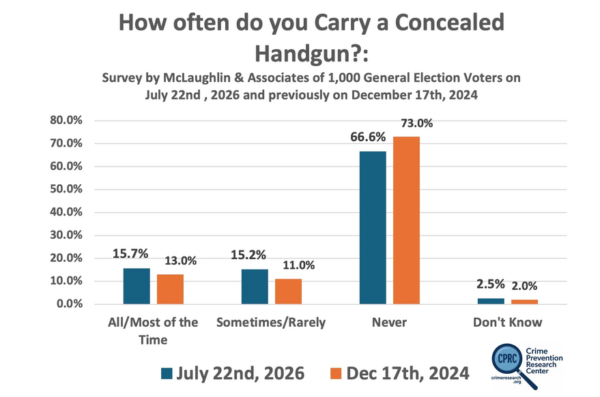
The total who carry increased from 24% in 2024 to 30.9% in 2026, or 6.6% of the sample.
Similarly, the total of those who say they never carry dropped from 73% to 66.6%, a 6.4% drop. Those who claim they “don’t know” if they carry increased from 2% to 2.5%. The sample is of likely voters in general elections. Such a sample may or may not be indicative of the habits of non-voters.
20.1% of the respondents stated they possessed a concealed handgun permit. This is slightly lower than previous findings. The slightly lower number may be related to the increasing number of Constitutional Carry states, now at 29, where no permit is needed to carry a holstered handgun, openly or concealed, in most public spaces. 68.9% of the people who carry most or all of the time are located in Constitutional Carry states. The 29 Constitutional Carry states contain 47% of the population of the United States. The 29 Constitutional Carry states account for 68.8% of the land area of the United States of America. About 2/3 of the people who carry all or most of the time in Constitutional Carry states have a concealed carry permit. About half of the people who carry some of the time in Constitutional Carry states have a concealed carry permit.
People aged 18-40 carry at higher rates than people aged 41 and up. In ethnic groups, Hispanics carry at slightly higher rates than Blacks, Asians carry at the lowest levels, and White people and Other are in between. Republicans carry at higher rates than Democratic or Independent voters do. When ranked by ideology, very liberal voters carry at the highest rates, with 30.8% carrying all the time, vs 21.6% of very conservative voters carrying all the time.
According to CPRC research, economic status shows the strongest correlation with carrying concealed handguns.
Those who identified themselves as wealthy showed a percentage who carried all or most of the time at 62.9%. Those who considered themselves upper middle class and who carried all or most of the time were 28%. Those who considered themselves middle middle class showed 15.7% carrying all the time, lower middle class showed on 9% carrying all the time and only 7% of self identified poor people carried all the time. 4.1% of the sample considered themselves to be wealthy, and 15.5% of the sample considered themselves to be poor. 80.4% considered themselves to be in the middle class.
From the self-identified sample, it appears the average income of those who considered themselves to be wealthy was over $175K per year per household.
These surveys commissioned by the Crime Prevention Research Center offer fascinating insight into the makeup of people who routinely go armed in the United States. The numbers and percentages keep increasing. While not all people who go armed support the Second Amendment, going armed increases the odds of valuing the Second Amendment.
When a person goes about armed, it changes their mental set. They become more independent and aware. They are more likely to view those who seek to disarm them with suspicion.
The wealthy in society tend to be those who set trends. The large percentage of wealthy who carry all the time suggest the percentage of people who carry will continue to increase.
About Dean Weingarten:
Dean Weingarten has been a peace officer, a military officer, was on the University of Wisconsin Pistol Team for four years, and was first certified to teach firearms safety in 1973. He taught the Arizona concealed carry course for fifteen years until the goal of Constitutional Carry was attained. He has degrees in meteorology and mining engineering, and retired from the Department of Defense after a 30 year career in Army Research, Development, Testing, and Evaluation.