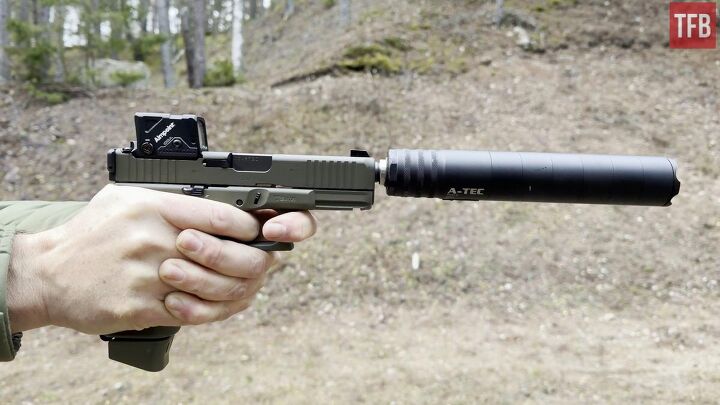
This sequence of still images captures the recoil cycle of a suppressed Glock 45 Hunter Edition (Gen 5) fitted with an Aimpoint COA red-dot sight, A-Cut interface. Compared to a standard Glock 45, this configuration is notably more front-heavy due to the attached suppressor, which influences how the pistol behaves during the firing cycle. The red dot has some part of it as well, as everything adds weight to the barrel or the slide.
The suppressor is manufactured by A-TEC of Norway ( Model PMM-6). As with most pistol suppressors intended for Browning-type tilting-barrel handguns, it is equipped with a Nielsen device, also known as a recoil booster.
This mechanism momentarily decouples the mass of the suppressor from the barrel during firing by allowing the suppressor body to move independently under spring tension. Doing so enables the barrel to tilt and unlock as designed, preserving reliable cycling despite the added weight at the muzzle.
The weight of the suppressor is 215 grams (7.58 oz). The weight of the Aimpoint COA is 48 grams (1.7 ounces). It means we added 263 grams overall, but in different places. A loaded Glock 45 weighs about 860 grams (30.34 oz), so the added weight is substantial. About 30% in fact, if my math is correct, and most of it in the wrong places. All numbers from the manufacturers’ data sheets.
Viewed frame by frame, the stills illustrate slide movement, barrel unlocking, and the return to battery, showing how a suppressed, optic-equipped Glock manages recoil and timing under increased forward mass.
In the still below, we’re reaching peak recoil, and the action is “done”. From around here, the slide moves forward, picking up another round on its way. Eventually, the gun will dip below the horizontal line, and the shooter will try to pick up the sight picture, trying to align the pistol to the target again, like a decreasing sinus wave. A suppressor will add to the time, due to its mass.
We won’t bore you with the large amount of uninteresting frames until the next shot is fired, as it takes a huge amount of time (in slow-mo) until the Glock settles due to the suppressor creating a lot of extra motion compared to an unsuppressed firearm. As an experienced shooter, you can see this in the red dot that takes a longer time to settle and return to the target. With experience over time, you will be able to call your shots, as you know where you hit and the sight will return. It’s also possible to shoot a little ahead, as the red dot drops on the target.
This is a non-scientific Photo Of The Day, made for fun, but with the intention to give some food for thought about how pistols behave, and details the eye cannot capture. This was filmed with an iPhone in slow-motion, 240 fps in HD, and the stills were captured via DaVinci Resolve (which took me a while to figure out). All comments and feedback are welcome.