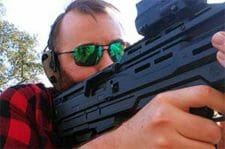
PSA M4A1 Review: Quad Rails, Iron Sights and M4 Nostalgia

I was never issued an M4A1 during my time in the service. I had a plain Jane M4 for such a short period of time that it’s barely worth mentioning. More than a decade and a few dozen pounds later, I had forgotten just how light and handy that little carbine could be. The PSA M4A1 brought it all back: the quad rail, iron sights, rickety stock and unmistakable feel of a rifle built for the early 2000s.
It’s not a ‘real’ M4A1, but it’s as close as most of us will get unless the machine gun registry opens. PSA has jumped headfirst into the world of modern military clone rifles. Cloners can be a bit like Champagne enthusiasts. If it doesn’t come from the Champagne valley, then it’s just a sparkling white wine.
The M4A1 attempts to be fairly accurate in its cloned nature. The gun features a 14.5-inch barrel with a pinned-and-welded muzzle device, preventing it from being classified as an SBR. The gun comes with the classic M4 quad rail, a rickety M4-style stock, and an A2-type pistol grip. We get the A-frame front sight and the USGI-style backup iron sights. The gun even comes with quad rail covers and an imitation Knight’s Armament vertical grip.
Out of the box, it’s ready to go with a classic G.I. style 30-round magazine. The PSA M4A1 even has the U.S. Government property marking and a UID tag. To me, it’s clone correct enough to be an enjoyable walk down memory lane.


Live Inventory Price Checker
| PSA Sabre-15 Forged 14.5" CHF CL M4A1 Rifle with Quad Rail, FDE Anodized | Palmetto State Armory | $ 899.99 |
|
|
| PSA Sabre-15 Forged 16" FN CHF CL M4A1 with Quad Rail and Vertical Grip Classic Rifle | Palmetto State Armory | $ 999.99 |
|
|
| PSA "M4A1" 14.5" P&W 5.56 1/7 Nitride Quad Rail Rifle | Palmetto State Armory | $ 619.99 |
|
|
| PSA Sabre-15 Forged 14.5" CHF CL M4A1 with Quad Rail and Vertical Grip Classic Rifle | Palmetto State Armory | $ 899.99 |
|
The M4A1 – Light and Handy
In a modern era of LPVOs, lights, lasers, and all the other stuff we shove on a gun, it’s easy to forget the classic AR carbine is a light and handy rifle. The PSA M4A1 delivers that lightweight, short experience and reminded me why I wanted one so bad for those room-clearing events during my younger days.
The M4A1 isn’t the smallest AR these days, but still feels light, handy, and easy to maneuver with. That doesn’t mean we don’t have to make a few compromises with what will likely soon be considered a retro rifle.

The quad rail is short, so your mounting space is limited. It also restrains your hand placement on the gun. The M4 quad rail is short enough that it doesn’t feel all that front-heavy, which is nice.
The M4 style stock has always been fine, but it’s also always been a bit sloppy. It moves a bit on the receiver extension, and doesn’t offer the best cheek rest. It’s fine, but we’ve made some advancements in stock design for a reason.

The A-Frame front sight will be in the way with a lot of optics. With a red dot, it’s a bit of a who cares; with a magnified optic, it eats a little of your window.
Optics? Who Needs Them?
Speaking of optics, I did the majority of my shooting with the included iron sight. I don’t often shoot with irons, so it was a return to tradition.
I prefer optics for performance-based reasons, but I forget how much fun irons are. There is something so much more satisfying about hearing a ding at 100 yards when shooting with irons. This served as both an iron skill-building experience and a gun review.

The USGI flip-up sights are quite nice. I had Knight’s sights on my issued rifle, so the MaTech style flip-ups were new to me. After finding the instructions online, I printed the 25 Meter M4 target, set my windage knob to 300, and zeroed the sights. It didn’t take much until I was zeroed and ready to hit the range.
Going Live With the PSA M4A1
In the spirit of the M4A1, I shot like it was 2008 all over again. I used the vertical foregrip the way I was originally taught. The technique for foregrips has evolved, but I went straight broomstick with this gun. Sure, it’s not optimum, but it was a return to tradition.

After zeroing, the first thing I did was shoot the MEU(SOC) M4 qualification. It’s a 50-round course of fire that starts at 50 yards and moves forward. It’s a fun, fairly simple qual that fits with the classic M4 design. Did I do well?

Not at first. It took some time to get readjusted to irons. However, I cleaned up a lot after the first magazine. The M4A1 has the light recoil you expect from a 5.56 carbine. It barely moves between shots, but admittedly the small peep sight emphasizes that movement more than it would a red dot.

Still, I met the times and accuracy requirements. Mainly because the times are quite generous for most of the drills. This qual had me shoot pairs, failure to stop, multiple positions, and moving shots. None of it felt difficult for the M4A1 to accomplish.
Beyond the Qual
Rifles are rifles, so I took the rifle to one hundred yards and began engaging in some offhand, stand-up shooting. At 100 yards, I kept my shots within the chest and torso of an FBI Q target. This was slow going, and they tended to hit a little high with my zero, but remained within the target.

I shot in a semi-supported position with the rifle, taking my time, and I ended up with an 8-inch 10-round group with irons using Winchester M855. I felt proud of that. It’s not great, or even good, but with cheap ammo and irons it felt satisfying for my skill level. I could do better with a magnified optic, but it wouldn’t feel nearly as satisfying.

I’m a bit restricted by a 200-yard range, but at 200 yards, with the gun resting on a chest-high fence, I could hit a steel IPSC target with the majority of my shots. I could barely see the target with the front sight covering so much of it. Once I found my hold, I held onto it for dear life. Again, with an optic I could do a lot better, but the sound of dings wouldn’t be so pleasing to hear.
What I learned was that I need to work with irons and basic rifle shooting skills.
The Optic Addition
After tossing on a Primary Arms 1-6 LPVO, I felt a bit blasphemous, and I was able to clean my groups up quite a bit. With M855, I was seeing 3 to 3.5-inch five-round groups with my magnified optic crutch. My best total was a two-inch group with three rounds.

This was one of those groups that felt good. I began to get a little nervous that I’d do something to ruin the group, so I pumped the brakes after three and went to give it a peek.
Reliability
I had a single failure to fire in the 14 magazines I fired. A tap, rack, bang later and the problem disappeared. After that, I didn’t have any issues with the rifle’s reliability. Press the button, and it does the thing.

The vertical foregrip was not a tight fit. Even with it ratcheted down as tight as possible, it still wobbled a bit. That was probably my only notable issue with the gun.
The PSA M4A1
The PSA M4A1 retails for less than $700. That’s a pretty fair price for a quad rail equipped rifle that comes with a nice set of backup irons. The rail and sight are probably worth $200 to $250 of that price.

If you’re not into the cloner game, it’s still a solid base rifle. Add a decent optic, and maybe swap the stock and you’re ready to go at a budget price. I had a blast reliving my glory days with the M4A1, and for some reason it’s got me convinced to finally start working on my rifle skills.
I think me and the PSA M4A1 have started a long life together, and maybe I can shrink my iron sight groups a bit more.
About Travis Pike
Travis Pike is a former Marine Machine Gunner, a lifelong firearms enthusiast, and now a regular guy who likes to shoot, write, and find ways to combine the two. He holds an NRA certification as a Basic Pistol Instructor and is the world’s Okayest firearm’s instructor.