Recap: Ed Monk on Countering the Active Shooter With a Handgun
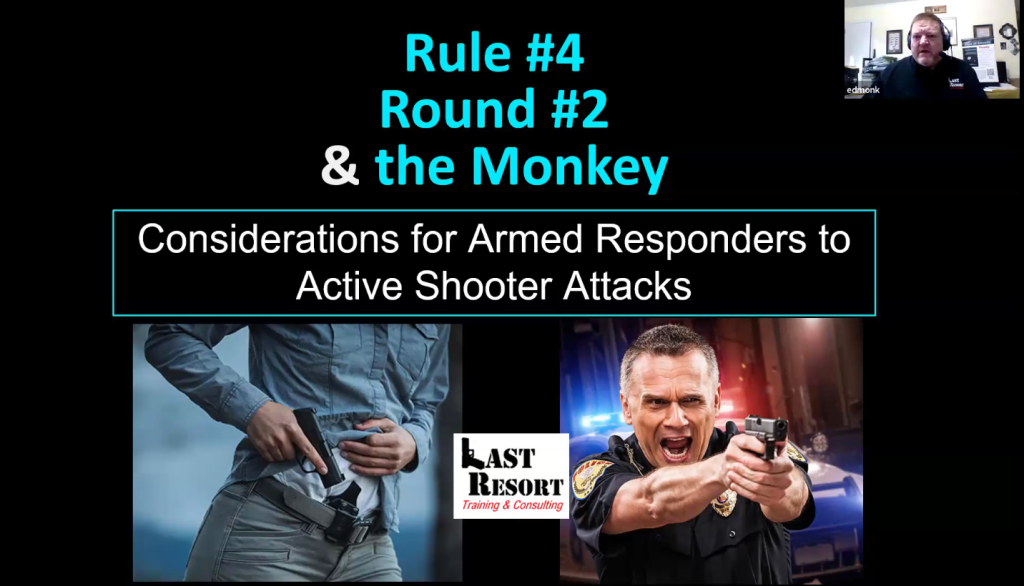
Last night we hosted Ed Monk for a live Guardian Nation webinar, and it was one of the more sobering and useful two hours we have put on in a while. The title was a mouthful, “Rule #4, Round #2, & the Monkey: Preparing to Counter the Active Shooter with a Handgun,” but the goal was simple.
If you carry a pistol in public and you have already decided that you would use it to stop an active shooter, this session was about what it actually takes to follow through. First, a thank you. Thank you to Ed Monk for sharing years of hard research and real teaching with our community, and for treating it like the serious subject it is. And thank you to the more than a hundred of you who showed up live, asked sharp questions, and stayed engaged the whole way through.
Nights like this are only worth doing because of the people on the other side of the screen. If you were there, this is a simple recap. If you missed it, here is a taste of what Ed covered, and how you can still watch the whole thing.
Bring a real plan to the fight
Ed spent 20 years as a U.S. Army officer, so he looks at the active shooter problem the way the military looks at any fight. The Army has spent a couple hundred years learning how to plan for violence, and Ed argues we should borrow that system. It comes down to three steps, in order. First, study the fight. Understand the opponent and the environment. Who is the active shooter, how has this kind of attacker behaved in the past, and where are you likely to meet him?
Second, build the best fighting plan you can. Not just a plan, the best one, which Ed defines as the plan that ends the violence in the least amount of time with the fewest good people hurt. Third, train to execute that plan. It is a simple framework that our society has yet to figure out. We keep taking action steps that doesn't effectively address the problem.
Meet the monkey
The centerpiece of the night was an idea Ed calls “the monkey.” It is the voice that pops up on your shoulder the instant you realize what is happening and starts screaming hurry up, hurry up, you are failing. Every gunshot you hear is another person hurt, and the monkey knows it. Here is the key: the monkey is not entirely wrong.
“Before we see the active shooter, the monkey is our friend. He's telling us to get there. But once we see the active shooter, we've got to tell the monkey to shut up.” Ed Monk
Early on, that urgency is exactly what you need. It drives you toward the threat instead of away from it. But the moment you actually see the shooter and it is time to make hits, that same screaming voice becomes your enemy. It will talk you into shooting at distances beyond your skill, or firing faster than you can actually land rounds. Learning to switch the monkey off at the right moment is the whole game.
Hit, don't just shoot
That leads to what might be the most quotable line of the night, and one worth writing on the wall of your training space.
“I don't need to shoot as soon as I can. I need to hit as soon as I can.” Ed Monk
Ed drew a hard line between two ways of running a gun under stress. One is emotional shooting, which he described as pointing the pistol in the general direction of the threat and yanking the trigger as fast as you can, making a lot of noise and not much else. The other is logical shooting, where you identify the threat, get your sights where they need to be, and press deliberately for the hit.
“The monkey loves emotional shooting. We don't do emotional shooting. We do logical shooting.” Ed Monk
He also spent real time on Rule #4 of gun safety, be sure of your target and what is beyond it. On a square range that second half is easy. In a crowded public space full of innocent people, being sure of what is behind your target becomes one of the hardest and most important problems you will ever face. And unlike a mugger who is right in front of you, the active shooter is often far enough away that distance alone will test everything you have.
Getting close changes everything
Ed made a compelling case that simply closing distance and letting the attacker know that someone is there to fight back sets off a chain of good outcomes. He walked through several things that can happen once a shooter realizes he is no longer the only armed person in the room, from surrendering, to stopping his attack, to ending it himself. His larger point was blunt: if nobody counterattacks, none of those good things happen at all. He backed it up with real cases, including a grocery store parking lot attack in Missouri just weeks ago where two armed citizens who did not know each other both moved toward the threat and ended it fast. He referenced Sutherland Springs, New Life Church in Colorado, and the Bethel, Alaska school attack, each of which illustrated a different piece of the puzzle. The through line was the same. Hesitation costs lives, and a prepared, deliberate response saves them.
About Ed Monk
Ed Monk is a retired U.S. Army Lieutenant Colonel and Battalion Commander, a former public high school teacher, and a current law enforcement officer. For roughly the last decade he has researched the active shooter problem full time and trained law enforcement, schools, and churches all over the country through his company, Last Resort Training & Consulting. His book, First 30 Seconds: The Active Shooter Problem, goes even deeper on the time and the math behind why an immediate, accurate response is the thing that reliably saves lives. You can grab a copy on Amazon here. If you would like Ed to present to your group, teach a class, or consult for your school, church, agency, or business, he offers active shooter presentations, response classes, school staff training, instructor classes, and planning consulting. You can reach him directly at [email protected].
Missed the webinar? Here is how to watch
The full recording is available inside Guardian University, our on-site video library, and this particular video is reserved for Guardian Nation members. Guardian Nation is our membership community, and the recording is just one piece of it. As a member you get to attend future live events like this one and ask your questions in real time, plus a growing library of member-only trainings, monthly live sessions with some of the best instructors in the country, 10% off everything in our store, member-only sales, a quarterly Guardian Gear Box, and a VIP experience and discounted price for the Guardian Conference. If nights like this are the kind of training you want more of, this is where it lives.
Thanks again to Ed, and to everyone who joined us live. Stay safe out there.