SAF, NRA & FPC Move to Block Maryland Glock Ban Before It Takes Effect
SB 334 targets factory-stock Glock and Glock-style pistols even though machine-gun conversion devices are already illegal under state and federal law.
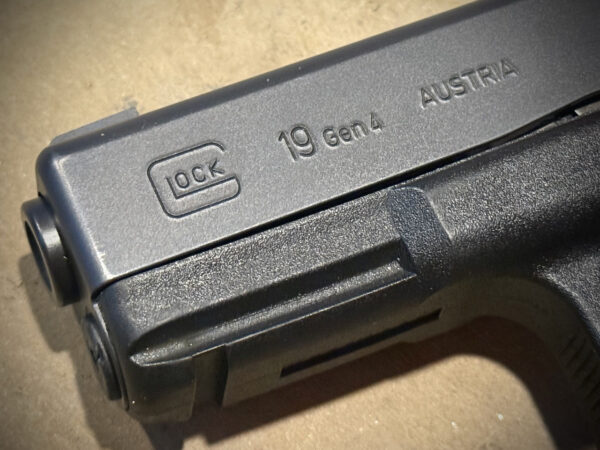
Maryland says it wants to stop illegal Glock switches. Instead of limiting itself to the criminals who possess and use those devices, the state passed a law that will prevent ordinary citizens from acquiring some of the most common self-defense handguns in America.
The Second Amendment Foundation (SAF), National Rifle Association (NRA), Firearms Policy Coalition (FPC), Maryland gun dealer Atlantic Guns, and two Maryland residents filed a motion for a preliminary injunction on July 20 in Bathras v. Moore.
The plaintiffs want a federal judge to block Maryland Senate Bill 334 before its handgun restrictions become enforceable on January 1, 2027. No judge has ruled that the law is unconstitutional yet; this is the coalition’s argument for stopping it while the lawsuit proceeds.
Maryland Bans the Pistol, Not Just the Switch
SB 334 prohibits a person from manufacturing, selling, offering for sale, purchasing, receiving, or transferring what Maryland calls a “machine gun convertible pistol.” A violation can bring up to three years in prison, a fine of up to $5,000, or both.
The law defines that category as a semiautomatic pistol with a cruciform trigger bar that can be converted into a machine gun by replacing the slide’s backplate with a pistol converter. It also covers a pistol with a blocking tab if the tab can be removed with a common household tool.
Factory-stock Glock pistols use a cruciform trigger bar. So do many Glock-pattern pistols produced by companies such as Palmetto State Armory, Ruger, and Shadow Systems. The plaintiffs contend there is a substantial likelihood that virtually all of these pistols will fall under the ban.
An unmodified Glock is not a machine gun. It fires one round for each pull of the trigger. A Glock switch, also called a pistol converter or auto sear, is a separate device that can illegally convert it to automatic fire.
Federal law already treats the device itself as a machine gun, with illegal possession carrying up to 10 years in prison and a $250,000 fine. Maryland also prohibited rapid-fire activators, including switch/auto-sear devices. This lawsuit does not challenge either prohibition.
“This case is about whether Maryland may ban Glock and Glock-style handguns,” the plaintiffs wrote, based on what criminals might convert them into.
Supporters point to a real increase in criminal use. ATF reported that conversion-device recoveries traced by the agency increased from 658 in 2019 to 5,816 in 2023. But an increase in crimes involving an already-illegal device does not automatically give Maryland the power to ban the lawful handgun onto which a criminal might install it.
Maryland can prosecute the switch, the illegal conversion, and the violent crime. SB 334 instead reaches the unmodified pistol when a law-abiding buyer tries to acquire it or its owner tries to transfer it.
“You Can Keep What You Already Own” Misses the Point
SB 334 does not generally order current owners to surrender their pistols. Existing owners can keep them and may transfer them to certain immediate family members. Other narrow exceptions principally benefit law enforcement, the military, and gunsmiths.
Gun-control advocates will undoubtedly point to that grandfathering provision and claim Maryland has not really banned Glocks. That misses the point.
After January 1, an ordinary Maryland resident generally will be unable to acquire a covered pistol. Existing owners will lose most of their ability to sell, trade, or transfer their property inside the state. Federal law also prevents a resident from simply buying a handgun elsewhere and bringing it home.
The right to keep and bear arms cannot mean that the government may freeze ownership at whatever level politicians choose and prohibit the next generation from acquiring the same protected arms.
Glocks Are Commonly Used Handguns
The plaintiffs’ constitutional argument begins with District of Columbia v. Heller, which called handguns the “quintessential self-defense weapon.” Under Heller and New York State Rifle & Pistol Association v. Bruen, arms in common lawful use are protected, and the government must justify a restriction through the nation’s historical tradition of firearm regulation.
Glocks are not exotic weapons. They are ordinary semiautomatic handguns widely owned by Americans and carried by law enforcement agencies across the country, including the Baltimore Police Department. The motion notes that Glock manufactured more than 500,000 pistols for the domestic market in 2021 alone, not counting imports.
If common use means anything, it includes Glock pistols.
Maryland’s theory is that the pistols are so easy to convert that they may be treated like machine guns. The plaintiffs respond that potential conversion is not actual conversion. An ordinary shotgun can be made into an illegal short-barreled shotgun with a hacksaw, while other semiautomatic firearms can also be illegally modified to fire automatically.
The criminal modification does not erase the lawful character of the original firearm.
Maryland’s Bianchi Problem
Maryland Attorney General Anthony Brown’s pre-signing review relied on Bianchi v. Brown, the Fourth Circuit decision that upheld Maryland’s ban on so-called “assault weapons.” Brown argued that a court could classify readily convertible pistols as unusually dangerous and poorly suited to self-defense.
Even Brown’s constitutional review letter was far from a ringing endorsement. He acknowledged that the outcome is uncertain and that a judge could find SB 334 to be a “back door ban” on a firearm in common use.
The plaintiffs are now turning Bianchi against Maryland. When the Fourth Circuit upheld the rifle ban, it distinguished the prohibited rifles from ordinary defensive handguns. The court specifically referred to the Glock 19 as a “commonly used handgun” and treated handguns as proportionate to the need for self-defense.
Maryland was happy to rely on that distinction when it helped preserve the state’s rifle ban. It now faces the difficult task of explaining why the same Glock 19 should be treated like a machine gun when the state wants to prohibit its future sale.
Gun-Rights Groups Seek an Injunction
The individual plaintiffs are David J. Bathras Sr., a Maryland Glock owner who wants additional models, and Roslyn Mickens, a licensed firearms instructor who also wants to acquire Glock and Glock-style pistols. Atlantic Guns says the law will prevent it from continuing to stock and sell a substantial category of popular handguns to Maryland customers.
The plaintiffs argue that they are likely to win because SB 334 restricts the acquisition of protected arms and Maryland cannot produce a historical tradition supporting the ban. They also contend that the loss of a constitutional right—even temporarily—is irreparable harm.
“Anti-gun politicians will constantly tell you that ‘no one is coming for your guns,’” said SAF Senior Director of Legal Operations Bill Sack. “And then they pass bills like this that bans the most commonly owned handgun in America. Both can’t be true. Maryland’s Glock ban, and those like it that have popped up around the country, are a thinly veiled attempt to ban all guns, one chunk of the market at a time. But the law is overwhelmingly on our side. The Supreme Court has already held that the Second Amendment protects handguns, as they are the ‘quintessential’ firearm of choice for self-defense, and Glock-style pistols are massively popular and commonly used in Maryland and around the country.”
SAF founder Alan Gottlieb described the law as an effort to hold lawful owners, manufacturers, and sellers responsible for criminal misuse.
“Laws like this strip peaceable Americans from access to constitutionally protected arms and seek to bully and hold liable lawful manufacturers and sellers for the criminal misuse of firearms,” said SAF founder and Executive Vice President Alan M. Gottlieb. “This law is the equivalent to banning free speech in the hopes of preventing fraud. It’s bad policy and unconstitutional. We look forward getting it tossed.”
Maryland does not have a constitutional blank check to ban an ordinary handgun because somebody might illegally alter it.
A factory semi-automatic Glock is not a machine gun. Potential criminal misuse is not a loophole in the Second Amendment. If Maryland can ban one of America’s most common handguns on that theory, nearly any firearm capable of unlawful modification could be next.
About Duncan Johnson:
Duncan Johnson is a lifelong firearms enthusiast and unwavering defender of the Second Amendment—where “shall not be infringed” means exactly what it says. A graduate of George Mason University, he enjoys competing in local USPSA and multi-gun competitions whenever he’s not covering the latest in gun rights and firearm policy. Duncan is a regular contributor to AmmoLand News and serves as part of the editorial team responsible for AmmoLand’s daily gun-rights reporting and industry coverage.