Good afternoon, everyone, and welcome back to TFB’s Silencer Saturday, brought to you by Yankee Hill Machine, manufacturers of the new Victra 20-gauge shotgun suppressor. I was browsing through public patent filings as I sometimes do, and saw several new ideas in the silencer world that are interesting. Let’s take a look at some new things that might be coming.
Silencer Saturday @ TFB:
- Silencer Saturday #419: Reflex Resurgence
- Silencer Saturday #418: Lawsuit And Legislation Update
- Silencer Saturday #417: What's New In Subsonic Ammo
- Silencer Saturday #416: Recovering From SHOT Show
- Silencer Saturday #415: How To Choose Your First Suppressor
Patents, Generally
Up front disclosure: I am not a patent attorney. This is like having a fixed-wing pilot explain the finer points of helicopter flying. They are both pilots, but do not really do the same thing. So not only am I not your attorney and not giving any legal advice, I am not even the right kind of attorney to even weigh in on patent issues.
Patents are a form of “intellectual property.” The basic idea is staking a claim to an idea or invention. Without a patent, companies can spend incredible amounts of money on research and development for a great new product, and other companies can make and sell that item too as soon as they figure out how to reverse-engineer it. There is some debate about whether the system as a whole is good or bad and whether it truly serves to facilitate research or simply locks out smaller inventors who cannot afford the legal fees to obtain a patent. Either way, it is the law.
Critically, patents are public. If an inventor is working on a new development, they need to be able to look at existing patents to see if someone already patented the thing they are working on. Imagine working for months on a new widget, only to find out that someone had secretly patented it years earlier, and then they sue you for selling your widget. Making patents public puts the onus on everyone making inventions (and their attorneys) to see if someone else has already beaten them to that idea.
There are two main types of patents that we see in the firearms space. Design patents protect the way a product looks. This keeps competitors from taking a unique and recognizable branding or styling that another company has patented. Those last for 15 years. One example would be the hexagon pattern on Hexmags, which is a design patent for putting hexagon designs on magazines, and which Hexmag has reportedly attempted to enforce by sending cease and desist letters to other companies that use hexagons. Utility patents protect a function or process and last for 20 years. Examples here would be inventing a new material or creating a product that functions in a new way that no one has done before.
There is one big asterisk to go before we get into the patents themselves. A patent is not a guarantee that a product will hit the market. Sometimes, the patent goal is simply to protect the idea while the company figures out if it is commercially viable. Other times, the patent is good, but the product can never reach a level of durability where the company is comfortable putting its name on it. Still others are cooked up by crazy inventors and then licensed out to a manufacturer. So seeing a patent does not guarantee that the item depicted, or something like it, will be on dealer shelves at any point. With that out of the way, let’s see some interesting new ideas.
HuxWrx Double Barrel Shotgun Silencer
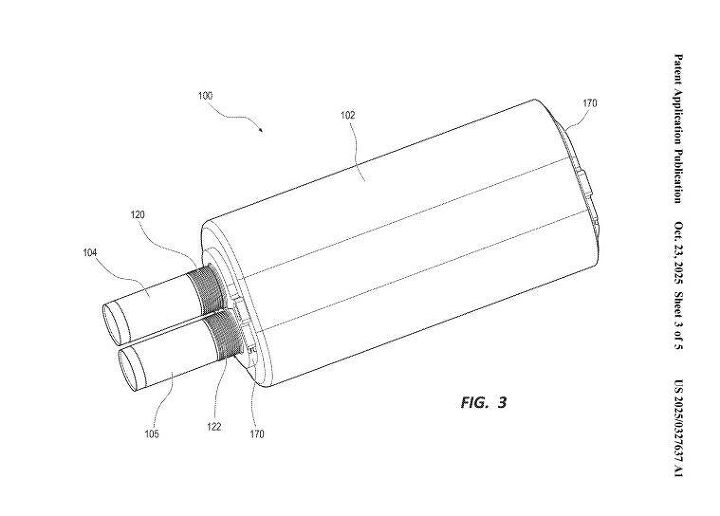
First up is a product I was pondering about the other day. Shotgun silencers have become increasingly common, with Silencer Saturday sponsor YHM, Banish, JK Armament, and SilencerCo all offering options. But shotguns frequently have multiple barrels, and all of those suppressors are for single-barrel guns. HuxWrx seems to have figured out an option for double-barreled guns.
Special choke tubes accept a mount for the suppressor itself. But the two bores are not parallel. The convergence is adjustable to match that of the host gun, so the barrels hit the same point at a certain distance. The coupler that secures the silencer to the choke tubes sets that convergence with screws.
What is not clear is how a shooter will aim when the silencer is installed. In the diagrams, the silencer body sits in the way of the sightline. We will have to see when and if this silencer hits the market, and how that is handled.


