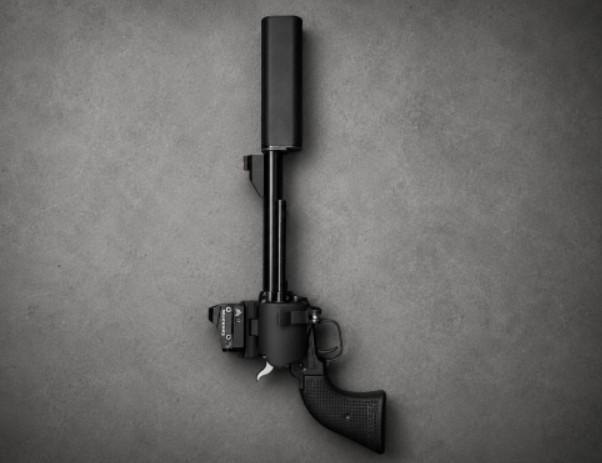
Good afternoon, everyone, and welcome back to TFB’s Silencer Saturday, brought to you by Yankee Hill Machine, manufacturers of the new Victra 20-gauge shotgun suppressor. Revolvers are the least suppressed type of firearm, thanks to the issues with gas leakage around the cylinder and barrel. But Revolver Seal has a new method for quieting down your wheel gun.
Silencer Saturday @ TFB:
- Silencer Saturday #437: Precision Armament TiTrex 300Ti Review
- Silencer Saturday #436: Subsonic Loads With Trail Boss Powder
- Silencer Saturday #435: Father's Day Gift Guide 2026
- Silencer Saturday #434: Give Me A Brake (On My Suppressor)
- Silencer Saturday #433: Scout Rifle Silencers
Why Are Revolver Silencers So Rare?
Revolvers struggle as silencer hosts due to the gap between the cylinder and barrel. On almost every other firearm, the chamber and the bore are part of the same piece of material with no gap between them. Revolvers align the firing chamber with the bore (hopefully) on each shot. Even if that gap is aligned very precisely, there is still enough space that gases can escape during firing. So even if a suppressor is added to the muzzle, the path of least resistance for gas and noise is out through the cylinder gap instead of just the muzzle.
There are a few examples of suppressed revolvers, but they are very rare. The most common is the Russian M1895 Nagant revolver. Unlike most other revolvers, the cylinder moves forward during the firing sequence to close the gap with the forcing cone. The extended case of the 7.62x38mm round then seals the gap between cylinder and barrel. Silencer aficionados have taken to threading Nagants as suppressor hosts, but they are more of a novelty than a serious item.
Smith & Wesson produced a prototype silenced J-frame in .22 LR during the Cold War, featured in this video. It was tailored for silencer use with tall sights for use over the top of the can. The barrel was also a little longer than normal. The included silencer used wipes. No one knows where this gun spent its life, but it was returned to S&W in 1990 through their government sales office in the National Capitol Region. While details are scarce, it is not hard to see the appeal of a quiet, hammerless revolver that would not leave casings at the scene of the assasination “incident.”
Knight’s Armament also had a silent revolver of its own. This Revolving Rifle got the Ian McCollum treatment, and his video is full of interesting details about that firearm. It addressed the cylinder gap with unique, rare, and prohibitively expensive ammunition which expanded to cover the cylinder gap, then retracted to allow the cylinder to rotate.
Revolver Seal
Revolver Seal takes a different approach. Rather than using special ammunition to bridge the cylinder gap, their approach is to simply enclose that gap. The marketing copy is very careful not to describe this product as a tool for suppressing sound, though. Instead it focuses on closing the cylinder gap in an effort to redirect gases down the bore. It does not hold gas, trap it, or cool it, and does not independently reduce the sound of the shot.
The unit attaches to the top of the frame. Clamshell sides secure around the cylinder using a latch below the frame. With the latch open, the clamshells open and the cylinder is free for loading and manipulation. The top of the Revolver Seal has a picatinny rail for attaching optics. A deep channel down the middle allows iron sight use.


