Springfield Armory 1911 DS Prodigy 3.5″ Review: Short Slide, Full Grip, 18+1 Rounds

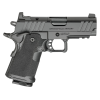
Double-stack 1911 handguns are increasingly popular thanks to their modularity, soft-shooting 9mm chambering, and legacy ergonomics. Springfield Armory knows the classic 1911, and the Prodigy is their take on the double-stack concept. The new 1911 DS Prodigy 3 1/2-inch combines a compact slide with a full-size grip for concealed-carry crossover.
Springfield Prodigy Crossover Features
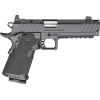
For competition and potential duty work, Springfield Armory produces the full-sized Prodigy with a 4 1/4 or 5-inch barrel and a standard grip that accommodates an eighteen-round magazine. That is followed up by the compact Prodigy that wears a 3 1/2 inch barrel and a compact grip with a fifteen-round capacity. The new 1911 DS Prodigy is now available with a compact 3 1/2-inch barrel and a full grip.
Beyond that curious configuration, this model is little different from the others. It uses a polymer grip frame and trigger guard assembly mated to an aluminum lower frame and a carbon steel slide.

The grip frame has a slight flare and is provisioned for aftermarket magazine wells. The grip panels and backstrap have subtle stippling, while the front strap is undercut smooth around the reversible magazine release. The lower frame is neatly black anodized and houses a rounded skeletonized aluminum trigger and a dual slot rail for a weapon light.

The slide is black cerakoted and has forward and rearward cocking serrations. As with other recent Springfield products, the Prodigy is cut for the AOS optic mounting system. The pistol also wears high profile iron sights–a black serrated rear square notch and a tritium front post.
The Prodigy inherits the same legendary ergonomics as its 1911 forbearers with some refinement added. This includes that 1911 grip angle, extended grip safety, ambidextrous manual thumb safety, and a bushing-less bull barrel. The pistol also has a slide release mounted on the left side.
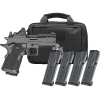
The overall package comes with Springfield’s soft pistol case and two 18-round MecGar magazines at an MSRP of $1,582.
Live Inventory Price Checker
First Impressions
The Springfield Prodigy is a known quantity in the double-stack 1911 market, particularly at its more most price point compared to the alternatives. As the type becomes more popular outside the competition circuit, crossover variations are the end result. The Prodigy Compact makes sense for a carry gun. Its slide and grip are easier to conceal with only the loss of a few rounds of capacity. Crossover pistols have their benefits and drawbacks. Some users believe a longer slide and shorter grip make for a softer shooting and more concealable combination. The short slide/ long grip approach of the Prodigy gives the user less slide to dig into the gut, but more capacity while sacrificing some concealability–given that it is the grip that prints the most under clothing.
No matter where you are on the crossover debate, there is no doubt the Prodigy defies the price point. The MecGar magazines are effortless to load to capacity and the pistol itself is well finished with no burrs or defects.
The trigger breaks at a respectable 3 lbs. 3 oz. on my Lyman scale and is more comfortable on the index pad than typical squared up 1911 triggers. It also has an overtravel adjustment screw if you are so inclined to tune the trigger. The trigger has a little more take up than the usual 2mm on traditional 1911s, but the break is cleaner. There is no slop at all when bringing the trigger out to reset, which the trigger return spring does stoutly.
The AOS plates are easy to install and come with a rear sight already in place. I mounted my Vortex Defender ST 3 MOA dot without issue. The controls are well setup, and the only tradeoff is the lack of an ambi slide release. But the Prodigy can be forgiven for that, as the slide release has to be one-sided to use in the disassembly process.
Fast Specs: Springfield Prodigy 3.5 inch 1911 DS
- Caliber: 9mm Luger
- Capacity: 18+1
- Barrel Length: 3.5 inches
- Overall Length: 6.5 inches
- Height: 6.0 inches
- Slide Width: .91 inch
- Overall Width: 1.3 inches
- Weight: 2 lb. 5.3 oz. (loaded)
Range Work with the Springfield Prodigy Crossover
For a comp design turned carry gun, my usual 300 round range test is hardly a test. But it does give us a pulse as to the accuracy, reliability and ergonomic feedback of this curious crossover.
Accuracy
I began by sighting in the Vortex ST and moving onto a ten yard offhand accuracy test. The ammunitions tested are as follows:
| Brand | Muzzle Velocity (fps) | Accuracy (inch) |
| Barnes XPD 115 gr. +P | 1184 | 1.2 |
| Federal Syntech 130 gr. PCC | 1090 | 1.1 |
| Hornady Critical Duty 124 +P | 1,131 | 2.8 |
| Igman 124 gr. FMJ | 1053 | 2.0 |
| Winchester 115 gr. JHP | 1,103 | 1.8 |
The winners in the accuracy department were the all-copper Barnes XPD hollow point and the Federal Syntech 130 grain load. Each gave consistent five-shot groups at just over an inch. The other rounds produced acceptable accuracy except for the Hornady Critical Duty load that consistently shot poorly.

After this initial test, I posted a target at the fifty-yard line and was surprised to get 10 out of 10 in a six-inch pattern with the Syntech load. The balance of the pistol and the sharp dot from the Vortex ST, no doubt, helped. Not bad for a compact handgun. The performance out at fifty was so good, I decided to post my 1/2 steel silhouette and lob rounds at it until I was spent.
Handling
Although its configuration can be disagreeable from a concealed carry perspective, the Prodigy works on the firing line. The 1911 grip angle and well-appointed beavertail encourage a naturally high hold. In spite of the shorter slide and barrel, the weight of the barrel keeps the pistol balanced and pointing like a GI 1911. The controls are mechanically crisp and right where they need to be for easy access for most hands. As a natural southpaw, I appreciated the ambi thumb safety. The grip safety takes only a casual press to disengage, and it doesn’t leave hot spots in the hand under recoil. Not that 9mm recoil is much of a factor out of a mostly metal handgun with a full-sized grip. The grip itself is comfortable on the hand but a tad wide to accommodate double stack magazines. Small gun hands might need help with the offhand or a grip shift in order to drop the magazine or drop the slide with its release. When hit, the magazine release readily ejects empty magazines with gusto.

Reliability
Exciting products tend to have exciting outcomes. Fast high-tech cars require exciting times at the dealership. As a fan of stick-shift econobox cars, boring is best. The Prodigy is boring to shoot in the sense that there is nothing hard to overcome. I also had no malfunctions of any kind.
The Bottom Line
The Prodigy line excels in the features to price ratio and is one of the most popular 2011 designs out there. Naturally, as the virtues of the platform go beyond the circuit, carry models will come up. The Compact 3.5 inch model fits that bill well and this full-grip entry just might, depending on how you weight capacity and handling. Certainly, as a shooter, this Prodigy loses nothing.
About Terril Hebert:
Terril Hebert is a firearm writer native to south Louisiana. Under his motto—Guns, Never Politics—he tackles firearm and reloading topics both in print and on his Mark3smle YouTube channel, where he got his start. He has a soft spot for ballistics testing, pocket pistols, and French rifles. When he is not burning ammo, he is indulging his unhealthy wildlife photography obsession or working on his latest novel. Scourge of God was published in 2017.”