Supreme Court AR-15 Ban Cases: The Fight Begins
The Supreme Court just agreed to answer the question gun owners have been asking since Heller. Are the most common rifles in America protected by the Second Amendment?
On June 30, 2026, the Court granted review in two cases challenging bans on AR-15 platform rifles. It did it on the last order of the term, the day after its annual clean-up conference, and it consolidated both cases into a single argument. That is not a small thing. The Court does not take up a question like this to shrug it off.
For the gun rights community, this is the moment we assumed would eventually come and quietly worried might not. It came. Now comes the hard part.
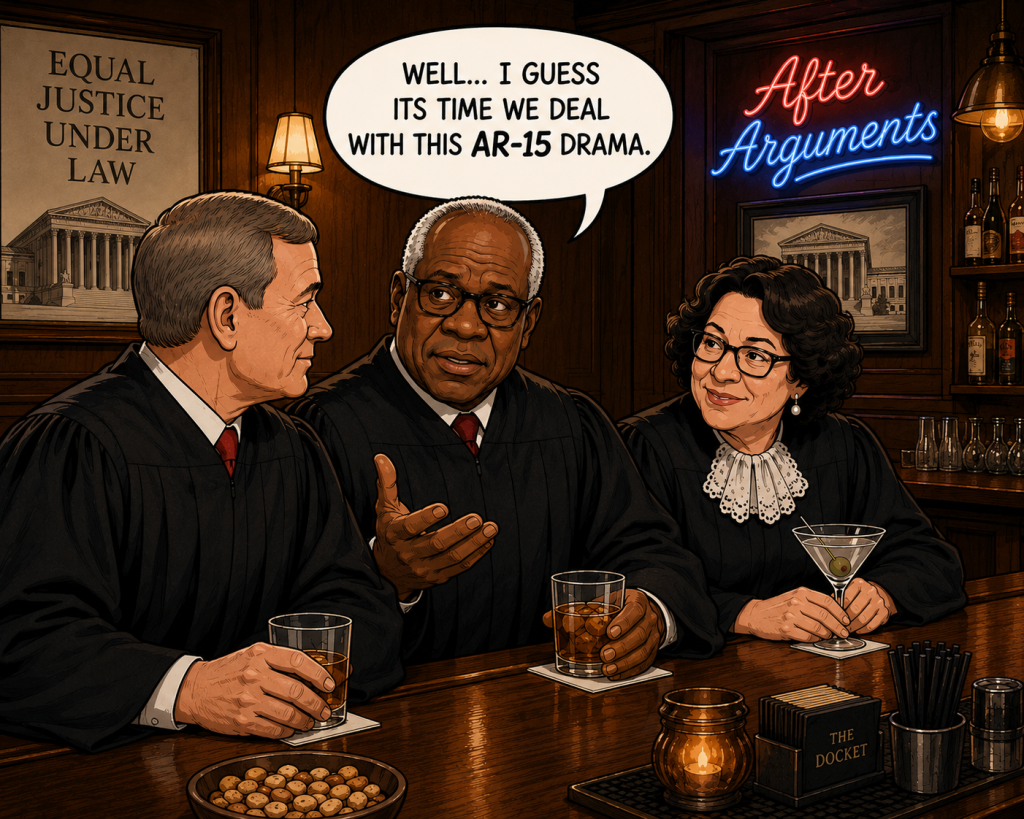
Image generated via AI for Educational… and Entertainment Purposes
What the Court Agreed to Decide
The two cases are Viramontes v. Cook County (out of Illinois) and Grant v. Higgins (out of Connecticut). The Court consolidated them and set aside one hour of argument on a single question, the one presented in Viramontes: whether the Second and Fourteenth Amendments protect the right to possess AR-15 platform and similar semi-automatic rifles that are in common use for lawful purposes.
Read that again, because the phrasing matters. The Court is not asking whether these rifles look intimidating or whether politicians dislike them. It is asking whether they are covered by the Constitution. Under the framework the Court set in Bruen back in 2022, that turns on text, history, and tradition, not on how a legislature feels about a firearm's appearance.
Argument is expected this fall, early in the new term. A ruling probably will not land until late in the 2026 to 2027 term, which puts a decision roughly a year out. And note what the Court did not take: it left the large-capacity magazine cases on hold. This fight is about the rifles themselves.
The Two Cases
Viramontes v. Cook County
Cutberto Viramontes filed suit in 2021 over Cook County's ban on semi-automatic rifles. That county ordinance was the blueprint for the statewide ban Illinois passed later. The case worked its way up through the Seventh Circuit.
Grant v. Higgins
Grant challenges Connecticut's ban, which the state expanded in the wake of the 2012 shooting in Newtown. The challengers went after the law both by the specific firearms it names and by the feature-based definitions it uses to sweep in everything else. The case reached the Court after a preliminary injunction ruling from the Second Circuit went against the plaintiffs.
Who Is Actually Behind These Cases
Both cases are Second Amendment Foundation cases. In Viramontes, SAF is joined by the Firearms Policy Coalition and two private citizens. In Grant, SAF is joined by the Connecticut Citizens Defense League and three private citizens.

If you have the means, these are the groups doing the work. They run on member and donor support, and the merits stage that starts now, meaning briefing, amicus coordination, and oral argument, is the expensive part.
Why This Is Happening Now
For years, the gun control fight lived in state legislatures. After Bruen, it moved into the courts, and the wins have been coming faster.
Just this term, the Court struck down Hawaii's private-property default carry ban, the so-called vampire rule, in Wolford v. Lopez. A week before that, it ruled unanimously in United States v. Hemani that the government cannot strip someone of gun rights based on marijuana use alone.
The rifle question was next in line, and everyone expected it. When the Court passed on the Maryland case Snope v. Brown in 2025, Justice Kavanaugh went out of his way to write that there is a strong argument these rifles are in common use and therefore protected, and that the Court should and presumably would take up the issue in a term or two. Justice Thomas put it more bluntly, saying he would not wait to decide whether the government can ban the most popular rifle in America. Kavanaugh pointed to an estimated 20 to 30 million of these rifles already in private hands.
A term later, here we are.
Our Position: These Bans Are Unconstitutional
We will say it plainly. A ban on AR-15 platform rifles is flatly unconstitutional, and we hope the Court says so.
The legal argument is not complicated. Heller protects arms in common use for lawful purposes. There is no serious dispute that these rifles clear that bar. They are among the most widely owned firearms in the country, bought by millions of law-abiding people for home defense, sport, and training. When a firearm is that common in ordinary hands, calling it unusual or dangerous is a political claim, not a historical one.
And history is exactly what the Bruen test demands. The government's problem is that there is no founding-era tradition of banning the common arms of the day. Colonial and early American governments regulated conduct, things like carrying while intoxicated or firing a weapon inside town limits, but they did not confiscate the standard firearms citizens actually owned. A modern ban on the most popular rifle in America has no analog in that tradition, which is precisely why these laws keep losing under Bruen.
As for public safety, the fear does not match the record. Rifles as a category, not just these, account for a small share of homicides in the FBI's own reporting, year after year. These are ordinary firearms owned by millions of responsible people, and they carry real defensive value in the home. Banning the most popular rifle in the country because of how it looks is not a safety policy. It is an infringement dressed up as one.
If you want to keep up with how these rulings change what you can own and carry, make sure you receive our email newsletter.