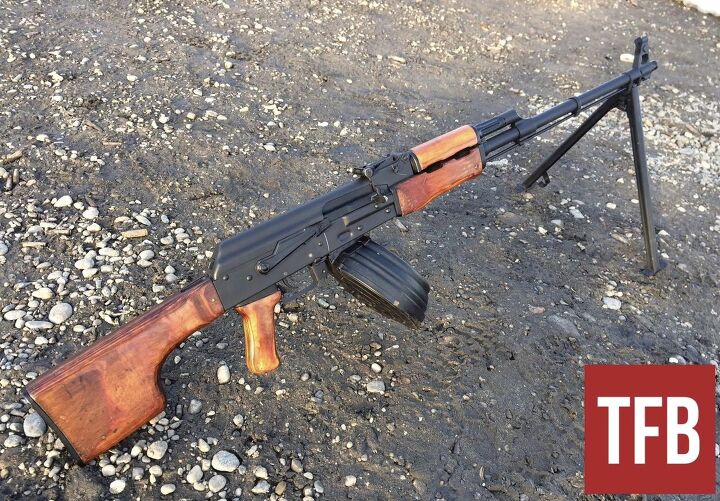
In the mid-1950s, the Soviet high command accepted a compromise that would shape frontline infantry small arms for decades: prioritizing platform commonality over dedicated squad-level suppressive fire capability. That decision, formalized with the 1959 adoption of an AK-derived automatic rifle, the RPK, sacrificed the sustained-fire advantages of the earlier belt-fed RPD in favor of simplified logistics, shared magazines and some parts, and easier training.
By the early 1960s, the RPD, a lightweight, intermediate-caliber automatic weapon that had already proven its value in the post-World War II Soviet arsenal, was withdrawn from many frontline formations and replaced in doctrine and practice by the magazine-fed RPK. The result was an enduring gap in squad firepower that Soviet infantry compensated for through doctrine and tactics for decades, and that was only beginning to be redressed after reforms in the 21st century and the combat experience of the Russo-Ukrainian war.
In the immediate postwar period, the RPD filled the role of a light machine gun (LMG): a portable, belt-fed weapon firing the newly adopted intermediate 7.62x39mm cartridge with a sustained-fire capability beyond that of a standard rifle. The RPD allowed squads to lay down longer bursts and more continuous suppressive fire, a capability that shapes how infantry maneuver, fix, or break contact. But in the mid-1950s, a different set of priorities drove Soviet small arms development: simplicity, mass producibility, and, crucially, some parts commonality, primarily magazine compatibility. The thinking in the Kremlin and in the armament bureaus favored standardization across small-arms families to reduce logistical burdens and speed fielding, though it left a significant capability gap.
The Gun
On April 8, 1959, the modernized 7.62x39mm Kalashnikov assault rifle (AKM) and the Kalashnikov light automatic rifle (RPK) were officially adopted by decree of the USSR Council of Ministers. The RPK was essentially an AKM reworked with a heavier barrel, stronger receiver and trunnion, a bipod, and the ability to accept larger-capacity magazines, including 40-round box magazines and 75-round drum magazines. In practice, however, it remained a magazine-fed automatic rifle rather than a true squad light machine gun: it offered modest gains in muzzle velocity over the standard AK, but not the volume or sustainability of fire of a belt-fed system. The decision to accept those trade-offs reveals a deliberate reorientation of Soviet doctrine toward uniformity and ease of supply at the expense of true suppressive fire capability.
That compromise had clear tactical consequences. A squad equipped primarily with an RPK instead of a belt-fed LMG could deliver accurate automatic fire, but lacked the same ability to sustain long bursts or to provide a continuous base of fire during extended engagements. In situations that favored defensive depth or prolonged firefights, the magazine-fed automatic rifle could be outclassed by a belt-fed machine gun. At the squad level, suppression is not only about raw firepower; it is also about the psychological and physical capacity to keep enemy heads down while friendly forces maneuver. The RPK could perform this role to a degree, but it was a compromise.
It is worth noting that, in the same era, many Western armies also fielded automatic rifles and medium machine guns in a similar spectrum of capabilities: the U.S. and other NATO forces did not universally deploy light, squad-level belt-fed guns; instead, they also used automatic rifles. The balance between magazine-fed automatic rifles and belt-fed LMGs was, therefore, a broader international question of doctrine, budgets, and industrial priorities. Still, the RPD’s withdrawal left the Soviet squad with less inherent sustained-fire capability than some contemporaries.
Operational experience revealed these differences. During the Vietnam War, for example, U.S. special operations units encountered and in many cases respected the RPD when it appeared in enemy hands. MACV-SOG teams and other specialized teams that modified the RPD for their needs, sometimes shortening barrels for close combat, found it adaptable and effective in close-quarter environments. The RPD’s portability and belt-fed nature made it a natural fit for the hit-and-run, jungle-ambush style of fighting seen in Southeast Asia. Conversely, the RPK’s strengths lay in its simplicity and reliability: it was easier to produce, repair, and train soldiers on, which mattered a great deal for the massive Soviet Army.
Over time, the Soviet Union and later the Russian Federation continued to rely on the RPK and, after the 1970s, on the 5.45x39mm RPK-74 as the squad-level automatic rifle. The 5.45x39, AK-74, and RPK-74 were developed by the Soviet Union in response to the new U.S. 5.56x45 and M16 during the Vietnam War. Later, the 7.62x54 PKM was widely used, as post-2008 reforms began to emphasize heavier general-purpose machine guns at lower echelons rather than the RPK-74. Those reforms shifted the balance toward the use of the PKM, belt-fed and powerful, as a more ubiquitous source of suppressive fire and overmatch capability. Combat experience in the 2010s, the loss of interest in the mag-fed RPK-16, and more recently, the Russo-Ukrainian war accelerated interest in restoring a dedicated squad-level automatic fire, prompting experiments and small-batch trials of modern 5.45x39mm designs such as the RPL-20 squad automatic rifle.
The RPD’s disappearance from many frontline units, therefore, reads as both a tactical loss and a strategic choice: the Soviet system deliberately traded performance for the advantages of standardization, commonality, and ease of training. That tradeoff made sense within a broader industrial and logistical framework. Still, it left infantry formations wishing for the higher sustained rates of fire that a belt-fed weapon can deliver.
Conclusion
To sum it up, the RPK was chosen at the expense of sustained-fire capability to simplify training for a large conscript army and share magazine commonality with the AK. The RPK entered service in 1959 alongside the newly adopted AKM, reflecting a broader push for commonality, specifically, having the squad light machine gun share its ammunition source with the service rifle. This emphasis on commonality was a recurring trend throughout much of the twentieth century, persisting into the 1970s with systems such as the FN Minimi. The USSR would learn that compromise’s limits during the protracted fights in Afghanistan and Chechnya, where the magazine-fed RPK proved an underwhelming light machine gun. Today, that lesson helps explain renewed Russian interest in belt-fed intermediate-caliber LMGs, with test batches of the 5.45x39 RPL-20 being trialed in the Russo-Ukrainian War to evaluate their combat value. From there, we will see whether they go full circle again and adopt an intermediate-caliber belt-fed LMG.