In the early 1960s, the Soviet military found itself at a crossroads. The recently adopted Kalashnikov PK general-purpose machine gun (GPMG) has solved many problems by easing logistics and supporting a single machine gun type. Still, its adoption also revealed new tactical expectations: a single GPMG was now supposed to fill a variety of roles, such as mounted roles, and be light enough to be carried by every infantry squad. The PK was accepted into service in 1961 and went into full production in 1962. Still, the weight and role tradeoffs of a universal design prompted a fresh round of experimentation aimed at a lighter, more squad-oriented automatic weapon. Simply put, the 19.84 lbs (9 kg) weight of a GPMG was too high for the Soviets, as it was also envisioned at the time to be carried by every infantry squad.
The Soviet AO-29 Lightweight GPMG
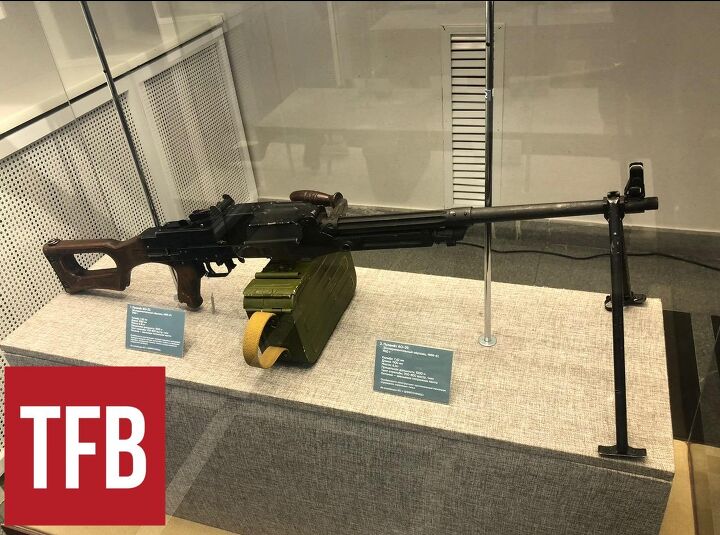

From 1962 onward, several design teams set out to create a lighter 7.62x54 GPMG that retained the cartridge's range and terminal performance while shedding pounds. Among the influences on Soviet thinking was the performance and concept of the U.S. M60, a belt-fed GPMG that was recently adopted and saw increasing use during the Vietnam War. During their evaluation, they also found it was on the heavy side, which reinforced the Soviet view that a lighter 7.62mm general-purpose or squad automatic weapon could be tactically beneficial.

The Gun
Work on the AO-29 began in 1962 under the leadership of A.I. Shilin with senior engineer P.A. Tkachev. The AO-29 was one entry in a formal competition announced by the USSR State Committee for Defense Equipment by Order No. 226 of April 17, 1963, for compliance with GRAU MO TTT No. 008056 and GRAU TTZ No. 08001. This directive tasked designers to meet specific GRAU technical requirements for a lighter, more versatile 7.62mm GPMG. Comparative trials of several contenders were conducted at the state test facility NII-61 (now known as TsNIITOCHMASH, the Central Research Institute of Precision Engineering), during the mid-1960s.
The AO-29 represented a real-world approach: keep the ballistics and range of the 7.62x54 cartridge, but rethink the packaging and mechanical layout to reduce mass without sacrificing reliability. The finished prototype reportedly weighed about 14.7 lbs (6.7 kg), down from the PK's original 19.8 lbs (9 kg), a significant 25.8% reduction.

Perhaps the most visually and functionally distinctive innovation attributed to the AO-29 was its spent-case ejection arrangement. Designers, in an attempt to address the PK's ejection pattern, a distinctive spent-cartridge ejection mechanism was designed to extract and eject spent casings forward and downward, away from the shooter. This was an ergonomics upgrade over the PK, as it ejects from 7 to 8 o'clock, which makes it interesting when shooting in the standing position.
The AO-29 was one of a handful of light GPMG concepts that participated in the competition, and it is reportedly one of the lightest. The AO-29 was competitive with contemporary light machine gun concepts. Alongside designs by Nikitin and Kalashnikov, and the AO-22M by V. P. Gryazev, G. P. Petrovpavlov, and N. L. Druzhinin, it entered trials.

Official records of the AO-29’s performance are not publicly released, and there is very little information in the public domain. The machine gun entered the state trials sequence but was withdrawn during the first stage in 1964. As a result of these tests, the Nikitin TKB-015 and the Kalashnikov 6P6L1 (PKM) were deemed worthy of improvement. Further work on the remaining prototypes, including the AO-29, was deemed impractical with no public explanation. The final experimental competitors, the TKB-015 and 6P6L1 (PKM) prototypes, proceeded to the next stages. In the end, the Soviet services adopted the modernized PKM on May 27, 1969, as the practical, weight-reduced solution to the problem the AO-29 and others had attempted to solve.

Conclusion
On the surface, the AO-29 is a lesser-known footnote to an experimental prototype that never reached production for one reason or another. But prototypes like the AO-29 matter because they reveal the weight reduction priorities of a particular moment in doctrinal evolution. The AO-29 shows Soviet engineers trying to square the tactical demand for portability with the strategic goal of getting lightweight GPMGs into frontline use. Its forward ejection and weight are definite advantages over the PK and PKM. These requirements foreshadowed later weight, ergonomic, and ambidexterity concerns that would become more prominent in small arms design worldwide.
The AO-29 is one of those Cold War projects for which comprehensive public documentation is limited. Much of what’s known comes from a handful of publicly available information, and full test reports and internal evaluations either remain in the Russian state or factory archives. That scarcity makes the AO-29 a compelling, if elusive, subject to trace how the Soviet Union balanced reliability, firepower, and portability during a decade of rapid small-arms development.