Virginia Revives Collective-Right Theory to Defend Its Gun Ban
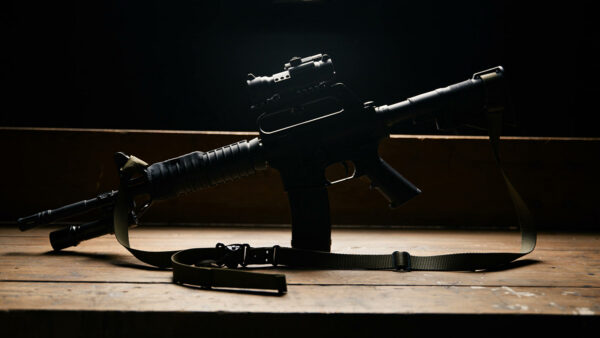
Imagine it’s the big game: The Ban Bowl, featuring the Richmond Gun-Grabbers vs. the Second Amendment.
It’s the final minutes of the fourth quarter. The Gun-Grabbers have the ball but they’re down by six and the play clock is running. There’s just enough time for one last Hail Mary pass and hope the point-after kick is good.
The center snaps the ball; the Gun Grabbers’ quarterback is sacked and fumbles; the Second Amendment’s line recovers the ball.
That’s about as close as I can come to an analogy to the motion to dismiss and demurrer filed by Virginia’s Attorney General in Crump v. Katz on July 15, 2026.
I often mention the Twilight Zone in reference to gun control reasoning (or lack thereof) but even Rod Serling would likely pass on AG Jay Jones. Of course, the fact the guns he and Governor Abigail Spanberger boasted about banning are back on dealer shelves statewide may have caused cognitive dissonance.
After claiming none of the plaintiffs, including the lead plaintiff, Ammoland contributor and Virginia resident John Crump, have standing, the Virginia motion to dismiss delivers a blockbuster:
“Virginia Constitution, Art I, §13 is not controlled by Federal Second Amendment doctrine. Plaintiffs’ Complaint invokes only the Constitution of Virginia, Article I, §13. Contrary to Plaintiffs’ assertions, federal Second Amendment doctrine does not control the meaning of §13 in this case. Marked textual differences between §13 of the Constitution of Virginia and the Second Amendment of the United States Constitution mean interpretations of the latter inform, but do not necessarily govern, the construction of the former. Given the history of §13, federal law cannot displace the provision’s text, structure, and ratification history.”
There are no words. This is either hubris on an Olympian scale or Jones slept through constitutional law.
The Second Amendment doesn’t control Article 1, §13, the Virginia analog, it supersedes it.
Virginia ratified the Fourteenth Amendment on October 8, 1869 as one of the conditions for readmission to the Union. The Second Amendment was incorporated into the Fourteenth Amendment under the Due Process Clause* on June 28, 2010 in the case of McDonald vs. City of Chicago.* Therefore, the right of the people to keep and bear arms was confirmed to be binding on the Commonwealth of Virginia 16 years before the state’s ban was passed.
Pursuant to Article VI, Clause 2, the U.S.Constitution is the supreme law of the land. When there is a conflict between the federal constitution and a state constitution, the federal constitution always prevails.
Hawaii tried Virginia’s ploy in 2024. The case was Hawaii v. Wilson. The Hawaii Supreme Court said the state preferred the “Spirit of Aloha” to the Second Amendment.
The U.S. Supreme Court smacked down Hawaii’s pretensions In Wolford v. Lopez.
“Hawaii’s argument that its “particular customs and laws,” support the new default rule fails because the Second Amendment has the same meaning in all parts of the United States. The Second Amendment cannot give way to “the spirit of Aloha” in Hawaii any more than it can yield to the spirit of the Big Apple or the Windy City. Merely local attitudes can neither shrink nor inflate the meaning of fundamental Bill of Rights guarantees that apply to the States through the Fourteenth Amendment.”
Next is the assertion that the Virginia Constitution, Art I, § 13’s text and history establish a collective, militia-tethered right: a guarantee of a collective right tied to militia service; not a freestanding guarantee.
This is what Article 1, §13 of the Virginia Constitution actually says: “That a well regulated militia, composed of the body of the people, trained to arms, is the proper, natural, and safe defense of a free state, therefore, the right of the people to keep and bear arms shall not be infringed; that standing armies, in time of peace, should be avoided as dangerous to liberty; and that in all cases the military should be under strict subordination to, and governed by, the civil power.”
Virginia used nearly three times as many words as the Second Amendment but the operative part is almost exactly the same: The right of the people keep and bear arms shall not be infringed.
Who are “the people?” In reality, this is a really stupid question – and a very embarrassing one for any attorney practicing in the Commonwealth.
Perhaps Virginia’s Attorney General should arrange a seance with George Mason.
Mason, a Virginian, fought for the inclusion of a Bill of Rights, including the right to be armed. He was also the author of Virginia Declaration of Rights in 1776.
On June 14, 1788, during debate in the Virginia Ratifying Convention, Mason said: “Mr. Chairman, a worthy member has asked who are the militia, if they be not the people of this country, and if we are not to be protected from the fate of the Germans, Prussians, &c., by our representation? I ask, Who are the militia? They consist now of the whole people, except a few public officers.”
The rest of the verbiage is what Justice Antonin Scalia called the prefatory clause in Heller. It explains the government’s reason for the inclusion of the right but doesn’t limit the right.
“In common use for lawful purposes” encompasses communal defense, self-defense, hunting, and plinking at tin cans with a .22.
The Second Amendment isn’t hard to understand: Some just find it hard to accept.
Nowhere in the history of Supreme Court jurisprudence has the court ever held the Second Amendment protected a collective right or could only be exercised in militia service.
In United States v. Cruikshank, Supreme Court Chief Justice Morrison Waite wrote: “The right to bear arms is not granted by the Constitution; neither is it in any manner dependent upon that instrument for its existence.”
It should be noted that by the time Cruikshank was heard in 1875, the state of Louisiana had disbanded its state militia. The National Guard, as we know it, did not exist until it was created by the Militia Act of 1903. So Louisiana was militia-free for almost 30 years.
In the twisted world of Jay Jones, this means there was no right to keep and bear arms in Louisiana from about 1874 to 1903.
Perhaps the closest the Supreme Court came to connecting the Second Amendment to military service was in Associate Justice James McReynolds’ 1939 majority opinion in United States v. Miller:
“In the absence of any evidence tending to show that possession or use of a ‘shotgun having a barrel of less than eighteen inches in length’ at this time has some reasonable relationship to the preservation or efficiency of a well regulated militia, we cannot say that the Second Amendment guarantees the right to keep and bear such an instrument. Certainly it is not within judicial notice that this weapon is any part of the ordinary military equipment, or that its use could contribute to the common defense.”
McReynolds was saying the Second Amendment did guarantee the right to possess weapons either in common use in the militia or suitable for use in militia service. Since sawed-off shotguns didn’t meet that standard, they weren’t protected.
Militia service is an obligation. This has been true in English common law since the reign of Alfred the Great in the Ninth Century. Militia service is not a right and failure to comply carried both civil and criminal penalties.
The belief that a fundamental, unalienable right exists only to allow a subset of the population to perform compulsory service might be a sign of a mental aberration. Perhaps Jay Jones needs to make his brief visits to reality more frequently.
However, there’s another possibility: Panic. For the first time in 35 years, courts aren’t using reasoning worthy of Lewis Carroll to uphold a ban. This time next year, assault weapon bans could be history.
*When it was ratified, the liberties enumerated in the Bill of Rights were not specifically included in the Fourteenth Amendment. Freedom of speech wasn’t binding on the states until 1925 (Gitlow v. New York); Freedom of Religion was added in 1934 (Hamilton v. Regents of the University of California); Right to Assemble followed three years later (De Jonge v. Oregon). The Supreme Court ruled the Establishment Clause was included in 1947 (Everson v. Board of Education).
About Bill Cawthon
Bill Cawthon first became a gun owner 55 years ago. He has been an active advocate for Americans’ civil liberties for more than a decade. He is the information director for the Second Amendment Society of Texas.